With respect to the Western Hoolock Gibbons, which of the following statements is/are correct ? A Sanctuary in North-east India is home to this ape species listed as Endangered in the International Union for Conservation of Nature (IUCN) Red List. They have specialized brachiation and can easily swing between trees. They possess a strong and heavy build like gorillas, yet are remarkably agile tree climbers. Select the answer using the code given below :
Contents18
- A1 only
- B1 and 2
- C2 and 3
- D3 only
Show answer
Answer: (B) 1 and 2
The correct answer is 1 and 2.
Key Points
- Statement 1 is correct. The Western Hoolock Gibbon (Hoolock hoolock) is the only ape species found in India. It lives only in the North-eastern states — Assam, Arunachal Pradesh and Mizoram. The Hoollongapar Gibbon Sanctuary in Assam is a main home for it. It is listed as Endangered on the International Union for Conservation of Nature (IUCN) Red List because its habitat is badly fragmented.
- Statement 2 is correct. These primates are famous for brachiation — moving through trees by swinging from branch to branch using only their long, powerful arms. This lets them travel fast and easily through the upper canopy of tropical evergreen forests.
- Statement 3 is incorrect. Gibbons belong to the 'Lesser Apes' family Hylobatidae and have a slender, light build. That light body is what makes them such agile climbers and swingers. They are much smaller and less muscular than 'Great Apes' like gorillas, which are heavy, massive and ground-dwelling.
Additional Information
- Physical and behavioural traits:
- They show sexual dimorphism: adult males are black with clear white eyebrows, while females turn copper-tan or greyish-brown once mature.
- Their diet is mainly frugivorous — mostly ripe fruits, plus leaves, shoots and insects.
- They are monogamous and live in small family groups. They mark their territory with loud, melodic calls or 'songs' at dawn.
- Conservation status:
- Protected under Schedule I of the Wildlife Protection Act, 1972, the highest legal protection in India.
- Main threats: deforestation, encroachment for tea plantations, and linear infrastructure such as railway lines cutting through protected habitats.
Western Hoolock Gibbons are India's only native ape species, found exclusively in northeastern states like Assam, Arunachal Pradesh, and Mizoram.
The question tests whether students can distinguish between Lesser Apes (gibbons) and Great Apes (gorillas) - gibbons have light, slender builds that enable brachiation, not heavy builds like gorillas.
Western Hoolock Gibbons
Environment Western Hoolock Gibbons Endangered IUCN Red List brachiation
Western Hoolock Gibbons: India's Only Ape Species
India's only ape species found in North-eastern states (Assam, Arunachal Pradesh, Mizoram)
Endangered on IUCN Red List due to habitat fragmentation
Famous for brachiation - swinging through trees using long arms
Lesser Apes with slender, light build - not heavy like Great Apes
Protected under Schedule I of Wildlife Protection Act, 1972
What Makes Them Special
Western Hoolock Gibbons (Hoolock hoolock) are India's only native ape species and belong to the Lesser Apes family Hylobatidae. Unlike their massive cousins the Great Apes, these primates have evolved a slender, lightweight build perfectly adapted for life in the forest canopy.
Key Characteristics
Aspect | Details |
|---|---|
Scientific Name | Hoolock hoolock |
Family | Hylobatidae (Lesser Apes) |
Distribution | North-east India only - Assam, Arunachal Pradesh, Mizoram |
IUCN Status | Endangered |
Body Build | Slender and light - enables agile tree movement |
Locomotion | Brachiation - arm-over-arm swinging through trees |
Diet | Frugivorous - mainly fruits, plus leaves and insects |
Social Structure | Monogamous family groups |
Sexual Dimorphism & Behavior
Males: Black coat with distinctive white eyebrows
Females: Copper-tan or greyish-brown when mature
Territory marking: Loud melodic calls or 'songs' at dawn
Habitat: Upper canopy of tropical evergreen forests
Movement: Can travel rapidly through trees using specialized brachiation
Protected Habitats
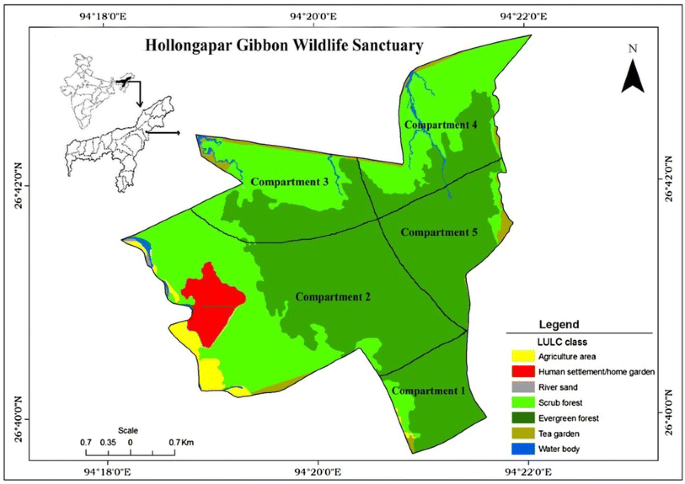
Source: Springer Nature — Diet and feeding ecology of the western hoolock gibbon (Hoolock hoolock) in a tropical forest fragment of Northeast India | Primates | Springer Nature Link · link.springer.com
Question Connection
This question tested knowledge of India's only ape species and the key distinction between Lesser Apes (light, agile) and Great Apes (heavy build like gorillas). Statement 3 was the trap - mixing up gibbon characteristics with gorilla traits.
Trap: Confusing Lesser Apes (gibbons) with Great Apes (gorillas, chimpanzees) - gibbons are light and slender
Trap: Assuming India has multiple ape species - Western Hoolock is the only one
Trap: Missing that brachiation is the specialized arm-swinging locomotion of gibbons
Trap: Confusing IUCN status - they are Endangered, not Critically Endangered or Vulnerable
Lesser Apes vs Great Apes
Environment strong and heavy build gorillas agile tree climbers
Lesser Apes vs Great Apes: Key Differences for UPSC
Lesser Apes (gibbons) have light, slender builds for tree swinging
Great Apes (gorillas, chimpanzees, orangutans) are heavy and muscular
Only Lesser Apes can perform true brachiation
India has only Lesser Apes (Western Hoolock Gibbons)
Why This Distinction Matters
UPSC often tests the difference between Lesser Apes and Great Apes because they represent different evolutionary adaptations. The body build determines their lifestyle and habitat preferences.
Comparative Analysis
Feature | Lesser Apes (Gibbons) | Great Apes |
|---|---|---|
Family | Hylobatidae | Hominidae |
Body Build | Light, slender (6-8 kg) | Heavy, muscular (40-200+ kg) |
Primary Locomotion | Brachiation (arm swinging) | Knuckle walking or ground movement |
Habitat Preference | Upper forest canopy | Ground + trees or mainly ground |
Tail | No tail (like all apes) | No tail (like all apes) |
Examples | Western Hoolock Gibbon | Gorillas, Chimpanzees, Orangutans |
In India | Yes - Western Hoolock only | No native species |
Brachiation Explained
Brachiation: Specialized form of locomotion using arms to swing from branch to branch
Requires long arms and lightweight body - why only Lesser Apes can do it efficiently
Speed: Can travel up to 35 mph through forest canopy
Energy efficient: Uses pendulum motion and gravity to conserve energy
Evolutionary advantage: Allows access to fruits in thin branches that can't support heavier apes
Trap: Assuming all apes have similar body builds - Lesser Apes are fundamentally different
Trap: Thinking heavy build = better climber - actually light build enables better tree movement
Trap: Confusing brachiation with regular climbing - it's specialized arm-swinging locomotion
Trap: Missing that no Great Apes are native to India - only the Lesser Ape Western Hoolock
Hoollongapar Gibbon Sanctuary
Environment Sanctuary North-east India
Hoollongapar Gibbon Sanctuary: India's Ape Conservation Hub
Located in Assam - main protected area for Western Hoolock Gibbons
Only sanctuary in India specifically dedicated to ape conservation
Part of biodiversity hotspot of North-east India
India's Unique Ape Sanctuary
Hoollongapar Gibbon Sanctuary in Assam is India's only sanctuary specifically established for ape conservation. It protects the last viable populations of Western Hoolock Gibbons in their natural tropical evergreen forest habitat.
Sanctuary Details
Aspect | Details |
|---|---|
Location | Assam (Jorhat district) |
Established | 1997 |
Area | Approximately 20.98 sq km |
Primary Species | Western Hoolock Gibbon |
Habitat Type | Tropical evergreen forest |
Other Wildlife | Capped Langur, Stump-tailed Macaque, Slow Loris |
Conservation Status | Schedule I species protection |
Conservation Challenges
Habitat fragmentation: Tea plantations and human settlements surrounding the sanctuary
Linear infrastructure: Railway lines cutting through gibbon corridors
Small population: Limited genetic diversity due to isolated populations
Climate change: Affecting fruit availability and forest composition

Source: Roundglass Sustain — When Birdsong Fills the Tea Estates of Assam | Roundglass Sustain · roundglasssustain.com
IUCN Red List Categories
Environment IUCN Red List Endangered
IUCN Red List: Global Conservation Status Framework
Global standard for assessing extinction risk of species
Nine categories from Least Concern to Extinct
Endangered means high risk of extinction in wild
Updated regularly by International Union for Conservation of Nature
Global Conservation Standard
The IUCN Red List is the world's most comprehensive inventory of global conservation status. It provides critical information for conservation planning and policy decisions worldwide.
IUCN Categories Explained
Category | Code | Risk Level | Population Trend |
|---|---|---|---|
Least Concern | LC | Lowest risk | Stable or increasing |
Near Threatened | NT | Close to qualifying for threatened | Declining but not rapid |
Vulnerable | VU | High risk of endangerment | Declining |
Endangered | EN | High risk of extinction | Rapid decline |
Critically Endangered | CR | Extremely high risk | Severe decline |
Extinct in Wild | EW | Only survives in captivity | Zero wild population |
Extinct | EX | No individuals remain | Complete extinction |
Endangered Criteria
Population decline: 50-70% reduction over 10 years or 3 generations
Geographic range: Severely fragmented or restricted area
Small population: Fewer than 2,500 mature individuals
Quantitative analysis: 10-20% probability of extinction within 20 years
Trap: Mixing up Endangered (EN) with Critically Endangered (CR) - EN is one step less severe
Trap: Assuming Near Threatened means same as Vulnerable - NT is not yet in threatened categories
Trap: Forgetting that Data Deficient (DD) and Not Evaluated (NE) are separate from the main scale