Consider the following: 1. Photosynthesis 2. Respiration 3. Decay of organic matter 4. Volcanic action Which of the above add carbon dioxide to the carbon cycle on Earth?
Contents16
- A1 and 4 only
- B2 and 3 only
- C2, 3 and 4 only
- D1, 2, 3 and 4
Show answer
Answer: (C) 2, 3 and 4 only
The key is understanding which processes RELEASE CO₂ and which ABSORB it.
Photosynthesis REMOVES CO₂:
Plants take in CO₂ + sunlight + water → produce glucose + oxygen.
So photosynthesis is a CO₂ SINK, not a source. That eliminates options (a) and (d).Respiration ADDS CO₂:
All living organisms break down glucose → release CO₂ + energy.Decay of organic matter ADDS CO₂:
When dead plants/animals decompose, bacteria break down organic matter → release CO₂.Volcanic action ADDS CO₂:
Volcanoes release CO₂ stored deep in the Earth's crust.
So the answer is (c) — 2, 3, and 4.
Memory trick:
Only photosynthesis takes CO₂ IN; everything else in the list puts CO₂ OUT.
Photosynthesis is the only major natural process that removes CO₂ from the atmosphere, while respiration, decay, and volcanic activity all release CO₂ back into the carbon cycle.
The question tests whether students can distinguish between carbon sources (processes that add CO₂) and carbon sinks (processes that remove CO₂) in the global carbon cycle.
Photosynthesis & Carbon Absorption
Environment Photosynthesis
Photosynthesis: The Major Carbon Sink Process
Photosynthesis removes CO₂ from atmosphere, making it a carbon sink not a carbon source
Process: 6CO₂ + 6H₂O + sunlight → C₆H₁₂O₆ + 6O₂
Occurs in chloroplasts using chlorophyll pigment
Core Process
Photosynthesis is the process where green plants use CO₂ + water + sunlight to produce glucose and oxygen. This makes plants natural carbon sinks that reduce atmospheric CO₂ levels.
Photosynthesis Steps
%%{init: {"flowchart": {"wrappingWidth": 460}}}%%
flowchart TD
  s1["`**CO₂ Absorption**
Plants absorb CO₂ through **stomata** in leaves`"]
  s2["`**Light Reaction**
**Chlorophyll** captures sunlight energy in chloroplasts`"]
  s3["`**Dark Reaction**
CO₂ + water combine using light energy`"]
  s4["`**Glucose Formation**
**C₆H₁₂O₆** (glucose) + **O₂** (oxygen) produced`"]
  s1 --> s2
  s2 --> s3
s3 --> s4Trap: Students confuse photosynthesis as CO₂ source - it's actually a CO₂ sink
Key distinction: Photosynthesis removes CO₂, respiration releases CO₂
Memory aid: Photo = light = plants making food = taking in CO₂
Respiration & CO₂ Release
Environment Respiration
Respiration: Breaking Down Glucose to Release CO₂
Respiration adds CO₂ to atmosphere by breaking down glucose
Process: C₆H₁₂O₆ + 6O₂ → 6CO₂ + 6H₂O + energy (ATP)
Occurs in all living organisms - plants, animals, microbes
Core Process
Cellular respiration breaks down glucose using oxygen to release energy for life processes. This produces CO₂ as waste that gets released into atmosphere.
Photosynthesis vs Respiration
Process | CO₂ Role | Equation | Energy | Organisms |
|---|---|---|---|---|
Photosynthesis | Absorbs CO₂ | 6CO₂ + 6H₂O → C₆H₁₂O₆ + 6O₂ | Stores energy | Plants only |
Respiration | Releases CO₂ | C₆H₁₂O₆ + 6O₂ → 6CO₂ + 6H₂O | Releases energy | All organisms |
Trap: Thinking only animals respire - plants also respire (especially at night)
Key fact: Respiration happens 24/7 in all living cells
Decay of Organic Matter
Environment Decay of organic matter
Decomposition: How Dead Matter Releases CO₂
Decay adds CO₂ when bacteria break down dead plants and animals
Decomposer bacteria convert organic carbon back to atmospheric CO₂
Rate depends on temperature, moisture, and oxygen availability
Decomposition Process
When plants and animals die, decomposer bacteria and fungi break down their organic matter. This releases the stored carbon as CO₂ back into the atmosphere, completing the carbon cycle.
Decay Process
%%{init: {"flowchart": {"wrappingWidth": 460}}}%%
flowchart TD
  s1["`**Death of Organism**
Plant or animal dies, leaving organic matter`"]
  s2["`**Bacterial Action**
**Decomposer bacteria** start breaking down tissues`"]
  s3["`**Carbon Release**
Organic carbon converted to **CO₂** through bacterial respiration`"]
  s4["`**Atmospheric Return**
CO₂ released back to atmosphere`"]
  s1 --> s2
  s2 --> s3
  s3 --> s4
Types of Decomposition
Aerobic decay: With oxygen - produces CO₂ + water
Anaerobic decay: Without oxygen - produces CO₂ + methane (CH₄)
Soil respiration: Major source of CO₂ from forest floors and agricultural lands
Volcanic Action & CO₂
Environment Volcanic action
Volcanic Emissions: Geological CO₂ Release
Volcanoes add CO₂ by releasing carbon stored deep in Earth's crust
Volcanic CO₂ comes from limestone decomposition and magma degassing
Natural geological source contributing to long-term carbon cycle
Volcanic CO₂ Sources
Volcanoes release CO₂ stored in Earth's crust through two main processes: decomposition of limestone rocks under heat and degassing of carbon-rich magma during eruptions.
Volcanic CO₂ Mechanisms
Limestone heating: CaCO₃ → CaO + CO₂ (thermal decomposition)
Magma degassing: CO₂ dissolved in molten rock escapes during eruption
Continuous emission: Even non-erupting volcanoes release CO₂ through vents
Volcanic Emissions
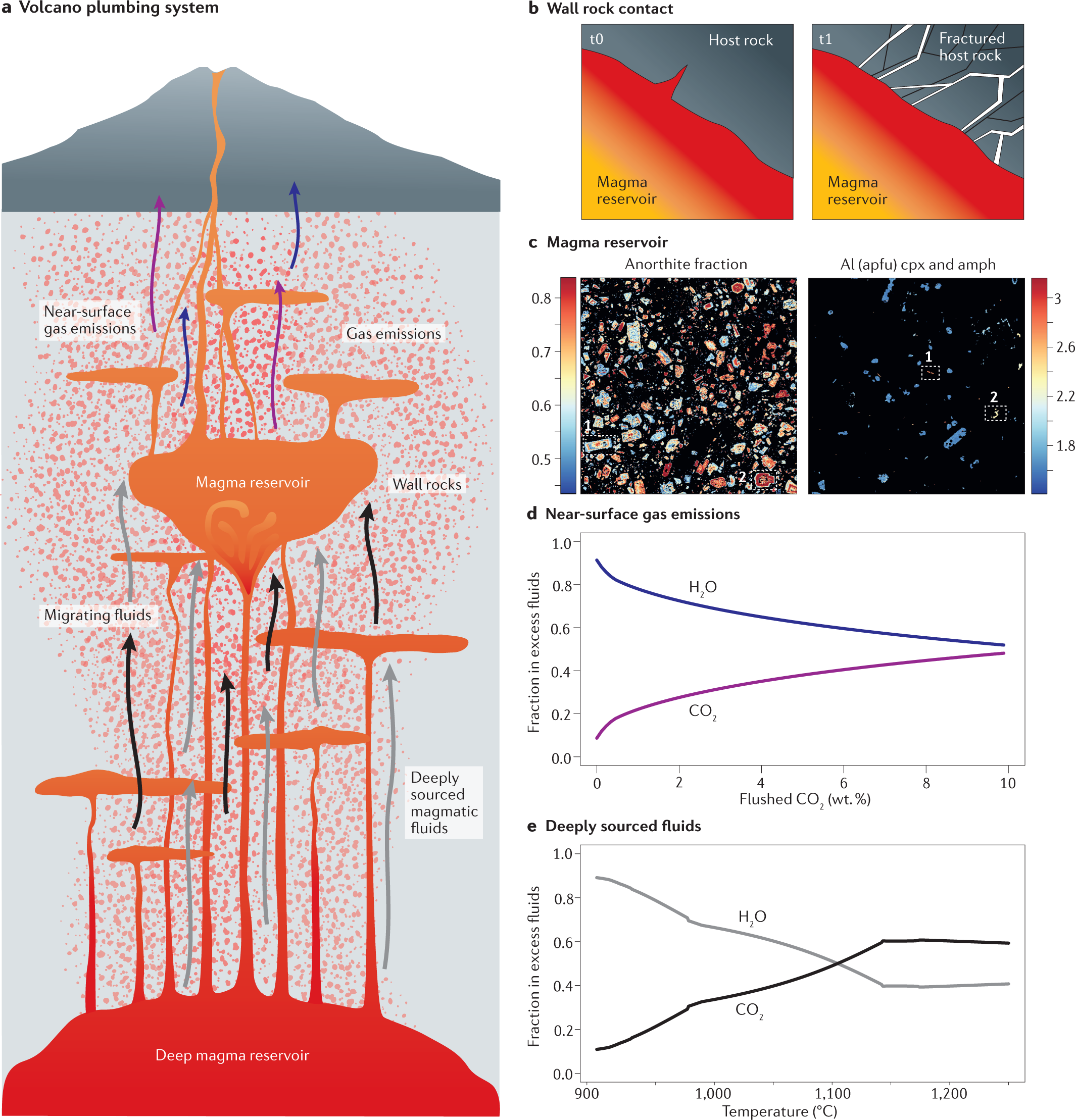
Source: Nature — The build-up and triggers of volcanic eruptions | Nature Reviews ... · www.nature.com
Carbon Cycle Components
Environment
Carbon Cycle: Sources vs Sinks in UPSC Context
Only photosynthesis removes CO₂ - all other biological/geological processes add CO₂
Carbon sources: Respiration, decay, volcanoes, fossil fuels, deforestation
Carbon sinks: Photosynthesis, ocean absorption, soil storage
CO₂ Sources vs Sinks
Process | Effect on Atmospheric CO₂ | Mechanism | Scale |
|---|---|---|---|
Photosynthesis | Removes CO₂ | Plants convert CO₂ to glucose | Major sink |
Respiration | Adds CO₂ | Glucose breakdown in all organisms | Major source |
Decay | Adds CO₂ | Bacterial decomposition | Major source |
Volcanic action | Adds CO₂ | Geological carbon release | Minor source |
Ocean absorption | Removes CO₂ | CO₂ dissolves in seawater | Major sink |
Fossil fuel burning | Adds CO₂ | Human activity | Major source |
Major trap: Confusing photosynthesis as CO₂ source when it's the main CO₂ sink
Question pattern: UPSC tests which processes ADD vs REMOVE CO₂
Memory rule: Only photo-synthesis takes CO₂ in; everything else mentioned puts CO₂ out