There is a concern over the increase in harmful algal blooms in the seawaters of India. What could be the causative factors for this phenomenon? 1. Discharge of nutrients from the estuaries. 2. Run-off from the land during the monsoon. 3. Upwelling in the seas. Select the correct answer from the codes given below:
Contents20
- A1 only
- B1 and 2 only
- C2 and 3 only
- D1, 2 and 3
Show answer
Answer: (D) 1, 2 and 3
ALL THREE factors cause harmful algal blooms (HABs) by adding excess nutrients (especially nitrogen and phosphorus) to seawater.
(1) Estuarine discharge: Rivers carry agricultural fertilizers, sewage, and industrial waste into estuaries, which then flow into the sea — nutrient overload.
(2) Monsoon run-off: Heavy rains wash fertilizers and organic matter from farmlands into rivers and eventually into coastal waters — seasonal nutrient surge.
(3) Upwelling: Deep ocean water is naturally rich in nutrients (from decomposed organic matter). When this water rises to the surface, it brings those nutrients up, feeding algal growth.
The common thread: All three INCREASE NUTRIENT LEVELS in surface waters → algae get 'overfed' → bloom explosively → some species produce toxins = harmful algal bloom.
Harmful algal blooms damage marine ecosystems, kill fish, contaminate seafood, and create oxygen-depleted dead zones in coastal waters.
All three factors increase nutrient levels in seawater - estuaries bring land pollutants, monsoon runoff carries fertilizers, and upwelling brings deep-water nutrients to the surface.
The question tests whether students understand that both human activities and natural processes can trigger the same environmental problem through the same mechanism - nutrient enrichment.
Harmful Algal Blooms
Environment harmful algal blooms seawaters algal blooms
Harmful Algal Blooms: Causes, Effects & Marine Impact
HABs occur when excess nutrients cause explosive algae growth that produces toxins
All three factors - estuarine discharge, monsoon runoff, and upwelling - add nitrogen & phosphorus to seawater
HABs create dead zones by consuming oxygen and releasing toxins
Indian coast faces HABs especially during post-monsoon period
What Are HABs
Harmful Algal Blooms (HABs) are explosive growth of algae that produce toxins harmful to marine life, humans, and ecosystems. Unlike normal algae, these blooms occur when nutrient levels spike beyond natural limits, creating a feeding frenzy for certain algal species.
Three Nutrient Sources
Source | How It Works | Peak Season | Key Nutrients |
|---|---|---|---|
Estuarine Discharge | Rivers carry fertilizers & sewage to sea | Year-round | Nitrogen, Phosphorus |
Monsoon Runoff | Rain washes farm chemicals into coastal waters | Monsoon & post-monsoon | Agricultural fertilizers |
Upwelling | Deep nutrient-rich water rises to surface | Seasonal winds | Natural N, P from decomposition |
HAB Formation Process
%%{init: {"flowchart": {"wrappingWidth": 460}}}%%
flowchart TD
  s1["`**Excess Nutrients Enter Water**
Nitrogen & phosphorus from any of the 3 sources`"]
  s2["`**Algae Population Explodes**
Rapid multiplication due to abundant food`"]
  s3["`**Oxygen Depletion**
Algae consume oxygen faster than it can be replenished`"]
  s4["`**Toxin Production**
Stressed algae release harmful chemicals`"]
  s5["`**Marine Ecosystem Damage**
Fish kills, dead zones, contaminated seafood`"]
  s1 --> s2
  s2 --> s3
  s3 --> s4
  s4 --> s5
Why All Three Cause HABs
Common mechanism: All three add nutrients (especially nitrogen and phosphorus) that algae need to multiply
Estuarine discharge provides year-round nutrient input from human activities upstream
Monsoon runoff creates seasonal nutrient surges when fertilizers wash off farmlands
Upwelling brings naturally accumulated deep-sea nutrients to the sunlight zone where algae thrive
Trap: Thinking upwelling is 'natural' so cannot cause HABs — it does by bringing deep nutrients to surface
Trap: Assuming only human activities cause HABs — natural upwelling also triggers blooms
Trap: Missing that monsoon runoff affects coastal waters, not just inland water bodies
Eutrophication
Environment nutrients discharge run-off
Eutrophication: Nutrient Overload in Water Bodies
Eutrophication = excessive nutrients in water causing algae overgrowth
Main culprits are nitrogen and phosphorus from fertilizers and sewage
Results in oxygen depletion and dead zones in water bodies
Both natural (upwelling) and anthropogenic (runoff) sources contribute
The Nutrient Problem
Eutrophication occurs when water bodies receive excess nutrients, primarily nitrogen and phosphorus. These act like fertilizers for aquatic plants and algae, causing them to multiply rapidly beyond the ecosystem's capacity to handle them.
Nutrient Sources & Pathways
Source Type | Examples | Primary Nutrients | Pathway to Water |
|---|---|---|---|
Agricultural | Fertilizers, pesticides | Nitrates, Phosphates | Surface runoff, groundwater seepage |
Urban Sewage | Domestic waste, detergents | Phosphorus, Nitrogen | Direct discharge, treatment plant overflow |
Industrial | Food processing, chemicals | Varied compounds | Direct discharge, accidental spills |
Natural | Deep ocean water, soil erosion | Decomposed organic matter | Upwelling, natural weathering |
Eutrophication Cycle
%%{init: {"flowchart": {"wrappingWidth": 460}}}%%
flowchart TD
  s1["`**Nutrient Input**
N & P enter water from multiple sources`"]
  s2["`**Primary Production Boom**
Algae & aquatic plants multiply rapidly`"]
  s3["`**Biomass Accumulation**
Excessive plant matter in water column`"]
  s4["`**Decomposition Begins**
Dead plants sink and decay`"]
  s5["`**Oxygen Consumption**
Bacteria use O2 to break down dead matter`"]
  s6["`**Hypoxic Conditions**
Low oxygen = fish kills, dead zones`"]
  s1 --> s2
  s2 --> s3
  s3 --> s4
  s4 --> s5
  s5 --> s6
India-Specific Context
Arabian Sea: Upwelling off Kerala coast brings nutrients, sometimes triggering blooms
Bay of Bengal: Massive freshwater discharge from Ganga-Brahmaputra carries agricultural runoff
Monsoon impact: Post-monsoon period sees highest nutrient loading in coastal waters
Estuarine hotspots: Major river mouths like Hooghly, Krishna, Godavari show frequent eutrophication
Ocean Upwelling
Geography upwelling seas
Ocean Upwelling: Deep Water Rising & Nutrient Transport
Upwelling = cold, nutrient-rich deep water rises to surface due to wind patterns
Brings nitrogen, phosphorus from decomposed organic matter in deep ocean
Creates highly productive fishing areas but can trigger algal blooms
India experiences upwelling along western coast during southwest monsoon
The Deep Ocean Reservoir
Deep ocean waters are naturally rich in nutrients because dead marine organisms sink and decompose there, releasing nitrogen and phosphorus. Upwelling brings this nutrient treasure trove to the surface where sunlight allows explosive algal growth.
Upwelling Mechanism
%%{init: {"flowchart": {"wrappingWidth": 460}}}%%
flowchart TD
  s1["`**Wind Blows Parallel to Coast**
Usually seasonal trade winds or monsoons`"]
  s2["`**Surface Water Moves Away**
Coriolis effect pushes water offshore`"]
  s3["`**Deep Water Rises**
Cold, dense water from 200-1000m depth ascends`"]
  s4["`**Nutrients Reach Surface**
N, P, silicates enter sunlight zone`"]
  s5["`**Phytoplankton Boom**
Primary productivity increases dramatically`"]
  s1 --> s2
  s2 --> s3
  s3 --> s4
  s4 --> s5
Indian Ocean Upwelling
Region | Season | Driving Force | Impact |
|---|---|---|---|
Kerala-Karnataka Coast | Jun-Sep (SW Monsoon) | Offshore winds | Rich fisheries, some blooms |
Somalia Coast | Jun-Sep | Strong SW monsoon winds | Intense upwelling, productivity |
Arabian Sea (Central) | Jan-Mar (NE Monsoon) | Winter cooling | Moderate upwelling |
Upwelling Visualization
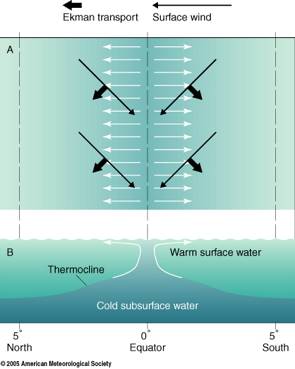
Source: Ocean Motion and Surface Currents — Ocean Motion : Definition : Wind Driven Surface Currents ... · oceanmotion.org
Trap: Thinking upwelling only brings cold water — it primarily brings nutrients that matter for blooms
Trap: Assuming upwelling is always beneficial — it can cause harmful blooms when nutrient levels spike too high
Trap: Missing that upwelling is seasonal and location-specific based on wind patterns
Monsoon Agricultural Runoff
Environment run-off land monsoon
Monsoon Runoff: Agricultural Chemicals Reaching Coastal Waters
Monsoon runoff washes fertilizers and pesticides from farmlands into rivers and seas
Creates seasonal nutrient surge in coastal waters during and after monsoons
Non-point source pollution — diffuse contamination across large agricultural areas
Peak impact in post-monsoon months when river discharge is highest
The Agricultural Connection
Indian agriculture relies heavily on chemical fertilizers containing nitrogen and phosphorus. During monsoons, heavy rainfall acts like a giant washing machine, carrying these chemicals from millions of farms through rivers into coastal waters — creating a massive seasonal nutrient dump.
Runoff Sources & Timing
Source | Key Chemicals | Peak Runoff Period | Coastal Impact |
|---|---|---|---|
Rice Fields | Urea, DAP, Potash | Kharif harvest (Sep-Oct) | High N, P loading |
Sugarcane | NPK fertilizers | Year-round, peaks in monsoon | Continuous but seasonal spikes |
Vegetable Crops | Mixed fertilizers, pesticides | Multiple crop cycles | Variable throughout year |
Dairy/Poultry | Organic waste, feed chemicals | Monsoon washout | Organic N, P, pathogens |
Farm to Sea Pathway
%%{init: {"flowchart": {"wrappingWidth": 460}}}%%
flowchart TD
  s1["`**Fertilizer Application**
Farmers apply N-P-K fertilizers to crops`"]
  s2["`**Monsoon Rainfall**
Heavy rains exceed soil absorption capacity`"]
  s3["`**Surface Runoff**
Excess water carries dissolved chemicals`"]
  s4["`**River Transport**
Streams carry runoff to major rivers`"]
  s5["`**Estuarine Mixing**
Fresh water meets salt water`"]
  s6["`**Coastal Nutrient Loading**
Chemicals enter marine environment`"]
  s1 --> s2
  s2 --> s3
  s3 --> s4
  s4 --> s5
  s5 --> s6
Why Monsoon Timing Matters
Kharif season: Fertilizers applied in May-Jun get washed away during peak monsoon (Jul-Sep)
Soil saturation: Once soil is saturated, additional rainfall becomes pure runoff carrying surface chemicals
River flood stage: High water levels during monsoon carry maximum pollutant loads to coastal areas
Concentration effect: Post-monsoon period sees concentrated discharge as rivers carry accumulated pollutants
Trap: Thinking only point sources (factories) cause water pollution — diffuse agricultural runoff is often worse
Trap: Missing the seasonal timing — runoff impact peaks during and immediately after monsoons
Trap: Forgetting that fertilizer excess from farms eventually reaches coastal waters through river systems