In the context of global oil prices, "Brent crude oil" is frequently referred to in the news. What does this term imply? 1. It is a major classification of crude oil. 2. It is sourced from North Sea. 3. It does not contain sulphur. Which of the statements given above is/are correct?
Contents12
- A2 only
- B1 and 2 only
- C1 and 3 only
- D1, 2 and 3
Show answer
Answer: (B) 1 and 2 only
Statements 1 and 2 are correct.
Statement 3 is WRONG.
Statement 1 (✓):
Brent crude is one of the major BENCHMARK classifications of crude oil used to price about 60% of the world's oil.
The other major benchmark is WTI (West Texas Intermediate).
Statement 2 (✓):
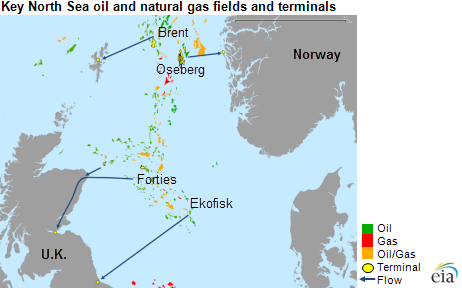
Brent crude is sourced from the North Sea, between the UK and Norway.
It's named after the Brent oilfield (discovered in 1971).
Statement 3 (✗):
Brent crude DOES contain sulphur — just relatively LOW amounts.
It's classified as 'light, sweet' crude, where 'sweet' means LOW sulphur content (below 0.5%), not ZERO sulphur.
No crude oil is completely sulphur-free.
Crude oil classifications to remember:
- Light vs Heavy = based on density (API gravity).
- Sweet vs Sour = based on sulphur content (sweet = low sulphur, sour = high sulphur).
- Brent = light + sweet (low density, low sulphur).
Brent crude is a major global oil pricing benchmark that determines prices for about 60% of the world's oil trades.
Oil price volatility and energy security concerns make understanding major oil benchmarks like Brent and WTI essential for international relations.
The question tests knowledge of oil classification terminology - light vs heavy crude (density) and sweet vs sour crude (sulfur content).
Crude Oil Benchmark Classifications
World Affairs (International Relations) Brent crude oil major classification
Crude Oil Benchmark Classifications: Brent vs WTI vs Dubai
Brent crude prices ~60% of world's oil, sourced from North Sea
WTI (West Texas Intermediate) is the other major global benchmark
Benchmarks are reference prices for oil trading worldwide
Dubai/Oman crude benchmarks Middle Eastern oil
Oil benchmarks are reference crude oils used to set prices for other oil types globally. They act like stock market indices — representing broader market conditions through specific, high-quality crude types.
Major Oil Benchmarks
Benchmark | Source Region | Market Share | Key Characteristic |
|---|---|---|---|
Brent | North Sea (UK-Norway) | ~60% of global oil | Light, sweet crude |
WTI | West Texas, USA | Major US benchmark | Light, sweet crude |
Dubai/Oman | Middle East | Asian market benchmark | Medium, sour crude |
Why Benchmarks Matter
Price discovery: Oil producers use benchmark prices + premiums/discounts to price their crude
Financial contracts: Oil futures, derivatives, and long-term contracts reference these benchmarks
Market transparency: Benchmarks provide standardized pricing for a commodity with thousands of varieties
Statement 1 was correct: Brent IS a major classification/benchmark, not just a random crude type
Don't confuse WTI (West Texas Intermediate) with other US oil regions
Dubai crude is a benchmark too — not just Brent and WTI globally
Brent Crude & North Sea Oil
World Affairs (International Relations) Brent crude oil North Sea sourced from
Brent Crude: North Sea Origins & Geographic Significance
Brent oilfield discovered in 1971 in North Sea
Located between UK and Norway in offshore waters
Name comes from Brent goose (Shell's bird-naming convention)
North Sea oil transformed UK into net energy exporter (1980s-2000s)
The Brent oilfield in the North Sea gave its name to the global oil benchmark. Located in UK waters between Scotland and Norway, it represents the high-quality light, sweet crude characteristic of North Sea oil production.
North Sea Oil Fields
Source: EIA — Summer maintenance affects North Sea crude oil production ... · www.eia.gov
North Sea Oil Significance
Offshore drilling: Advanced deep-water extraction technology developed here
Strategic importance: Made Western Europe less dependent on Middle East oil
Economic impact: Generated massive revenues for UK and Norway since 1970s
Declining production: North Sea output peaked in 1990s, now gradually declining
Statement 2 was correct: Brent IS sourced from North Sea, not Middle East or Americas
Don't assume all major oil comes from Middle East — North Sea is a major Western source
UK-Norway shared waters, not just one country's territory
Crude Oil Quality: Sweet vs Sour
World Affairs (International Relations) sulphur does not contain sulphur
Crude Oil Quality Classifications: Light/Heavy & Sweet/Sour
Sweet crude = LOW sulphur (below 0.5%), not zero sulphur
Sour crude = HIGH sulphur (above 0.5%), needs more refining
Light crude = low density, easier to refine into gasoline
Brent = light + sweet (high quality, premium price)
Crude oil quality determines refining costs and final product yield. Sweet vs sour refers to sulphur content, while light vs heavy refers to density. Higher quality oil (light + sweet) commands premium prices.
Crude Oil Quality Matrix
Classification | Measurement | Threshold | Examples |
|---|---|---|---|
Sweet | Sulphur content | Below 0.5% | Brent, WTI |
Sour | Sulphur content | Above 0.5% | Dubai, Venezuelan heavy |
Light | API gravity | Above 31.1° | Brent (38°), WTI (39°) |
Heavy | API gravity | Below 22.3° | Canadian oil sands, Venezuelan |
Why Quality Matters
Refining costs: Sour crude needs expensive desulphurization before processing
Product yield: Light crude produces more gasoline, heavy crude more fuel oil
Environmental rules: Low-sulphur fuel regulations increase demand for sweet crude
Price premiums: Light, sweet crude sells at $5-15/barrel premium over heavy, sour
Statement 3 was WRONG: Brent DOES contain sulphur — just LOW amounts (sweet ≠ sulphur-free)
No crude oil is completely sulphur-free — 'sweet' means below 0.5%, not zero
Don't confuse API gravity (light/heavy) with sulphur content (sweet/sour)
Global Oil Pricing Mechanisms
World Affairs (International Relations) global oil prices frequently referred to in news
How Global Oil Prices Are Determined: Benchmarks to End Markets
Oil prices set through benchmark crude + premium/discount formula
Futures markets (NYMEX, ICE) provide daily price discovery
Supply-demand fundamentals drive long-term price trends
Geopolitical events cause short-term price spikes
Oil Pricing Process
%%{init: {"flowchart": {"wrappingWidth": 460}}}%%
flowchart TD
  s1["`**Benchmark Prices**
**Brent, WTI, Dubai** crude futures set daily reference prices`"]
  s2["`**Quality Adjustments**
Producers add **premiums** (high quality) or **discounts** (lower quality)`"]
  s3["`**Location Factors**
Transport costs and regional demand affect final pricing`"]
  s4["`**Contract Terms**
Long-term contracts vs spot market purchases determine actual prices`"]
  s1 --> s2
  s2 --> s3
  s3 --> s4
Price Influencing Factors
OPEC decisions: Production cuts/increases by oil cartel affect global supply
Strategic reserves: Government stockpile releases can cool price spikes
Refinery capacity: Processing bottlenecks affect crude demand
Currency fluctuations: Oil priced in US dollars, so USD strength affects prices
Brent pricing role: Remember it prices ~60% of global oil, not just European oil
Oil prices aren't set by single authority — result of market trading on futures exchanges
Benchmark ≠ the only oil traded — thousands of crude varieties reference benchmarks