Which of the following National Parks is unique in being a swamp with floating vegetation that supports a rich biodiversity?
Contents16
- ABhitarkanika National Park
- BKeibul Lamjao National Park
- CKeoladeo Ghana National Park
- DSultanpur National Park
Show answer
Answer: (B) Keibul Lamjao National Park
Keibul Lamjao National Park in Manipur is the world's only floating national park.
It is located within Loktak Lake and is characterized by 'phumdis' — masses of floating, decomposed plant material that form a thick, spongy surface on the water.
This unique ecosystem supports rich biodiversity and is the last natural habitat of the endangered Sangai (Brow-antlered deer), also called the 'dancing deer of Manipur'.
Now, why are the other options wrong?
- Bhitarkanika (Odisha) is famous for mangroves and saltwater crocodiles.
- Keoladeo Ghana/Bharatpur (Rajasthan) is a famous bird sanctuary but not a floating swamp.
- Sultanpur (Haryana) is also a bird sanctuary near Delhi.
None of them have the floating vegetation feature.
Key fact to remember: Loktak Lake + Phumdis + Sangai deer = Keibul Lamjao.
Keibul Lamjao in Manipur is the world's only floating national park, built on decomposed plant material called 'phumdis' in Loktak Lake.
This park is the last habitat of the endangered Sangai deer, making it critical for biodiversity conservation in Northeast India.
UPSC tests whether students can distinguish unique ecosystem features — floating vegetation versus mangroves, bird sanctuaries, or wetlands.
Keibul Lamjao National Park
Environment Keibul Lamjao National Park floating vegetation swamp
Keibul Lamjao: World's Only Floating National Park
World's only floating national park located in Manipur
Located within Loktak Lake with unique phumdis (floating vegetation)
Last natural habitat of endangered Sangai deer (Brow-antlered deer)
Also called 'dancing deer of Manipur'
Unique Ecosystem
Keibul Lamjao National Park in Manipur holds the distinction of being the world's only floating national park. Located within Loktak Lake, it features a unique ecosystem built on phumdis — floating masses of decomposed plant material that create a thick, spongy surface on water.
Key Features
Phumdis: Decomposed organic matter forming floating islands that can support human weight
Loktak Lake: Largest freshwater lake in Northeast India, provides the base for the park
Sangai Conservation: Primary habitat for the endangered Brow-antlered deer found nowhere else
Rich Biodiversity: Supports various waterfowl, migratory birds, and aquatic species
Traditional Use: Local communities historically used phumdis for fishing and agriculture
Floating Ecosystem
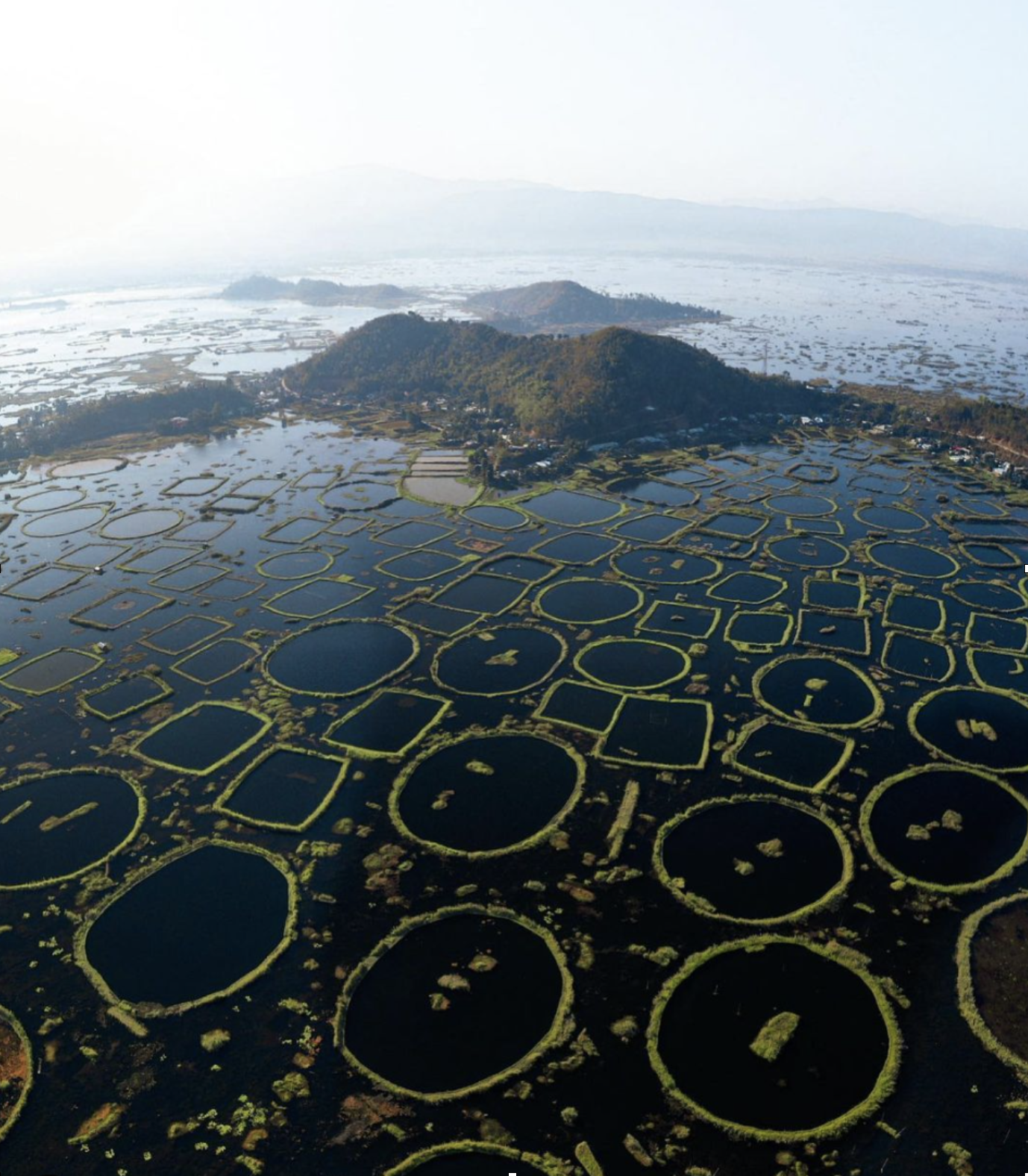
Source: ChaloHoppo — ChaloHoppo | Birds Eye View of Beautiful Northeast India · chalohoppo.com
Trap: Don't confuse with Bhitarkanika (mangrove swamp) or Keoladeo (bird sanctuary wetland)
Trap: Remember Sangai deer is specific to Keibul Lamjao, not other wetland parks
Trap: Floating vegetation is the key distinguishing feature — other parks have wetlands but not floating ecosystems
Major Wetland National Parks
Environment Bhitarkanika National Park Keoladeo Ghana National Park Sultanpur National Park
Major Wetland National Parks & Their Specialties
Bhitarkanika (Odisha): Mangroves and saltwater crocodiles
Keoladeo Ghana (Rajasthan): Premier bird sanctuary, UNESCO World Heritage
Sultanpur (Haryana): Bird sanctuary near Delhi
Wetland Parks Comparison
National Park | State | Primary Ecosystem | Key Species | Special Feature |
|---|---|---|---|---|
Keibul Lamjao | Manipur | Floating swamp | Sangai deer | World's only floating park |
Bhitarkanika | Odisha | Mangrove forest | Saltwater crocodiles | Second largest mangrove in India |
Keoladeo Ghana | Rajasthan | Marshland | Migratory birds | UNESCO World Heritage Site |
Sultanpur | Haryana | Seasonal wetland | Waterfowl | Near Delhi, winter migration |
Distinctive Features
Bhitarkanika: Home to India's largest population of saltwater crocodiles, second-largest mangrove ecosystem after Sundarbans
Keoladeo Ghana: Also called Bharatpur Bird Sanctuary, famous for Siberian cranes (historically), over 230 bird species
Sultanpur: Important stopover for Central Asian migratory birds, easily accessible from National Capital Region
Loktak-Keibul Lamjao: Only park with floating vegetation ecosystem, critical for Sangai deer survival
Trap: Keoladeo Ghana = Bharatpur Bird Sanctuary (same park, different names)
Trap: Don't mix up Bhitarkanika crocodiles with Sundarbans tigers
Trap: Sultanpur is in Haryana near Delhi, not in Rajasthan like Keoladeo
Loktak Lake & Phumdis
Environment floating vegetation
Loktak Lake: Northeast India's Unique Floating Ecosystem
Largest freshwater lake in Northeast India
Phumdis are floating masses of decomposed organic matter
Located in Manipur, supports local fishing communities
Lake Formation
Loktak Lake is the largest freshwater lake in Northeast India, located in Manipur. The lake's unique feature is its phumdis — floating islands made of decomposed plant material, soil, and organic matter that form naturally over time.
Phumdis Formation Process
%%{init: {"flowchart": {"wrappingWidth": 460}}}%%
flowchart TD
  s1["`**Organic Accumulation**
Dead vegetation and organic matter accumulate in shallow lake areas`"]
  s2["`**Decomposition**
Plant material partially decomposes underwater, forming thick mats`"]
  s3["`**Gas Entrapment**
Methane and other gases get trapped, providing buoyancy`"]
  s4["`**Surface Formation**
Dense organic mat rises to surface, creating floating islands`"]
  s5["`**Vegetation Growth**
New plants grow on phumdis, strengthening the floating structure`"]
  s1 --> s2
  s2 --> s3
  s3 --> s4
  s4 --> s5
Ecological Significance
Natural Water Filtration: Phumdis help purify lake water by absorbing pollutants
Fish Breeding: Provide sheltered areas for fish spawning and nursery habitats
Carbon Storage: Store significant amounts of organic carbon in floating biomass
Traditional Livelihoods: Support athaphum fishing (traditional method using phumdis)
Climate Regulation: Help moderate local temperature and humidity
Phumdis Structure
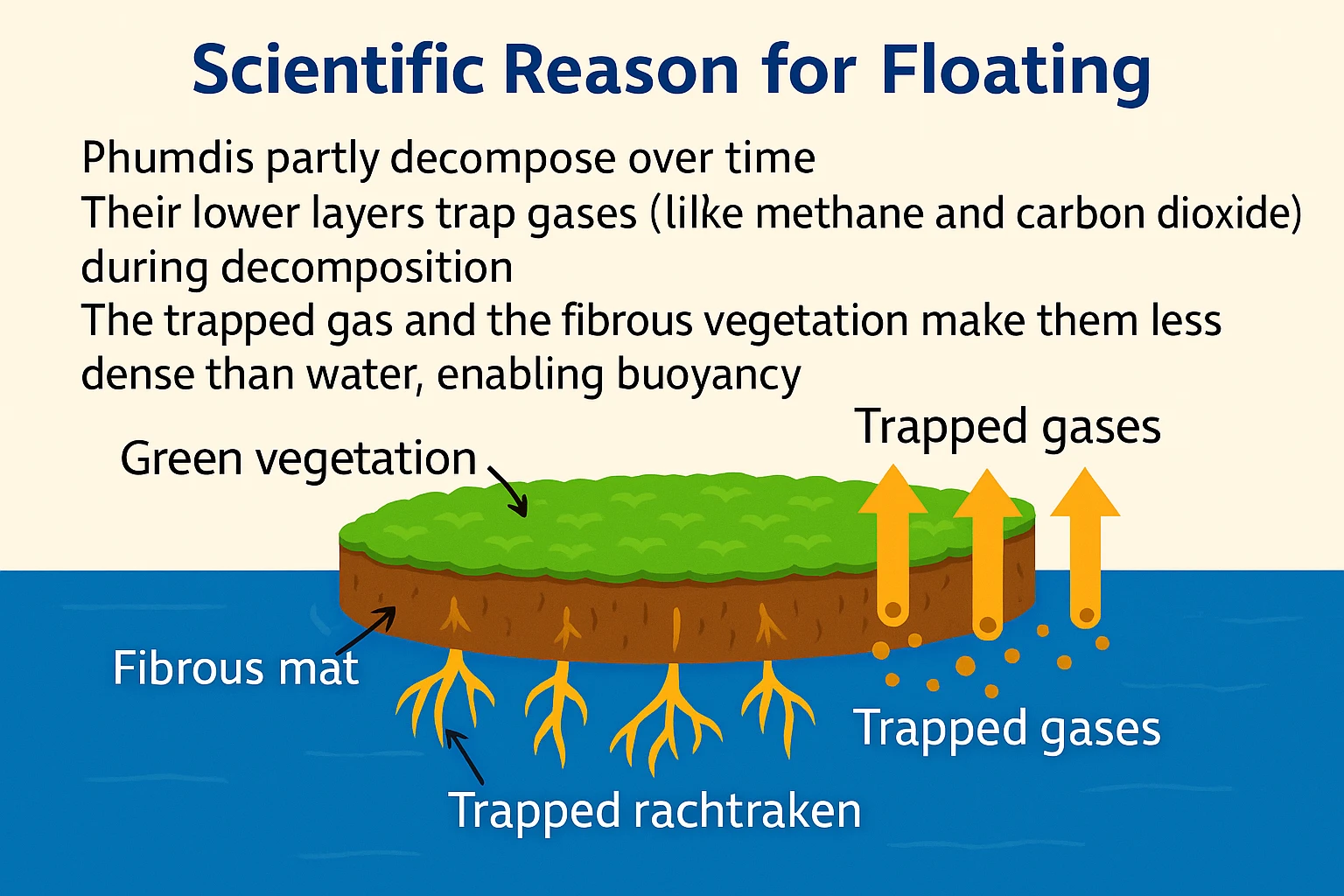
Source: Travel Guide — Loktak Lake Manipur – Floating Phumdis Best Guide 2025 · travelwiseguide.com
Sangai Deer (Brow-antlered Deer)
Environment
Sangai Deer: Manipur's Dancing Deer & Conservation
Brow-antlered deer endemic to Manipur, also called 'dancing deer'
Critically endangered with population only in Keibul Lamjao
State animal of Manipur, adapted to floating phumdis habitat
Unique Characteristics
The Sangai (Rucervus eldii eldii) is a subspecies of Eld's deer found only in Manipur. Called the 'dancing deer' due to its graceful movements on floating phumdis, it has uniquely adapted to life on the spongy, unstable surface of Keibul Lamjao's floating islands.
Conservation Status & Threats
Population: Approximately 200-250 individuals (2020 estimates)
Habitat Loss: Shrinking phumdis due to dam construction and water level changes
Poaching: Illegal hunting despite strict protection measures
Pollution: Water pollution in Loktak Lake affecting food sources
Human Encroachment: Fishing activities and boat traffic disturbing habitat
Sangai vs Other Indian Deer
Species | Habitat | Distribution | Conservation Status | Key Feature |
|---|---|---|---|---|
Sangai | Floating swamps | Manipur only | Critically Endangered | Lives on phumdis |
Barasingha | Grasslands, swamps | Central India | Vulnerable | Hard hooves for soft ground |
Hangul | Alpine meadows | Kashmir only | Critically Endangered | Cold climate adaptation |
Chital | Forests, grasslands | Pan-Indian | Least Concern | Spotted coat year-round |
Trap: Sangai is found ONLY in Keibul Lamjao, not in any other park
Trap: Don't confuse with Hangul (Kashmir stag) or Barasingha (swamp deer)
Trap: 'Dancing deer' refers specifically to Sangai, not other graceful deer species