Recently, "oilzapper" was in the news. What is it?
Contents19
- AIt is an eco-friendly technology for the remediation of oily sludge and oil spills
- BIt is the latest technology developed for under-sea oil exploration
- CIt is a genetically engineered high biofuel-yielding maize variety
- DIt is the latest technology to control the accidentally caused flames from oil wells.
Show answer
Answer: (A) It is an eco-friendly technology for the remediation of oily sludge and oil spills
Oilzapper is a BIOREMEDIATION technology developed by TERI (The Energy and Resources Institute) in India.
It uses a cocktail of five naturally occurring bacterial strains that literally 'eat' or degrade oil and oily sludge, converting hydrocarbons into harmless CO₂ and water.
How it works:
- Oil-eating bacteria are grown in the lab
- Mixed with a carrier material (like sawdust)
- Sprinkled over oil-contaminated soil or water
- Bacteria feed on the oil
- Within 4-16 weeks, the oil is broken down into non-toxic substances.
Why it matters:
- Traditional oil spill cleanup methods (burning, chemical dispersants) are expensive and cause additional pollution.
- Oilzapper is eco-friendly, cost-effective, and doesn't produce secondary pollution.
- It's been successfully used by ONGC and Indian Oil Corporation to clean up oil sludge at refineries and drilling sites.
Key term: BIOREMEDIATION = using living organisms to clean up pollution. 'Bio' = life, 'remediation' = fixing a problem.
Oilzapper is an Indian bioremediation technology that uses oil-eating bacteria to clean up petroleum contamination without creating secondary pollution.
UPSC is testing whether students can distinguish bioremediation from other oil industry technologies - the question uses similar technical terms across options to create confusion.
The key concept being tested is bioremediation - using living organisms to solve environmental problems rather than chemical or mechanical methods.
Oilzapper Technology
Environment oilzapper oil spills oily sludge
Oilzapper: India's Breakthrough Oil Cleanup Technology
Oilzapper is a bioremediation technology using 5 bacterial strains to eat oil and convert it to harmless CO₂ and water
Developed by TERI (The Energy and Resources Institute) in India
Takes 4-16 weeks to completely break down oil contamination
Successfully used by ONGC and Indian Oil Corporation at refineries
What is Oilzapper
Oilzapper is India's indigenous bioremediation technology that uses naturally occurring bacteria to clean up oil pollution. Unlike chemical methods that create secondary pollution, this eco-friendly solution literally allows bacteria to 'eat' the oil and convert hydrocarbons into harmless substances.
How Oilzapper Works
%%{init: {"flowchart": {"wrappingWidth": 460}}}%%
flowchart TD
  s1["`**Bacterial Cultivation**
**5 specific bacterial strains** are grown in laboratory conditions`"]
  s2["`**Carrier Mixing**
Bacteria mixed with **carrier material** like sawdust or rice husk`"]
  s3["`**Application**
Mixture **sprinkled over** oil-contaminated soil or water surface`"]
  s4["`**Bacterial Action**
Bacteria **feed on hydrocarbons**, breaking down oil molecules`"]
  s5["`**Complete Cleanup**
Oil converted to **CO₂ and water** within **4-16 weeks**`"]
  s1 --> s2
  s2 --> s3
  s3 --> s4
  s4 --> s5
Oilzapper vs Traditional Methods
Aspect | Oilzapper | Traditional Methods |
|---|---|---|
Approach | Biological degradation | Chemical dispersants, burning |
Environmental Impact | Zero secondary pollution | Additional toxic chemicals |
Cost | Cost-effective | Expensive equipment and chemicals |
Time Required | 4-16 weeks | Immediate but incomplete |
End Products | CO₂ and water (harmless) | Toxic residues remain |
Applications & Success
Oil refineries: Cleaning accumulated oily sludge at petroleum facilities
Oil spills: Marine and terrestrial oil spill remediation
Drilling sites: Cleanup of contaminated soil around oil wells
Industrial adoption: Used by ONGC, Indian Oil Corporation, HPCL
International recognition: Patented technology with global applications
Trap: Option B mentions 'under-sea oil exploration' - Oilzapper is for cleanup, not exploration
Trap: Option C mentions 'biofuel-yielding maize' - Oilzapper uses bacteria, not genetically modified crops
Trap: Option D mentions 'oil well flames' - Oilzapper handles liquid oil pollution, not fire control
Memory trick: 'Zapper' suggests destroying something - here it destroys oil pollution
Bioremediation Techniques
Environment
Bioremediation: Using Life to Clean Pollution
Bioremediation uses living organisms (bacteria, fungi, plants) to break down pollutants
In-situ (on-site) and ex-situ (off-site) treatment methods available
Effective for organic pollutants like oil, pesticides, and industrial chemicals
Core Concept
Bioremediation combines 'bio' (life) + 'remediation' (fixing problems). It harnesses natural biological processes where microorganisms break down harmful substances into harmless end products like CO₂, water, and biomass.
Types of Bioremediation
# Bioremediation Methods
## By Location
- **In-situ** (on-site treatment)
- **Ex-situ** (excavate & treat elsewhere)
## By Organism
- **Microbial** (bacteria, fungi)
- **Phytoremediation** (plants)
- **Enhanced** (added nutrients)
## By Conditions
- **Aerobic** (with oxygen)
- **Anaerobic** (without oxygen)
- **Combined** approach
Bioremediation Applications
Pollutant Type | Organisms Used | Examples | Time Frame |
|---|---|---|---|
Oil & Petroleum | Oil-eating bacteria | Oilzapper, Exxon Valdez cleanup | 4-16 weeks |
Heavy Metals | Metal-tolerant plants | Phytoremediation of lead, cadmium | 1-3 years |
Pesticides | Degrading bacteria | DDT, organophosphates | 6 months-2 years |
Industrial Solvents | Specialized microbes | TCE, benzene cleanup | 3-12 months |
Advantages & Limitations
Eco-friendly: No secondary pollution, uses natural processes
Cost-effective: Cheaper than physical/chemical methods long-term
Limitation: Works only on biodegradable pollutants (not heavy metals directly)
Time factor: Slower than chemical methods but more thorough
Site-specific: Effectiveness depends on soil conditions, temperature, pH
Oil Spill Cleanup Methods
Environment oil spills remediation
Oil Spill Response: Traditional vs Biological Methods
Mechanical methods (booms, skimmers) remove oil physically from water surface
Chemical dispersants break oil into droplets but create toxic underwater pollution
Bioremediation uses bacteria to completely degrade oil into harmless substances
In-situ burning destroys oil but releases toxic fumes into atmosphere
Why Oil Spills Matter
Oil spills cause massive environmental damage to marine ecosystems, coastal areas, and wildlife. The cleanup method chosen determines whether the response creates additional pollution or truly solves the problem.
Oil Spill Cleanup Comparison
Method | How it Works | Advantages | Disadvantages |
|---|---|---|---|
Mechanical Recovery | Booms contain, skimmers collect oil | Physically removes oil | Only works in calm seas, slow |
Chemical Dispersants | Chemicals break oil into droplets | Quick action, works in rough seas | Toxic to marine life |
In-situ Burning | Controlled burning of oil slick | Destroys oil completely | Air pollution, toxic smoke |
Bioremediation | Bacteria eat and degrade oil | Eco-friendly, complete breakdown | Slower process (weeks) |
Famous Oil Spill Cases
Exxon Valdez (1989): Alaska spill used bioremediation successfully after mechanical cleanup
Deepwater Horizon (2010): Gulf of Mexico disaster, massive use of chemical dispersants
Taylor Energy (2004-present): Ongoing Louisiana spill, longest in US history
Indian context: ONGC Mumbai High fire (2005), Chennai oil spill (2017)
Oil Spill Response
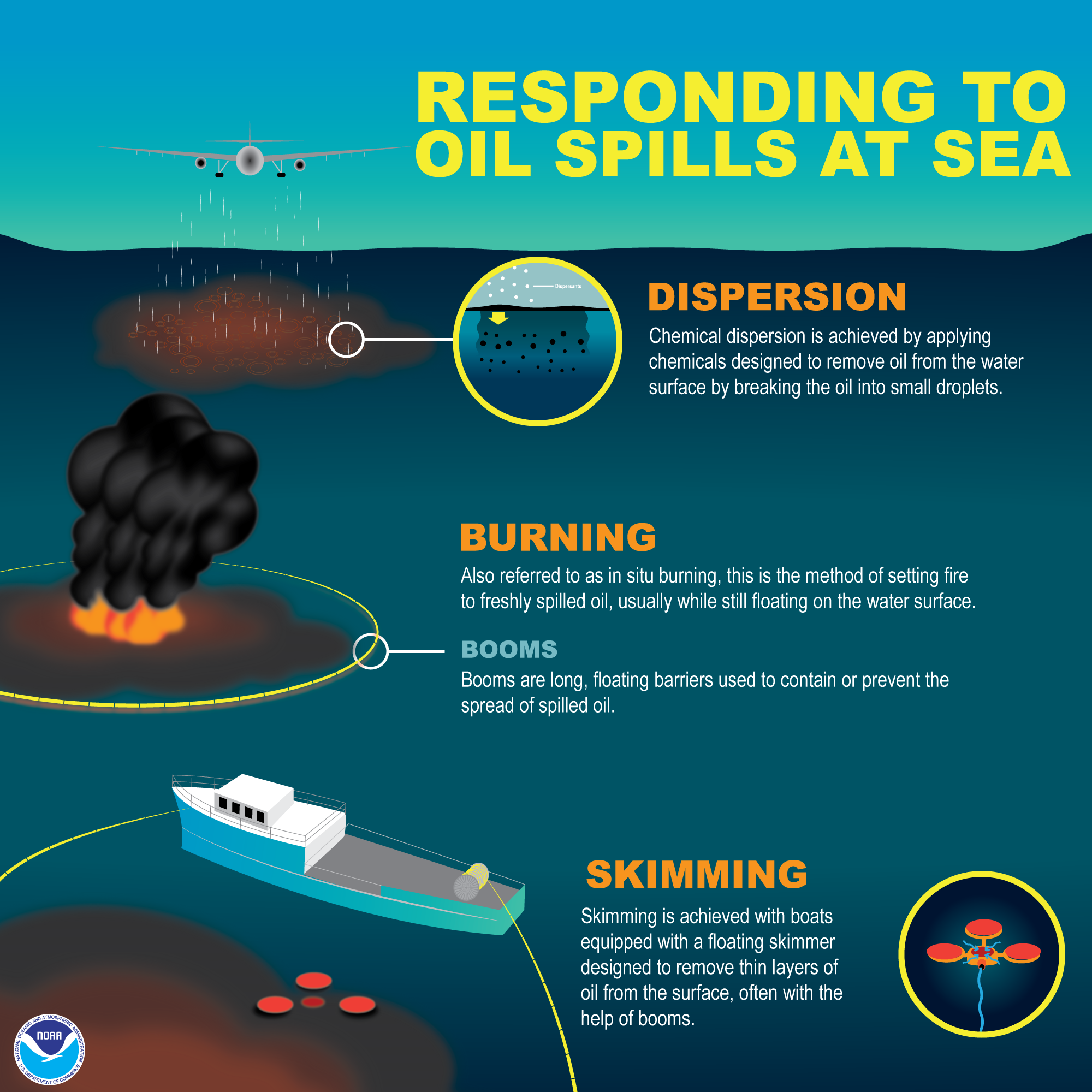
Source: Office of Response and Restoration - NOAA — How Do Oil Spills out at Sea Typically Get Cleaned Up? | response ... · response.restoration.noaa.gov
Don't confuse: Oilzapper is for cleanup after spills, not preventing spills or exploration
Remember: Chemical dispersants look effective but create underwater pollution
Key distinction: Mechanical methods remove oil, bioremediation destroys oil completely
TERI & Environmental Research
Environment TERI
TERI: Leading India's Environmental Research
TERI = The Energy and Resources Institute, premier environmental research organization
Developed Oilzapper technology for oil spill bioremediation
Founded by Dr. Rajendra Pachauri (former IPCC Chairman)
About TERI
The Energy and Resources Institute (TERI) is India's leading think tank focused on sustainable development, energy security, and environmental solutions. Originally founded as Tata Energy Research Institute, it became independent and developed breakthrough technologies like Oilzapper.
TERI's Key Areas
# TERI Research Focus
## Energy
- Renewable energy
- Energy efficiency
- Clean coal technology
## Environment
- **Oilzapper technology**
- Air quality monitoring
- Climate change research
## Sustainable Development
- Green buildings
- Biotechnology
- Policy research
Notable Achievements
Oilzapper: Patented bioremediation technology adopted by petroleum companies
GRIHA: Green building rating system for India
Delhi Sustainable Development Summit: Annual global conference on sustainability
Policy influence: Advisor to government on energy and environmental policies