Human activities in the recent past have caused the increased concentration of carbon dioxide in the atmosphere, but a lot of it does not remain in the lower atmosphere because of 1. Its escape into the outer stratosphere. 2. The photosynthesis by phytoplankton in the oceans. 3. The trapping of air in the polar ice caps. Which of the statements given above is/are correct?
Contents18
- A1 and 2
- B2 only
- C2 and 3
- D3 only
Show answer
Answer: (B) 2 only
The answer is (b) — only Statement 2 (phytoplankton photosynthesis) is correct.
Oceans are the biggest carbon sink on Earth, absorbing about 25-30% of human-produced CO₂.
The primary mechanism is photosynthesis by ocean phytoplankton — these tiny organisms absorb dissolved CO₂ to make food, just like land plants.
This is called the 'biological carbon pump.'
Statement 1 (✗): CO₂ does NOT 'escape into the outer stratosphere.'
CO₂ is a relatively heavy molecule that stays in the lower atmosphere.
It doesn't float up and escape.
Earth's gravity holds atmospheric gases firmly.
Statement 3 (✗): Polar ice caps TRAP air bubbles that contain atmospheric gases (which is how scientists study ancient climates), but this is an extremely SLOW process that doesn't significantly REMOVE CO₂ from the atmosphere.
The amount trapped is negligible compared to oceanic absorption.
Key takeaway: Oceans (phytoplankton + direct dissolution) are the planet's primary CO₂ cleanup system, absorbing billions of tons of CO₂ annually.
Oceans absorb about 25-30% of all human-produced CO₂ annually, making them Earth's largest carbon sink and crucial for preventing even faster climate change.
The question tests a common misconception that CO₂ escapes to space - in reality, CO₂ is too heavy to escape Earth's atmosphere and stays trapped in the lower atmosphere unless absorbed by natural processes.
Students must distinguish between significant CO₂ removal processes (ocean absorption) versus negligible ones (ice trapping) to avoid the trap options.
Oceanic Carbon Sinks
Environment phytoplankton oceans photosynthesis
Oceanic Carbon Sinks: How Oceans Absorb CO₂
Oceans absorb 25-30% of human-produced CO₂ annually
Phytoplankton photosynthesis is the primary biological mechanism
Oceans are Earth's largest carbon sink — bigger than forests
Process called biological carbon pump transfers surface CO₂ to deep ocean
Why Oceans Matter
Oceans are Earth's primary CO₂ cleanup system, absorbing billions of tons annually. Without oceanic absorption, atmospheric CO₂ levels would be much higher.
Carbon Absorption Mechanisms
Mechanism | Process | Scale | Timeframe |
|---|---|---|---|
Phytoplankton Photosynthesis | Microscopic algae convert dissolved CO₂ to organic matter | 25-30% of human emissions | Continuous |
Direct Dissolution | CO₂ gas dissolves directly into seawater | Significant but slower | Ongoing |
Biological Carbon Pump | Dead organisms sink, carrying carbon to deep ocean | Long-term storage | Decades to centuries |
Biological Carbon Pump
%%{init: {"flowchart": {"wrappingWidth": 460}}}%%
flowchart TD
  s1["`**CO₂ Dissolution**
Atmospheric CO₂ dissolves into ocean surface water`"]
  s2["`**Phytoplankton Photosynthesis**
Marine algae absorb dissolved CO₂ and convert to organic carbon`"]
  s3["`**Food Chain Transfer**
Zooplankton eat phytoplankton, transferring carbon up the food web`"]
  s4["`**Sinking & Storage**
Dead organisms sink to deep ocean, storing carbon for decades/centuries`"]
  s1 --> s2
  s2 --> s3
  s3 --> s4
Question Context
This question tests understanding of real vs fake CO₂ removal mechanisms. Only oceanic phytoplankton significantly removes atmospheric CO₂ from the options given.
Trap: CO₂ does not escape to outer stratosphere — it's too heavy and Earth's gravity retains it
Trap: Polar ice trapping air is extremely slow — not a significant CO₂ removal mechanism
Common confusion: Mixing up CO₂ storage (ice caps) vs active removal (phytoplankton)
UPSC loves testing oceanic carbon absorption — remember the 25-30% figure
Atmospheric CO₂ Behavior
Environment carbon dioxide lower atmosphere stratosphere
Why CO₂ Stays in Lower Atmosphere
CO₂ is relatively heavy — does not escape to outer atmosphere
Earth's gravity retains atmospheric gases including CO₂
CO₂ stays in troposphere where it causes greenhouse effect
Molecular Weight Reality
CO₂ molecules are heavier than many atmospheric gases. Earth's gravitational field easily retains CO₂ in the lower atmosphere — it doesn't 'float away' to space.
Atmospheric Gas Behavior
Gas | Molecular Weight | Atmospheric Behavior | Climate Impact |
|---|---|---|---|
Carbon Dioxide (CO₂) | 44 units | Stays in troposphere | Major greenhouse gas |
Oxygen (O₂) | 32 units | Well-retained | Essential for life |
Nitrogen (N₂) | 28 units | Dominant atmospheric gas | Relatively inert |
Hydrogen (H₂) | 2 units | Can escape over geological time | Very light, minimal retention |
Why CO₂ Accumulates
Human emissions add CO₂ faster than natural removal processes
Long atmospheric lifetime — CO₂ persists for decades to centuries
Mixing occurs between atmospheric layers, but CO₂ doesn't escape Earth
Concentration builds up because sinks (oceans, forests) have limited capacity
Trap: CO₂ does NOT escape to space — this is a completely false mechanism
Don't confuse with ozone depletion in stratosphere — different gas, different process
Molecular weight matters — heavier gases like CO₂ stay in lower atmosphere
Polar Ice Carbon Storage
Environment polar ice caps trapping of air
Polar Ice: Climate Records vs Active Carbon Removal
NOT a significant mechanism for removing current atmospheric CO₂
Polar ice traps air bubbles containing ancient atmospheric gases
Ice core data reveals past climate conditions spanning thousands of years
Scientific Value vs Climate Impact
Polar ice caps preserve atmospheric samples in trapped air bubbles, creating invaluable climate records. However, this process is extremely slow and removes negligible amounts of current CO₂.
Ice vs Ocean Carbon Processes
Process | Mechanism | Speed | CO₂ Removal Scale | Primary Value |
|---|---|---|---|---|
Oceanic Absorption | Phytoplankton photosynthesis | Continuous | Billions of tons/year | Active climate regulation |
Ice Trapping | Air bubble preservation | Geological timescales | Negligible | Scientific research & records |
Why Ice Cores Matter
Paleoclimate research — reveals CO₂ levels from thousands of years ago
Baseline data for understanding natural vs human-caused climate change
Validation tool for climate models and projections
Evidence of rapid change — shows current CO₂ rise is unprecedented
Question Context
The question asks about active CO₂ removal from atmosphere. Ice trapping is storage of past atmosphere, not removal of current emissions.
Trap: Ice caps preserve atmospheric gases but don't remove significant current CO₂
Don't confuse scientific value (climate records) with active carbon sink capacity
Timescale matters — ice processes work over millennia, not years/decades
Global Carbon Cycle
Environment carbon dioxide atmosphere
Global Carbon Cycle: Sources, Sinks & Human Impact
Four major carbon reservoirs: atmosphere, oceans, land, geological
Natural balance disrupted by human fossil fuel emissions
Oceans and forests are primary carbon sinks absorbing excess CO₂
Atmospheric CO₂ has increased 50% since pre-industrial times
Carbon Reservoirs & Processes
# Global Carbon Cycle
## Atmospheric Carbon
- CO₂ gas
- Greenhouse effect
- 420+ ppm current level
## Oceanic Carbon
- Dissolved CO₂
- Phytoplankton
- Deep ocean storage
- Biological pump
## Terrestrial Carbon
- Forest biomass
- Soil organic matter
- Plant photosynthesis
- Decomposition
## Human Sources
- Fossil fuel burning
- Deforestation
- Industrial processes
- Land use change
Major Carbon Sinks
Carbon Sink | Annual Absorption | Mechanism | Capacity Limit |
|---|---|---|---|
Oceans | ~25-30% of emissions | Phytoplankton + dissolution | Ocean acidification risk |
Forests | ~25-30% of emissions | Tree photosynthesis | Deforestation threat |
Soils | ~5-10% of emissions | Organic matter storage | Land use dependent |
Wetlands | Small but significant | Plant growth + storage | Limited area available |
Carbon Cycle Diagram
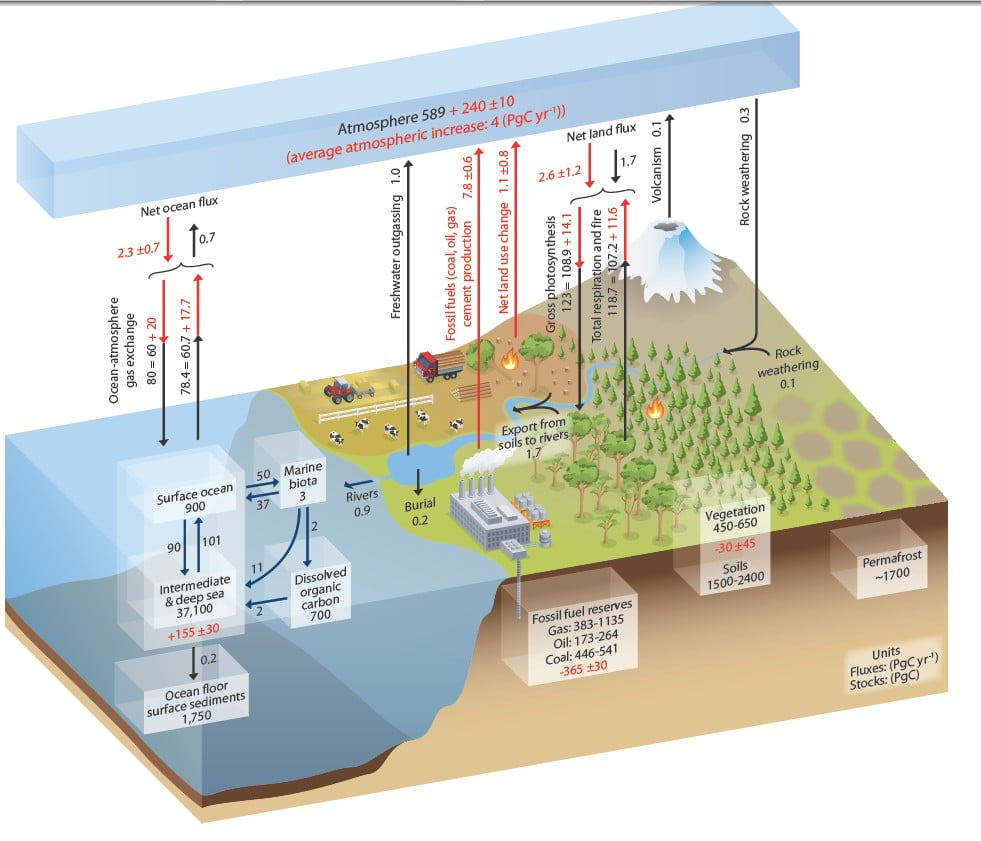
Source: MetLink — MetLink - Royal Meteorological Society The Changing Carbon ... · www.metlink.org
Ocean acidification — excess CO₂ absorption makes oceans more acidic
Sink saturation — forests and oceans may absorb less CO₂ as climate warms
Positive feedback loops — warming releases more carbon from soils/permafrost
Remember specific percentages — oceans and forests each absorb ~25-30% of human emissions