In the context of ecosystem productivity, marine upwelling zones are important as they increase the marine productivity by bringing the 1. Decomposer microorganism to the surface. 2. Nutrients to the surface. 3. Bottom-dwelling organisms to the surface. Which of the statements given above is/are correct?
Contents20
- A1 and 2
- B2 only
- C2 and 3
- D3 only
Show answer
Answer: (B) 2 only
The answer is (b) — Upwelling increases marine productivity by bringing NUTRIENTS to the surface.
Upwelling is the process where deep, cold, nutrient-rich water rises to the surface (caused by wind patterns pushing surface water away).
Why nutrients matter:
- Deep ocean water is rich in nutrients (nitrogen, phosphorus, silica, iron) from decomposed organic matter that sank from above.
- When upwelling brings these nutrients to the sunlit surface zone, phytoplankton explode in numbers (like adding fertilizer to a garden)
- zooplankton feed on phytoplankton
- fish feed on zooplankton
- marine food chain thrives.
This is why the world's most productive fishing grounds (Peru, northwest Africa, California coast) are in upwelling zones.
Why not other options?
(1) Decomposer microorganisms — they exist everywhere, not specifically brought up by upwelling.
(3) Bottom-dwelling organisms — upwelling doesn't lift creatures from the seabed; it's about water circulation, not organism transportation.
The key input is NUTRIENTS, which fuels photosynthesis → entire food chain.
Upwelling zones like Peru's coast produce about 20% of the world's fish catch despite covering less than 1% of ocean area, making this a high-stakes ecological concept.
The core mechanism is that deep ocean water contains concentrated nutrients from decomposed organic matter, and when upwelling brings these nutrients to the sunlit surface zone, phytoplankton populations explode like fertilizer being added to a garden.
Marine Upwelling Zones
Environment upwelling marine productivity nutrients
Marine Upwelling: Process, Nutrient Transport & Productivity Impact
Upwelling brings deep, cold, nutrient-rich water to the ocean surface
Wind patterns push surface water away, allowing deeper water to rise
Nutrients (nitrogen, phosphorus, silica) fuel phytoplankton blooms at surface
World's most productive fishing grounds occur in upwelling zones
What is Upwelling
Upwelling is the oceanic process where deep, cold, nutrient-rich water rises to the surface. This happens when wind patterns consistently push surface water away from a coast or region, creating a vacuum that pulls deeper water upward to replace it.
Upwelling Process
%%{init: {"flowchart": {"wrappingWidth": 460}}}%%
flowchart TD
  s1["`**Wind Action**
Persistent winds push warm surface water away from coast`"]
  s2["`**Water Replacement**
Cold, deep water rises to replace displaced surface water`"]
  s3["`**Nutrient Transport**
Deep water carries nutrients (N, P, Si, Fe) to sunlit surface zone`"]
  s4["`**Phytoplankton Boom**
Surface nutrients fuel massive phytoplankton growth`"]
  s5["`**Food Chain Impact**
Enhanced primary productivity supports entire marine ecosystem`"]
  s1 --> s2
  s2 --> s3
  s3 --> s4
  s4 --> s5
Major Upwelling Zones
Region | Location | Wind Pattern | Productivity Impact |
|---|---|---|---|
Peru Current | Western South America | Southeast trade winds | World's largest fishery (anchovies) |
California Current | Western North America | Northwest winds | High sardine, tuna productivity |
Canary Current | Northwest Africa | Northeast trade winds | Major fishing grounds off Morocco |
Benguela Current | Southwest Africa | Southeast winds | Rich fisheries off Namibia, South Africa |
Question Connection
This question tests understanding of why upwelling increases marine productivity. The mechanism is nutrient transport, not organism transport. Students who chose options 1 or 3 confused upwelling with physical movement of organisms rather than chemical enrichment of surface waters.
Trap: Thinking upwelling physically brings decomposer organisms to surface — decomposers exist everywhere, upwelling brings their nutrient products
Trap: Confusing upwelling with bottom-dwelling organism transport — upwelling moves water and dissolved nutrients, not benthic creatures
Trap: Missing that productivity boost comes from nutrients enabling photosynthesis — not from adding more organisms directly
Upwelling Mechanism
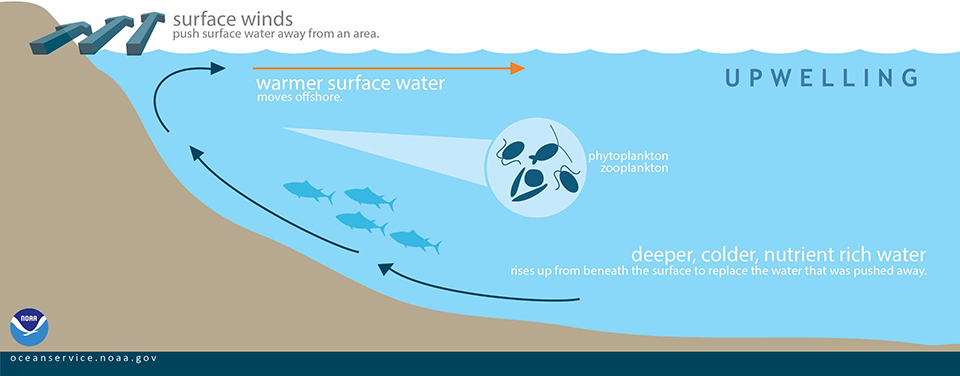
Source: NOAA's National Ocean Service — What is upwelling? · oceanservice.noaa.gov
Marine Nutrients & Primary Productivity
Environment nutrients productivity
Marine Nutrients: Types, Sources & Role in Ocean Productivity
Nitrogen, phosphorus, silica are key limiting nutrients for marine phytoplankton
Deep ocean waters are nutrient-rich from decomposed organic matter
Nutrient availability controls primary productivity in oceans
Surface waters are typically nutrient-poor due to biological uptake
Key Marine Nutrients
Nutrient | Chemical Form | Role in Marine Life | Limiting Factor |
|---|---|---|---|
Nitrogen | Nitrate (NO₃⁻), Nitrite (NO₂⁻) | Protein synthesis, chlorophyll | Most common limiting nutrient |
Phosphorus | Phosphate (PO₄³⁻) | DNA, RNA, ATP energy | Often co-limiting with nitrogen |
Silica | Silicate (SiO₄⁴⁻) | Diatom cell walls | Limits diatom productivity |
Iron | Dissolved Fe²⁺, Fe³⁺ | Chlorophyll, electron transport | Limits productivity in open ocean |
Deep vs Surface Waters
Deep ocean waters (below 200m) accumulate nutrients from decomposing organic matter that sinks from surface. Surface waters are typically nutrient-depleted because phytoplankton rapidly consume available nutrients. This creates a vertical nutrient gradient — rich deep waters, poor surface waters.
Productivity Mechanism
Primary productivity depends on both sunlight (surface only) and nutrients (deep waters)
Phytoplankton need both light and nutrients — upwelling solves this by bringing nutrients to sunlit zone
Nutrient input triggers phytoplankton blooms — foundation of entire marine food web
Limiting nutrient concept — productivity increases until the scarcest essential nutrient runs out
Nutrient Sources in Oceans
# Marine Nutrient Sources
## Upwelling
- Coastal upwelling
- Equatorial upwelling
- Deep water circulation
## River Input
- Terrestrial runoff
- Agricultural fertilizers
- Sewage discharge
## Atmospheric
- Dust deposition
- Nitrogen fixation
- Rainfall
## Internal Cycling
- Decomposition
- Excretion
- RemineralizationTrap: Thinking organisms themselves increase productivity — it's the nutrients they release through decomposition
Trap: Confusing nutrient transport with organism transport — upwelling moves dissolved chemicals, not living creatures
Ocean Zones & Productivity Patterns
Environment
Ocean Vertical Zones: Light, Nutrients & Productivity Distribution
Euphotic zone (0-200m) has light for photosynthesis but low nutrients
Aphotic zone (below 200m) is nutrient-rich but lacks light
Highest productivity occurs where nutrients reach sunlit surface waters
Thermocline acts as barrier preventing nutrient mixing
Ocean Vertical Zones
Zone | Depth | Light Level | Nutrient Level | Productivity |
|---|---|---|---|---|
Euphotic Zone | 0-200m | High (photosynthesis possible) | Low (depleted by uptake) | High where nutrients available |
Dysphotic Zone | 200-1000m | Dim (insufficient for photosynthesis) | Moderate | Low |
Aphotic Zone | Below 1000m | None (complete darkness) | High (from decomposition) | Very low |
Benthic Zone | Ocean floor | None (except thermal vents) | High (sediment accumulation) | Low |
The Productivity Paradox
Ocean productivity faces a fundamental constraint: photosynthesis requires surface light but nutrients accumulate in deep waters. Most ocean regions have either light without nutrients (surface) or nutrients without light (depths). Upwelling zones solve this paradox by bringing deep nutrients to the surface.
Thermocline Barrier Effect
Thermocline is a temperature boundary layer (typically 200-1000m depth)
Dense, cold deep water cannot easily mix with warm, light surface water
This stratification keeps nutrients trapped in deep waters most of the time
Wind-driven upwelling overcomes thermocline barrier through mechanical forcing
Seasonal mixing in temperate regions can also break down stratification
Ocean Zone Structure

Source: Nature — The Biological Productivity of the Ocean | Learn Science at Scitable · www.nature.com
Marine Decomposer Organisms
Environment decomposer microorganism
Marine Decomposers: Distribution, Role & Relation to Upwelling
Marine bacteria are the primary decomposers in ocean ecosystems
Decomposers exist throughout all ocean depths, not just deep waters
Upwelling transports decomposer products (nutrients), not decomposers themselves
They break down organic matter into inorganic nutrients (N, P, Si)
Types & Distribution
Heterotrophic bacteria — consume organic matter, found at all depths
Chemosynthetic bacteria — concentrate near hydrothermal vents and organic-rich sediments
Particle-attached bacteria — decompose sinking organic particles throughout water column
Free-living bacteria — abundant in surface waters where organic matter is produced
Sediment bacteria — highest concentrations on ocean floor with accumulated organic matter
Why Option 1 is Wrong
The question's Statement 1 incorrectly suggests upwelling brings decomposer microorganisms to the surface. Decomposers exist everywhere in the ocean — surface, middle depths, and bottom waters. Upwelling doesn't transport organisms; it transports the dissolved nutrients that decomposers have already released from organic matter.
Decomposition to Productivity
%%{init: {"flowchart": {"wrappingWidth": 460}}}%%
flowchart TD
  s1["`**Organic Matter Sinks**
Dead phytoplankton, feces, dead animals sink to deep waters`"]
  s2["`**Bacterial Decomposition**
Deep-water bacteria break down organic compounds`"]
  s3["`**Nutrient Release**
Decomposition releases dissolved N, P, Si into deep water`"]
  s4["`**Upwelling Transport**
Ocean currents carry nutrient-enriched water to surface`"]
  s5["`**Surface Productivity**
Surface phytoplankton use transported nutrients for growth`"]
  s1 --> s2
  s2 --> s3
  s3 --> s4
s4 --> s5Trap: Thinking upwelling moves organisms rather than dissolved nutrients — upwelling is about water circulation, not organism transport
Trap: Assuming decomposers only exist in deep waters — they're distributed throughout the entire ocean water column