Three of the following criteria have contributed to the recognition of Western Ghats-Sri Lanka and Indo-Burma regions as hotspots of biodiversity: 1. Species richness 2. Vegetation density 3. Endemism 4. Ethno-botanical importance 5. Threat perception 6. Adaptation of flora and fauna to warm and humid conditions Which three of the above are correct criteria in this context?
Contents13
- A1 2 and 6
- B2, 4 and 6
- C1, 3 and 5
- D3, 4 and 6
Show answer
Answer: (C) 1, 3 and 5
The answer is (c) — Species richness, Endemism, and Threat perception (Criteria 1, 3, and 5).
To qualify as a BIODIVERSITY HOTSPOT (concept by Norman Myers, 1988), a region must meet TWO strict scientific criteria:
(1) It must have at least 1,500 species of vascular plants as ENDemics (found nowhere else) — this tests ENDEMISM.
(2) It must have lost at least 70% of its original natural habitat — this tests THREAT PERCEPTION.
SPECIES RICHNESS (high number of total species) is also considered in the broader identification process.
Why other criteria are WRONG:
(2) Vegetation density — a dense forest isn't automatically a hotspot; what matters is unique species and threat level.
(4) Ethno-botanical importance — cultural/traditional use of plants is interesting but not a hotspot criterion.
(6) Adaptation to warm/humid conditions — many hotspots exist in cold/dry areas too (e.g., Mediterranean Basin).
India has 4 biodiversity hotspots: Western Ghats-Sri Lanka, Indo-Burma, Himalayas, Sundaland.
Memory: Hotspot = High endemism + High threat + Species richness.
Biodiversity hotspots are defined by strict scientific criteria: at least 1,500 endemic vascular plant species and loss of at least 70% of original habitat.
India contains four of the world's 36 biodiversity hotspots, making hotspot identification criteria a recurring UPSC topic across environment and geography papers.
Biodiversity Hotspots: Criteria & Recognition
Environment biodiversity hotspots Western Ghats-Sri Lanka Indo-Burma species richness endemism threat perception
Biodiversity Hotspots: Scientific Criteria & Global Recognition
Biodiversity hotspots require ≥1,500 endemic vascular plants + ≥70% habitat loss
Norman Myers (1988) developed the hotspot concept for conservation priorities
India has 4 hotspots: Western Ghats-Sri Lanka, Indo-Burma, Himalayas, Sundaland
Species richness supports identification but endemism and threat are mandatory
Biodiversity hotspots are regions with exceptional concentrations of endemic species facing severe habitat destruction. The concept prioritizes conservation funding toward areas where unique biodiversity faces immediate extinction risk.
Official Hotspot Criteria vs Common Misconceptions
Factor | Official Criterion? | Threshold/Requirement | Why It Matters |
|---|---|---|---|
Endemism | ✓ Required | ≥1,500 endemic vascular plants | Species found nowhere else = irreplaceable |
Threat Perception | ✓ Required | ≥70% original habitat lost | Urgency for conservation action |
Species Richness | ✓ Considered | High total species count | Overall biodiversity value |
Vegetation Density | ✗ Not a criterion | N/A | Dense forests ≠ unique species |
Ethno-botanical Use | ✗ Not a criterion | N/A | Cultural value ≠ biological rarity |
Climate Adaptation | ✗ Not a criterion | N/A | Hotspots exist in all climates |
India's Four Biodiversity Hotspots
Hotspot Name | Geographic Coverage | Key Features | Endemic Examples |
|---|---|---|---|
Western Ghats-Sri Lanka | Western coast + Sri Lanka | 36 endemic genera, highest plant endemism | Lion-tailed macaque, Nilgiri tahr |
Indo-Burma | Northeast India + Myanmar region | Extends into 7 countries | Hoolock gibbon, Burmese python |
Himalayas | Hindu Kush to Myanmar mountains | 10,000+ plant species, alpine diversity | Red panda, Snow leopard |
Sundaland | Nicobar Islands (India part) | Smallest Indian coverage | Nicobar megapode, Saltwater crocodile |
Global Hotspot Distribution
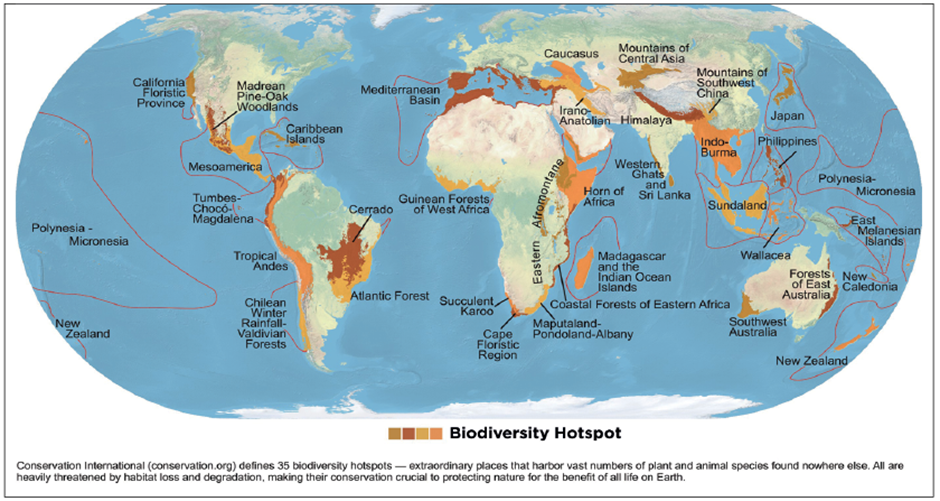
Source: Launchpad IAS — Biodiversity Hotspots · launchpadeducation.in
The Western Ghats-Sri Lanka and Indo-Burma hotspots mentioned in this question both meet the strict criteria: Western Ghats has over 4,000 endemic plant species with 83% habitat loss, while Indo-Burma contains 7,000+ endemic plants with 95% habitat destruction.
Trap: Vegetation density sounds scientific but dense forests don't guarantee endemic species
Trap: Ethno-botanical importance confuses cultural value with biological rarity
Trap: Climate adaptation seems logical but hotspots exist in Mediterranean, temperate climates too
Confusion: Species richness vs endemism — total species ≠ unique species found nowhere else
Memory aid: Hotspot = High ENdemism + High THreat (EN-TH-usiasm for conservation)
Endemism & Species Richness Concepts
Environment endemism species richness endemic species
Endemism vs Species Richness: Key Biodiversity Measures
Endemism = species found only in one specific location, nowhere else on Earth
Species richness = total number of different species in an area (native + non-native)
Endemic species are irreplaceable — if habitat is lost, they go extinct globally
Islands and isolated mountains show highest endemism due to geographic barriers
Endemism measures biological uniqueness while species richness measures total diversity. For conservation, endemic species are more critical because their loss means global extinction, not just local disappearance.
Endemism vs Species Richness Comparison
Measure | Definition | Conservation Value | Example | Why It Matters |
|---|---|---|---|---|
Endemism | Species found only here | Extremely high - irreplaceable | Nilgiri tahr (Western Ghats only) | Global extinction if habitat lost |
Species Richness | Total species count | High - overall diversity | Amazon has 40,000+ plant species | Ecosystem function and stability |
Native Richness | Indigenous species total | High - natural heritage | Sundarbans mangrove diversity | Original ecosystem integrity |
Introduced Species | Non-native additions | Variable - can be harmful | Lantana camara in India | May threaten native endemics |
Factors Driving High Endemism
Geographic isolation — islands, mountain ranges, isolated forests create speciation barriers
Stable climate refugia — areas that maintained conditions during ice ages allow species to evolve undisturbed
Habitat diversity — varied micro-climates within small areas promote adaptive radiation
Geological age — older landforms had more time for endemic species to evolve
Limited dispersal ability — plants and small animals more likely to become endemic than mobile species
Endemic Species Examples in India's Hotspots
Hotspot | Endemic Plant Example | Endemic Animal Example | Endemism Level | Threat Status |
|---|---|---|---|---|
Western Ghats | Strobilanthes (Kurinji flower) | Lion-tailed macaque | 36 endemic genera | Critically Endangered |
Indo-Burma | Begonia species complex | Hoolock gibbon | 7,000+ endemic plants | Endangered |
Himalayas | Rhododendron varieties | Red panda | 3,160 endemic plants | Vulnerable |
Sundaland | Pandanus palm species | Nicobar megapode | 15,000+ endemic plants | Near Threatened |
Trap: Endemic ≠ rare — some endemics are locally abundant but geographically restricted
Confusion: Native vs endemic — all endemics are native, but not all natives are endemic
Trick: High species richness doesn't guarantee high endemism — introduced species can inflate richness
Memory: Endemic = 'END' here — if this location ends, the species ends globally
Western Ghats-Sri Lanka & Indo-Burma Hotspots
Environment Western Ghats-Sri Lanka Indo-Burma
Western Ghats-Sri Lanka & Indo-Burma: India's Premier Hotspots
Western Ghats-Sri Lanka: 83% habitat loss, 4,000+ endemic plants, covers 1,600 km coastline
Indo-Burma: 95% habitat loss, 7,000+ endemic plants, spans 7 countries
Both hotspots face agriculture expansion and urbanization as primary threats
Western Ghats has 36 endemic genera — highest plant endemism in India
The Western Ghats-Sri Lanka and Indo-Burma hotspots represent two of the world's most threatened biodiversity regions. Both exceed the strict hotspot criteria and contain species found nowhere else on Earth.
Western Ghats-Sri Lanka vs Indo-Burma Comparison
Feature | Western Ghats-Sri Lanka | Indo-Burma | Significance |
|---|---|---|---|
Geographic Extent | Western India + Sri Lanka | Northeast India to Vietnam | Different biogeographic realms |
Area Coverage | 182,500 km² remaining | 100,000 km² remaining | Indo-Burma more fragmented |
Habitat Loss | 83% lost | 95% lost | Indo-Burma more critically threatened |
Endemic Plants | 4,000+ species | 7,000+ species | Both exceed 1,500 threshold |
Endemic Vertebrates | 325 species | 430+ species | High fauna endemism in both |
Main Threats | Coffee plantations, urbanization | Agriculture, logging, development | Human pressure primary factor |
Hotspot Geographic Coverage
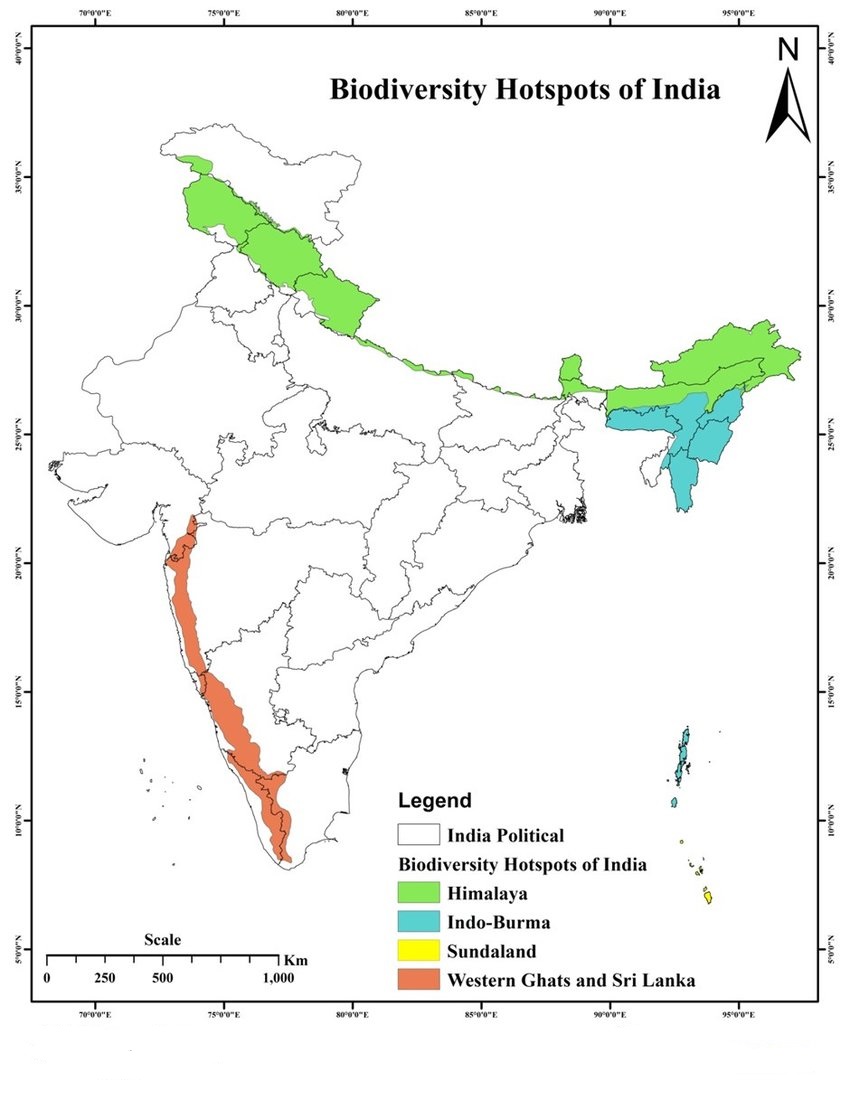
Source: Adda247 — Biodiversity Hotspots in India - Check IUCN Red List - · www.adda247.com
Key Endemic Species by Hotspot
# Endemic Species
## Western Ghats Flora
- Strobilanthes (Kurinji)
- Impatiens species
- Balsam varieties
- Cardamom wild relatives
## Western Ghats Fauna
- Lion-tailed macaque
- Nilgiri tahr
- Malabar gliding frog
- King cobra
## Indo-Burma Flora
- Begonia complexes
- Orchid varieties
- Bamboo species
- Dipterocarp trees
## Indo-Burma Fauna
- Hoolock gibbon
- Asian elephant
- Burmese python
- Clouded leopard
Conservation Challenges & Initiatives
Western Ghats: 37 UNESCO World Heritage Sites designated in 2012 covering 7,817 km²
Fragmentation pressure — both hotspots broken into small, isolated patches reducing population viability
Agricultural conversion — cardamom, coffee, tea plantations replace natural forests in Western Ghats
Cross-border coordination needed for Indo-Burma spanning India, Myanmar, Thailand, Laos, Vietnam, Cambodia
Indigenous communities — traditional practices often support conservation but face development pressure
Geography trap: Indo-Burma includes Northeast India but extends far beyond India's borders
Name confusion: Western Ghats-Sri Lanka is one combined hotspot, not two separate ones
Threat level: Indo-Burma has higher habitat loss (95%) than Western Ghats (83%)
Endemic count: Don't confuse total species with endemic species — endemism matters for hotspot status