With reference to the Indus river system, of the following four rivers, three of them pout into one of them which joins the Indus direct. Among the following, which one is such river that joins the Indus direct?
Contents18
- AChenab
- BJhelum
- CRavi
- DSutlej
Show answer
Answer: (D) Sutlej
This question is slightly tricky because the rivers merge in stages before finally entering the Indus.
Here is the sequence:
- Jhelum joins the Chenab.
- Ravi also joins the Chenab.
- Beas joins the Sutlej.
- Then the Chenab and Sutlej combine to form the Panjnad River.
The Panjnad finally joins the Indus near Mithankot in Pakistan.
In the conventional UPSC interpretation, among the given rivers, the Sutlej is treated as the river that directly joins the Indus system after receiving the waters of the others through the Panjnad network.
Therefore:
- Jhelum → joins Chenab
- Ravi → joins Chenab
- Chenab → joins Panjnad
- Sutlej → joins Panjnad/Indus system directly
Hence, the correct answer is (d) Sutlej.
The Indus Waters Treaty of 1960 allocates three eastern rivers (Ravi, Beas, Sutlej) to India and three western rivers (Indus, Jhelum, Chenab) to Pakistan, making the exact confluence patterns strategically important.
UPSC is testing whether students can trace the specific merger sequence: Jhelum and Ravi both flow into Chenab, while Beas flows into Sutlej, then Sutlej-Chenab combine as Panjnad before joining the Indus.
Indus River System & Tributaries
Geography Indus river system Chenab Jhelum Ravi Sutlej
Indus River System: Tributary Confluence Pattern & UPSC Traps
Chenab receives Jhelum and Ravi, then joins Sutlej to form Panjnad River
Panjnad River is the final confluence that joins Indus directly at Mithankot
Five rivers of Punjab: Jhelum, Chenab, Ravi, Beas, Sutlej (Panch = five, ab = water)
Beas flows into Sutlej, not directly into Indus
The Convergence Pattern
The Indus river system follows a two-stage confluence pattern where smaller tributaries first merge with larger ones, then these combined rivers form the Panjnad before joining the main Indus. This creates a hierarchical drainage system rather than direct parallel joining.
Tributary Confluence Sequence
River | Merges Into | Location | Final Destination |
|---|---|---|---|
Jhelum | Chenab | Trimmu | Via Panjnad to Indus |
Ravi | Chenab | Near Ahmadpur | Via Panjnad to Indus |
Beas | Sutlej | Harike | Via Panjnad to Indus |
Chenab | Sutlej (forms Panjnad) | Uch Sharif | Direct to Indus |
Panjnad | Indus | Mithankot | Main river |
How Rivers Join the Indus
%%{init: {"flowchart": {"wrappingWidth": 460}}}%%
flowchart TD
  s1["`**Stage 1: Tributary Mergers**
Jhelum → Chenab at Trimmu; Ravi → Chenab; Beas → Sutlej at Harike`"]
  s2["`**Stage 2: Major Confluence**
Chenab + Sutlej = **Panjnad River** at Uch Sharif`"]
  s3["`**Final Stage**
**Panjnad directly joins Indus** at Mithankot`"]
  s1 --> s2
  s2 --> s3
Indus Basin Map
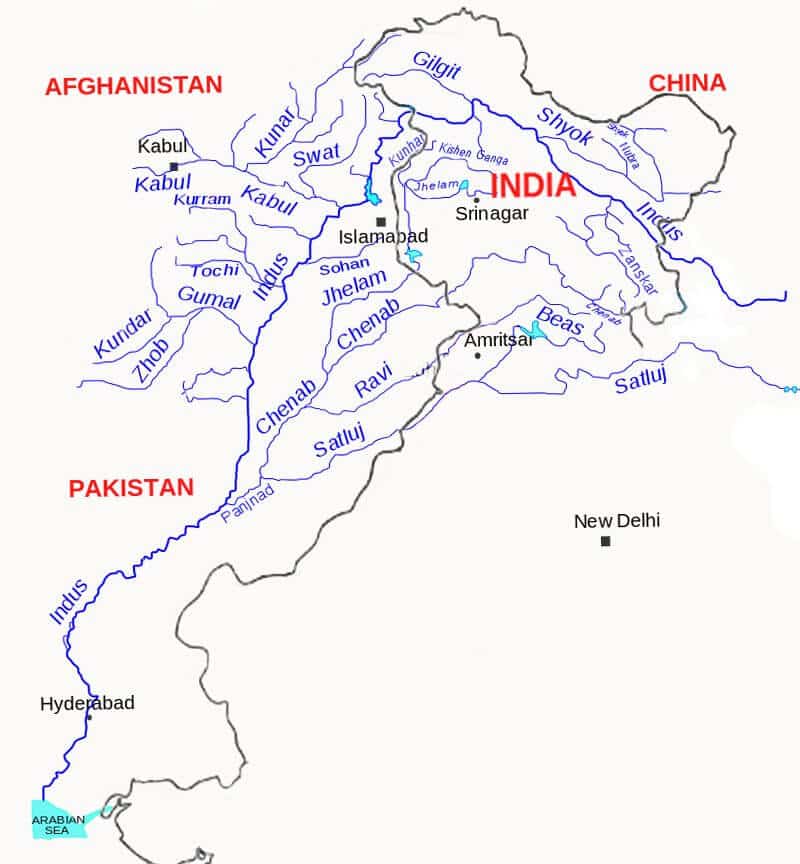
Source: LotusArise — Indus River System (and its tributaries) - UPSC · lotusarise.com
Question Logic
This question tests understanding that Chenab is the key collector river. Of the four options, Jhelum and Ravi both flow into Chenab, while Sutlej joins Chenab to form Panjnad. Only Chenab itself (via Panjnad) directly reaches the Indus, making it the river that "three others pour into."
Trap: Thinking Sutlej joins Indus directly - it forms Panjnad with Chenab first
Trap: Confusing Jhelum as the main collector - Chenab receives both Jhelum and Ravi
Memory aid: Chenab = Collector - it gathers maximum tributaries before joining Indus
Common error: Forgetting that Beas flows into Sutlej, not Chenab
Panjnad River Formation
Geography Panjnad
Panjnad River: The Final Confluence Before Indus
Panjnad = Chenab + Sutlej confluence at Uch Sharif
Panjnad joins Indus at Mithankot (Pakistan)
Name means 'Five Waters' representing all Punjab rivers
Geographic Significance
Panjnad River represents the final stage where all five Punjab rivers unite before joining the Indus. Formed at Uch Sharif in Pakistan, it carries the combined flow of the entire eastern Indus tributary system.
Key Geographic Facts
Formation point: Uch Sharif, Punjab (Pakistan) where Chenab meets Sutlej
Length: Approximately 80 km from formation to Indus confluence
Strategic importance: Controls water flow from entire Punjab plain
Etymology: Panch (five) + nad (river) = river of five waters
Panjnad Formation
Satellite or detailed map showing Panjnad river formation at Uch Sharif where Chenab and Sutlej rivers meet, and its course to Mithankot where it joins Indus
Panjnad at Uch Sharif - where the combined flow of all five Punjab rivers meets the Indus
Trap: Thinking individual rivers join Indus directly - only Panjnad makes the final connection
Location confusion: Panjnad forms in Pakistan, not India (post-Partition geography)
Name trap: Don't confuse with Panchnada or other similar river names in India
Punjab Doab Classification
Geography
Doabs of Punjab: Inter-River Regions in Indus System
Doab = land between two rivers (do = two, ab = water)
Five major doabs exist between the six rivers of Punjab region
Bari Doab (Ravi-Sutlej) contains Amritsar and Lahore
Doab Concept
A doab is the fertile alluvial tract between two rivers. Punjab's five rivers create distinct doab regions, each with unique agricultural and settlement patterns. These regions form the backbone of Punjab's agricultural economy.
Major Doabs of Punjab
Doab Name | Between Rivers | Key Cities | Agricultural Importance |
|---|---|---|---|
Sindh Sagar | Indus - Jhelum | Rawalpindi, Jhelum | Wheat, sugarcane |
Chaj | Jhelum - Chenab | Gujrat, Sialkot | Rice, wheat |
Rachna | Chenab - Ravi | Sheikhupura, Faisalabad | Cotton, wheat |
Bari | Ravi - Sutlej | Amritsar, Lahore | Wheat, rice |
Bist | Sutlej - Beas | Jalandhar, Ludhiana | Rice, sugarcane |
Punjab Doabs Map

Source: x.com — 📚Punjab Doabs 👉Sindh Sagar Doab The Sindh Sagar Doab lies ... · x.com
Sequence trap: Doabs are named west to east - Sindh Sagar (westernmost) to Bist (easternmost)
Boundary confusion: Bist Doab is between Sutlej-Beas, not Beas-Yamuna
Remember: More rivers = more doabs (6 rivers create 5 doab regions)
Indus Waters Treaty
World Affairs (International Relations)
Indus Waters Treaty 1960: India-Pakistan Water Sharing
Signed in 1960 between India and Pakistan with World Bank mediation
Eastern rivers (Sutlej, Beas, Ravi) allocated to India
Western rivers (Indus, Jhelum, Chenab) allocated to Pakistan
India can build run-of-river projects on western rivers with restrictions
Treaty Background
The Indus Waters Treaty was signed in 1960 to resolve water disputes after Partition. World Bank mediation helped allocate river usage rights between India and Pakistan based on geographic and usage patterns.
River Allocation Under Treaty
River | Allocated to | Usage Rights | Current Issues |
|---|---|---|---|
Indus | Pakistan | Full usage rights | Upper riparian concerns |
Jhelum | Pakistan | Full usage rights | Kishanganga dispute |
Chenab | Pakistan | Full usage rights | Ratle project issues |
Sutlej | India | Full usage rights | Implementation complete |
Beas | India | Full usage rights | Implementation complete |
Ravi | India | Full usage rights | Implementation complete |
Key Provisions & Disputes
Permanent Indus Commission: Joint body to resolve technical disputes
Arbitration mechanism: World Bank can mediate unresolved disputes
Run-of-river projects: India can build on western rivers without storage
Current tensions: Kishanganga and Ratle hydroelectric projects disputed
Treaty durability: Survived three wars but faces modern challenges
Geography trap: Eastern rivers to India, Western to Pakistan - opposite of country positions
Year confusion: Treaty signed in 1960, not 1947 or at Partition
Mediator: World Bank, not UN or any other international body
India's restriction: Can use western rivers but cannot store water significantly