Consider the following rivers: 1. Barak 2. Lohit 3. Subansiri Which of the above flows/flow through Arunachal Pradesh?
Contents14
- A1 only
- B2 and 3 only
- C1 and 3 only
- D1, 2 and 3
Show answer
Answer: (B) 2 and 3 only
Rivers flowing through Arunachal Pradesh:
Lohit — CORRECT: Flows through eastern Arunachal Pradesh; one of the major tributaries of the Brahmaputra. It enters India at Kibithu.
Subansiri — CORRECT: The largest tributary of Brahmaputra, flows through central Arunachal Pradesh. The controversial Subansiri Lower Hydroelectric Project is located at the Arunachal-Assam border.
Barak — WRONG: The Barak River flows through Manipur and southern Assam (Barak Valley), NOT through Arunachal Pradesh. It eventually flows into Bangladesh and becomes the Surma and Kushiyara rivers.
Memory: Arunachal's major rivers (west to east) = Kameng, Subansiri, Siang (main Brahmaputra), Dibang, Lohit. Barak is a separate river system altogether.
The Subansiri Lower Hydroelectric Project on the Arunachal-Assam border has been a major controversy for over a decade, making Subansiri river geographically important for UPSC.
The trap is including Barak river, which flows through Manipur and southern Assam but never enters Arunachal Pradesh - it belongs to a completely different river system.
Students must memorize the west-to-east sequence of major Arunachal rivers: Kameng, Subansiri, Siang, Dibang, Lohit - all Brahmaputra tributaries.
Rivers of Arunachal Pradesh
Geography Lohit Subansiri Arunachal Pradesh
Rivers of Arunachal Pradesh: Major Brahmaputra Tributaries
Lohit flows through eastern Arunachal Pradesh, enters India at Kibithu
Subansiri is the largest Brahmaputra tributary, flows through central Arunachal Pradesh
Barak does NOT flow through Arunachal Pradesh - it flows through Manipur and southern Assam
Major rivers flow west to east: Kameng, Subansiri, Siang, Dibang, Lohit
Overview
Arunachal Pradesh hosts several major Brahmaputra tributaries that originate from the Eastern Himalayas. These trans-Himalayan rivers flow northward into Tibet before re-entering India through Arunachal Pradesh.
Major Rivers Through Arunachal Pradesh
River | Region in Arunachal | Entry Point | Significance |
|---|---|---|---|
Lohit | Eastern Arunachal | Kibithu | Major Brahmaputra tributary |
Subansiri | Central Arunachal | Upper reaches | Largest Brahmaputra tributary |
Siang | Central Arunachal | Near Gelling | Main Brahmaputra stem |
Dibang | Eastern Arunachal | Anini district | Joins Siang to form Brahmaputra |
Kameng | Western Arunachal | Tawang region | Flows into Assam |
River Network Map
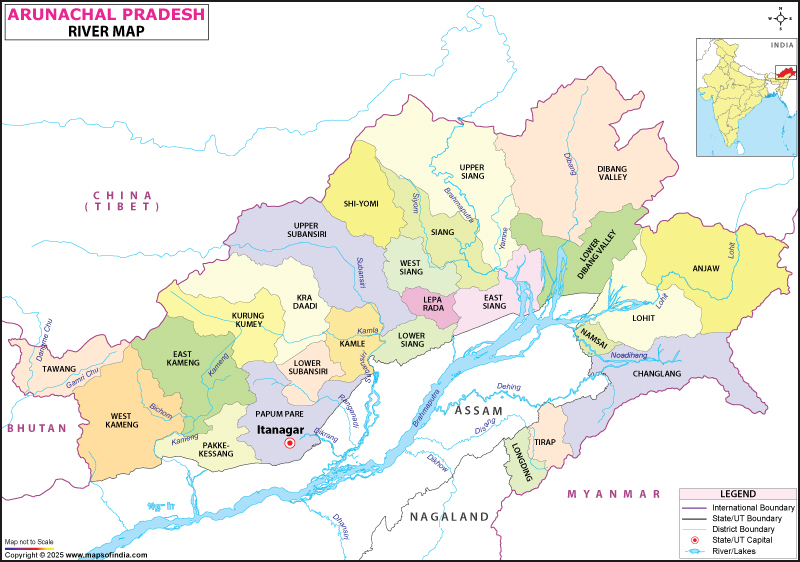
Source: India Map — Arunachal Pradesh River Map, Arunachal Pradesh Rivers · www.mapsofindia.com
Question Context
This question tested knowledge of which rivers actually flow through Arunachal Pradesh. Barak was the trap option - it flows through Manipur and southern Assam's Barak Valley, not Arunachal Pradesh.
Barak flows through Manipur and Assam, NOT Arunachal Pradesh - common confusion
Don't confuse Siang (main Brahmaputra) with Subansiri (largest tributary)
Lohit enters at Kibithu, not through central Arunachal like Subansiri
All major Arunachal rivers are Brahmaputra tributaries - Barak is a separate system
Barak River System
Geography Barak
Barak River System: Manipur-Assam-Bangladesh Flow
Barak originates in Manipur hills, flows through southern Assam
Forms Surma and Kushiyara rivers after entering Bangladesh
Does NOT flow through Arunachal Pradesh - separate from Brahmaputra system
River Course
The Barak River originates in the Manipur hills and flows northward through Barak Valley in southern Assam. Unlike Arunachal's rivers, it belongs to a completely separate drainage system from the Brahmaputra.
Barak Flow Sequence
%%{init: {"flowchart": {"wrappingWidth": 460}}}%%
flowchart TD
  s1["`**Originates**
**Manipur hills** - southern region`"]
  s2["`**Flows North**
Through **Cachar district**, southern Assam`"]
  s3["`**Enters Bangladesh**
Near **Bhanga** in Faridpur`"]
  s4["`**Bifurcates**
Forms **Surma** and **Kushiyara** rivers`"]
  s5["`**Final Destination**
Bay of Bengal via **Meghna River**`"]
  s1 --> s2
  s2 --> s3
  s3 --> s4
  s4 --> s5
Barak vs Brahmaputra System
Aspect | Barak System | Brahmaputra System |
|---|---|---|
States Covered | Manipur, Assam (south) | Arunachal Pradesh, Assam (north) |
Origin Region | Manipur hills | Tibet (Angsi Glacier) |
Major Tributaries | Sonai, Rukni, Katakhal | Lohit, Subansiri, Siang |
International Flow | Bangladesh (Surma-Kushiyara) | Bangladesh (Jamuna) |
Valley Name | Barak Valley (Assam) | Brahmaputra Valley (Assam) |
Barak and Brahmaputra are completely separate river systems in Northeast India
Barak flows through southern Assam (Barak Valley), not northern Assam like Brahmaputra
In Bangladesh: Barak becomes Surma-Kushiyara, Brahmaputra becomes Jamuna
Brahmaputra Tributary System
Geography Subansiri Lohit
Brahmaputra Tributary System: Trans-Himalayan Network
Subansiri is the largest tributary by volume, controversial dam project site
Lohit flows through eastern Arunachal, enters at Kibithu from China
Most tributaries are trans-Himalayan - originate in Tibet, flow through India
Left bank tributaries are longer and more significant than right bank ones
System Overview
The Brahmaputra receives major tributaries from both the Himalayas (left bank) and Meghalaya Plateau (right bank). The left bank tributaries are trans-Himalayan rivers that originate in Tibet.
Brahmaputra Tributary Classification
# Brahmaputra Tributaries
## Left Bank (Himalayan)
- **Lohit**
- **Dibang**
- **Subansiri**
- **Kameng**
- **Manas**
- **Sankosh**
## Right Bank (Plateau)
- **Burhi Dihing**
- **Dhansiri**
- **Kalang**
- **Kapili**
## Special Cases
- **Siang** (main stem)
- **Teesta** (joins in Bangladesh)
Key Tributary Details
Tributary | Origin | Length (km) | Special Feature |
|---|---|---|---|
Subansiri | Tibet | ~442 | Largest by volume, Lower Subansiri Dam |
Lohit | Tibet | ~200 | Enters at Kibithu, eastern Arunachal |
Siang | Tibet (Yarlung Tsangpo) | ~294 | Main Brahmaputra stem in India |
Dibang | Tibet | ~180 | Joins Siang to form Brahmaputra proper |
Manas | Bhutan Hills | ~376 | UNESCO Biosphere Reserve |
Hydroelectric Significance
Subansiri Lower project (2000 MW) - controversial due to earthquake concerns
Upper Siang project proposed - potential impact on downstream Bangladesh
Dibang multipurpose project - India's largest planned hydroelectric project
Most projects face environmental and China upstream concerns
Subansiri is the largest tributary by volume, not length
Siang is the main Brahmaputra stem, not technically a 'tributary'
Trans-Himalayan means originating in Tibet, flowing through Himalayas into India
Left bank tributaries are from Himalayas, right bank from Meghalaya Plateau