Consider the following statements: 1. The winds which blow between 30°N and 60°S latitudes throughout the year are known as westerlies. 2. The moist air masses that cause winter rains in the North-Western region of India are part of westerlies. Which of the statements given above is/are correct?
Contents17
- A1 only
- B2 only
- CBoth 1 and 2
- DNeither 1 nor 2
Show answer
Answer: (B) 2 only
As per NCERT Class 11 (India: Physical Environment, pg 35-36):
Statement 1 is INCORRECT — read the latitudes carefully.
The statement says westerlies blow between '30°N and 60°S.'
This would mean they blow from the Northern Hemisphere's 30° all the way across the equator to the Southern Hemisphere's 60° — which makes no sense.
Westerlies are prevailing winds that blow from the west to the east in the MIDDLE LATITUDES of BOTH hemispheres, i.e., between 30°N and 60°N in the Northern Hemisphere AND between 30°S and 60°S in the Southern Hemisphere.
The statement incorrectly mixes latitudes from different hemispheres (30°N to 60°S), making it wrong.
This is a classic UPSC trick of changing small details in otherwise correct statements.
Statement 2 is CORRECT:
The winter rains in northwestern India (Punjab, Haryana, Rajasthan, western UP) are caused by 'Western Disturbances.'
These are extratropical storm systems that originate over the Mediterranean Sea and travel eastward with the westerly winds.
When they reach northwestern India, they bring sudden winter rainfall, which is crucial for the Rabi crop (especially wheat).
These Western Disturbances are indeed part of the westerly wind system.
They provide non-monsoonal precipitation to the region.
Answer: 2 only.
Key concepts:
- Westerlies = 30°-60° in EACH hemisphere.
- Western Disturbances = extratropical storms carried by westerlies = winter rain in NW India.
Western Disturbances bring the only significant winter rainfall to northwest India, making them crucial for wheat and other Rabi crops in Punjab, Haryana, and western Uttar Pradesh.
UPSC tests careful reading by mixing latitudes from different hemispheres in the first statement - westerlies blow 30°-60° in each hemisphere separately, not from 30°N to 60°S across the equator.
Westerlies Wind System
Geography westerlies 30°N and 60°S
Westerlies: Location, Characteristics & UPSC Traps
Westerlies blow between 30°-60° in BOTH hemispheres separately
They blow from west to east in the middle latitudes
Carry Western Disturbances to northwestern India
Part of the three-cell circulation model (Hadley-Ferrel-Polar)
What Are Westerlies
Westerlies are prevailing winds that blow from west to east in the middle latitudes of both hemispheres. They form due to the Coriolis effect deflecting air moving from high-pressure subtropical zones toward low-pressure temperate zones.
Westerlies by Hemisphere
Hemisphere | Latitude Range | Direction | Key Characteristics |
|---|---|---|---|
Northern | 30°N to 60°N | Southwest to Northeast | Carries Western Disturbances to Europe, Asia |
Southern | 30°S to 60°S | Northwest to Southeast | Stronger than Northern, called Roaring Forties |
Question Connection
Statement 1 was a trap because it mixed latitudes from different hemispheres (30°N and 60°S). UPSC tests whether students understand that westerlies operate in BOTH hemispheres within their respective latitude bands, not across hemispheres.
Trap: 30°N to 60°S mixes Northern and Southern hemispheres - westerlies don't cross the equator
Trap: Confusing westerlies with trade winds (0°-30°) or polar easterlies (60°-90°)
Remember: Roaring Forties (40°S-50°S) are part of Southern Hemisphere westerlies
Don't mix: Western Disturbances (carried BY westerlies) vs westerlies themselves
Western Disturbances
Geography Western Disturbances winter rains North-Western region
Western Disturbances: Origin, Mechanism & Impact on India
Extratropical cyclones originating over Mediterranean Sea
Bring winter rainfall to northwestern India (Dec-Feb)
Carried by westerly winds and subtropical jet stream
Crucial for Rabi crops like wheat in Punjab, Haryana
Cause sudden temperature drops and hailstorms
Formation & Movement
Western Disturbances are low-pressure systems that form over the Mediterranean Sea and eastern Atlantic. They travel eastward with the westerly winds and subtropical jet stream, crossing Iran, Afghanistan, and Pakistan before reaching India.
Western Disturbance Pathway
%%{init: {"flowchart": {"wrappingWidth": 460}}}%%
flowchart TD
  s1["`**Origin**
Form over **Mediterranean Sea** as extratropical cyclones`"]
  s2["`**Transport**
Carried eastward by **westerly winds** and jet streams`"]
  s3["`**Entry**
Enter India through **northwestern borders** (J&K, Punjab)`"]
  s4["`**Precipitation**
Cause **winter rainfall** when they encounter barriers like Western Ghats`"]
  s5["`**Impact**
Move further east, weakening over central India`"]
  s1 --> s2
  s2 --> s3
  s3 --> s4
  s4 --> s5
Movement Pattern

Source: Drishti IAS — Western Disturbances · www.drishtiias.com
Regional Impact in India
Region | Rainfall Period | Importance | Crops Benefited |
|---|---|---|---|
Jammu & Kashmir | Dec-Mar | Heavy snowfall in mountains | Winter wheat, barley |
Punjab, Haryana | Dec-Feb | 20-25% annual rainfall | Wheat (main Rabi crop) |
Western UP, Rajasthan | Jan-Feb | 10-15% annual rainfall | Mustard, gram, wheat |
Western Himalayas | Dec-Mar | Snow accumulation | Glacial recharge, river flow |
Question Connection
Statement 2 was correct because Western Disturbances ARE part of the westerly wind system - they are carried by westerlies and bring the crucial winter rains that northwestern India depends on for Rabi agriculture.
Don't confuse: Western Disturbances (weather systems) vs westerlies (wind patterns that carry them)
Remember: These cause winter rainfall, not monsoon rains
Trap: Thinking Western Disturbances affect all of India - they mainly impact NW regions
Key distinction: Non-monsoonal precipitation vs SW monsoon rains
Planetary Wind Systems
Geography
Global Wind Systems: Trade Winds, Westerlies & Polar Easterlies
Three main wind systems based on latitude: Trade winds, Westerlies, Polar easterlies
Formed by pressure differences and Coriolis effect
Trade winds: 0°-30°, Westerlies: 30°-60°, Polar easterlies: 60°-90°
Global Wind Systems Comparison
Wind System | Latitude Range | Direction | Characteristics | UPSC Relevance |
|---|---|---|---|---|
Trade Winds | 0° to 30° | NE in NH, SE in SH | Blow toward equator, very consistent | Drive monsoons, ITCZ movement |
Westerlies | 30° to 60° | SW to NE in NH | Variable, carry weather systems | Western Disturbances, temperate cyclones |
Polar Easterlies | 60° to 90° | NE in NH, SE in SH | Cold, dry winds from poles | Arctic/Antarctic weather patterns |
Three-Cell Circulation Model
# Global Circulation
## Hadley Cell (0°-30°)
- Rising air at equator
- Trade winds
- Descending at 30°
- Subtropical high pressure
## Ferrel Cell (30°-60°)
- Westerly winds
- Rising at 60°
- Descending at 30°
- Carries weather disturbances
## Polar Cell (60°-90°)
- Cold polar easterlies
- Descending at poles
- Rising at 60°
- Polar high pressureDon't mix latitude ranges: Trade winds (0°-30°) vs Westerlies (30°-60°)
Remember: Wind direction is where it comes FROM, not where it goes
Coriolis effect deflects winds right in NH, left in SH
UPSC loves testing boundary latitudes: 30° and 60° are transition zones
India Winter Rainfall Patterns
Geography winter rains
India's Winter Rainfall: Sources & Regional Patterns
Two main sources: Western Disturbances (NW) and NE Monsoon (SE)
Western Disturbances bring winter rain to Punjab, Haryana, J&K
Northeast Monsoon brings winter rain to Tamil Nadu, coastal Andhra
Critical for Rabi crops and reservoir recharge
Why Winter Rainfall Matters
India receives winter rainfall from two distinct systems that affect different regions. This non-monsoonal precipitation is crucial for Rabi agriculture and helps maintain year-round water supply in key agricultural zones.
Winter Rainfall Sources in India
Source | Regions Affected | Peak Period | Origin | Rainfall Contribution |
|---|---|---|---|---|
Western Disturbances | J&K, Punjab, Haryana, W UP | Dec-Feb | Mediterranean Sea | 20-25% of annual rainfall |
Northeast Monsoon | Tamil Nadu, S Andhra, S Karnataka | Oct-Dec | Bay of Bengal | 50-60% of annual rainfall |
Cyclonic Systems | East coast (Odisha to Tamil Nadu) | Oct-Jan | Bay of Bengal | Variable, can be very high |
Winter Rainfall Distribution
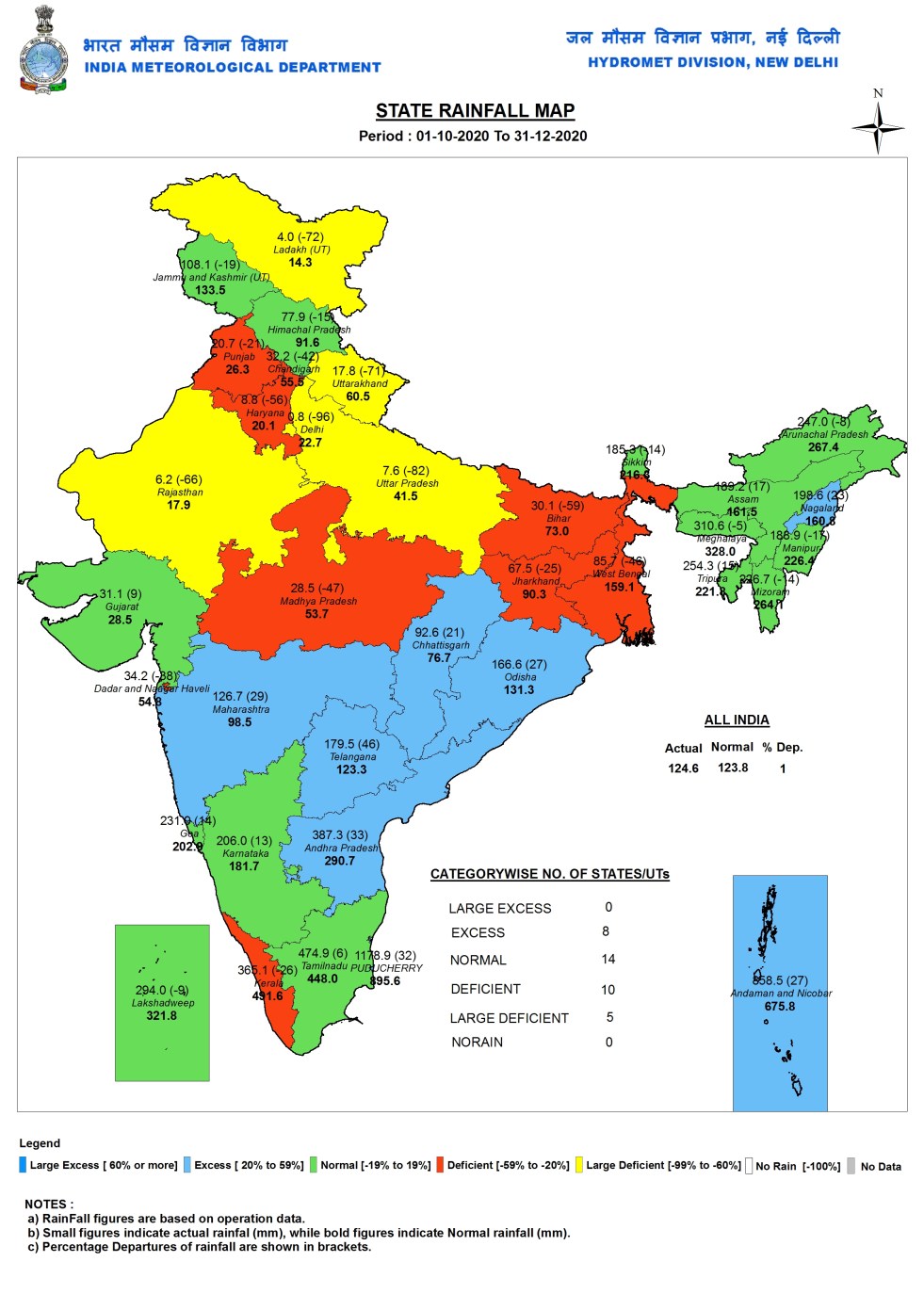
Source: SANDRP — Post Monsoon 2020: State wise Rainfall – SANDRP · sandrp.in
Don't confuse: Western Disturbances affect NW India, NE Monsoon affects SE India
Remember: Chennai gets most rain in winter (NE monsoon), not summer
Tamil Nadu is the only state with winter-dominant rainfall pattern
Coromandel Coast = winter rains, Malabar Coast = summer monsoon rains