Consider the following statements: Statement-I: The soil in tropical rain forests is rich in nutrients. Statement-II: The high temperature and moisture of tropical rain forests cause dead organic matter in the soil to decompose quickly. Which one of the following is correct in respect of the above statements?
Contents14
- ABoth Statement-I and Statement-II are correct and Statement-II is the correct explanation for Statement-I
- BBoth Statement-I and Statement-II are correct and Statement-II is not the correct explanation for Statement-I
- CStatement-I is correct but Statement-II is incorrect
- DStatement-I is incorrect but Statement-II is correct
Show answer
Answer: (D) Statement-I is incorrect but Statement-II is correct
Statement-I is wrong:
Tropical rainforest soil is actually nutrient-poor because nutrients are locked in the living vegetation and decaying matter is recycled so quickly that few nutrients reach the soil.
Statement-II is correct:
The high temperature and moisture in rainforests cause rapid decomposition by bacteria, fungi, and termites.
So Statement-I is wrong but Statement-II is correct.
Answer is (d).
Tropical rainforest soils are nutrient-poor because rapid decomposition means nutrients get absorbed by plants immediately rather than accumulating in the soil.
This question tests the counterintuitive fact that lush vegetation does not mean rich soil - in rainforests, nutrients cycle through living plants, not soil storage.
Tropical Rainforest Soil Characteristics
Geography tropical rain forests soil nutrients
Tropical Rainforest Soils: Why Lush Forests Have Poor Soils
Tropical rainforest soils are nutrient-poor despite lush vegetation above
Nutrients are stored in living vegetation, not soil
Rapid decomposition recycles nutrients before they accumulate in soil
Heavy rainfall causes leaching of minerals from topsoil
Tropical rainforests create a misleading impression - the world's most productive ecosystems grow on surprisingly nutrient-poor soils. This paradox occurs because the forest's nutrients are locked in the living biomass, not stored in the ground.
Soil vs Vegetation Nutrients
Component | Nutrient Content | Role in Forest |
|---|---|---|
Topsoil | Very low | Thin layer, nutrients quickly absorbed |
Living vegetation | Very high | Stores 90% of ecosystem nutrients |
Leaf litter | Rapidly recycled | Decomposes within weeks |
Root mat | Dense surface layer | Captures nutrients before soil absorption |
Why Soils Remain Poor
Rapid uptake: Tree roots and mycorrhizal fungi absorb nutrients immediately as organic matter decomposes
Heavy leaching: Intense rainfall (2000-4000mm annually) washes minerals deep below root zone
High temperatures: Accelerate chemical weathering, breaking down parent rock but also removing nutrients
Thin topsoil: Only 2-5cm deep in many areas due to constant decomposition and uptake cycle
Trap: Lush vegetation suggests rich soil - but nutrients are in plants, not ground
Confusion: High rainfall means fertile soil - actually causes nutrient leaching
Statement analysis: Statement-I (soil rich in nutrients) contradicts the rapid cycling described in Statement-II
Decomposition in Tropical Rainforests
Geography decompose quickly high temperature moisture
Rapid Decomposition in Tropical Rainforests
High temperature + moisture create ideal conditions for rapid decomposition
Leaf litter decomposes in weeks to months vs years in temperate forests
Bacteria, fungi, termites are primary decomposers
Tropical rainforests operate as rapid recycling systems where dead organic matter decomposes within weeks. The constant warmth (25-30°C) and high humidity (80-90%) create perfect conditions for decomposer organisms.
Decomposition Process
%%{init: {"flowchart": {"wrappingWidth": 460}}}%%
flowchart TD
  s1["`**Leaf/branch falls**
Fresh organic matter reaches forest floor`"]
  s2["`**Moisture absorption**
High humidity keeps matter constantly wet`"]
  s3["`**Bacterial invasion**
Warm temperatures accelerate bacterial growth`"]
  s4["`**Fungal breakdown**
Fungi decompose complex organic compounds`"]
  s5["`**Termite processing**
Insects physically break down larger pieces`"]
  s6["`**Nutrient release**
Minerals freed for immediate plant uptake`"]
  s1 --> s2
  s2 --> s3
  s3 --> s4
  s4 --> s5
  s5 --> s6
Decomposition Rate Comparison
Forest Type | Temperature | Moisture | Decomposition Time |
|---|---|---|---|
Tropical Rainforest | 25-30°C | 80-90% humidity | 2-8 weeks |
Temperate Forest | 5-20°C | Variable | 6 months - 2 years |
Boreal Forest | Below 10°C | Low | 2-7 years |
Desert | Variable | Very low | Very slow/minimal |
Key connection: Rapid decomposition explains WHY soils stay poor - nutrients don't accumulate
Statement-II accuracy: High temperature + moisture → rapid decomposition is scientifically correct
Nutrient Cycling in Rainforest Ecosystems
Geography
Closed Nutrient Cycling: Nature's Perfect Recycling System
Rainforests operate a closed nutrient cycle with minimal soil storage
90% of nutrients stored in living biomass, not soil
Mycorrhizal fungi form networks that capture nutrients instantly
Tropical rainforests demonstrate perfect recycling - nutrients move rapidly from dead matter back into living plants without accumulating in soil. This closed-loop system explains the paradox of rich forests on poor soils.
Rainforest Nutrient Cycle
# Nutrient Cycling
## Storage
- Living trees (80%)
- Root biomass (10%)
- Soil organic matter (5%)
- Mineral soil (5%)
## Capture Mechanisms
- Mycorrhizal networks
- Dense root mats
- Epiphyte interception
- Rapid uptake
## Loss Pathways
- Leaching by rainfall
- Gaseous emissions
- Erosion
- Human clearance
Ecosystem Adaptations
Buttress roots: Spread wide to capture nutrients from thin topsoil layer
Mycorrhizal partnerships: Fungi extend root systems 100x, absorb nutrients immediately
Rapid root growth: New roots grow within days to capture decomposing matter
Canopy interception: Epiphytes capture nutrients from rainfall before reaching ground
Visual: Nutrient Distribution
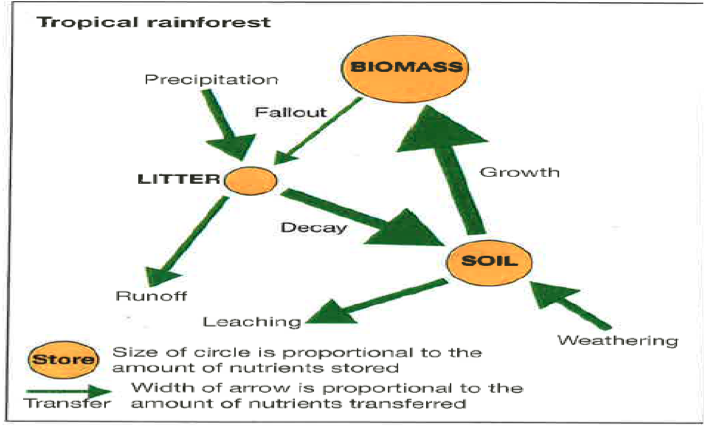
Source: Study Rocket — Nutrient Cycling – GCSE Geography B Edexcel Revision – Study Rocket · studyrocket.co.uk
UPSC Statement Analysis Strategy
Indian Polity Statement-I Statement-II
Mastering UPSC Statement-Based Questions
Verify each statement independently before checking relationships
Cause-effect logic must be scientifically accurate, not just plausible
One wrong statement eliminates options A, B, C automatically
Statement Analysis Method
%%{init: {"flowchart": {"wrappingWidth": 460}}}%%
flowchart TD
  s1["`**Check Statement-I**
Is this factually correct? Use domain knowledge`"]
  s2["`**Check Statement-II**
Is this factually correct? Independent verification`"]
  s3["`**Eliminate options**
Wrong statements eliminate 2-3 options immediately`"]
  s4["`**Check explanation link**
Does Statement-II actually explain Statement-I?`"]
  s5["`**Select answer**
Match your analysis to remaining options`"]
  s1 --> s2
  s2 --> s3
  s3 --> s4
  s4 --> s5
Option Elimination Strategy
If Statement-I is | If Statement-II is | Possible Answers |
|---|---|---|
Correct | Correct | A or B only |
Correct | Wrong | C only |
Wrong | Correct | D only |
Wrong | Wrong | No standard option (rare) |
This Question Analysis
Statement-I verification: "Rich nutrients" contradicts established rainforest soil science - WRONG
Statement-II verification: High temperature + moisture → rapid decomposition is correct mechanism - RIGHT
Relationship check: Even if both were right, Statement-II explains nutrient depletion, not enrichment
Answer logic: Statement-I wrong + Statement-II right = Option D
Trap: Assuming lush forest = rich soil without checking scientific facts
Logic trap: Statement-II sounds like it supports Statement-I but actually contradicts it
Option trap: Don't check explanation relationship if one statement is clearly wrong