Which of the following statements regarding laterite soils of India are correct? 1. They are generally red in colour. 2. They are rich in nitrogen and potash. 3. They are well-developed in Rajasthan and UP. 4. Tapioca and cashew nuts grow well on these soils. Select the correct answer using the codes given below:
Contents14
- A1, 2 and 3
- B2, 3 and 4
- C1 and 4
- D2 and 3 only
Show answer
Answer: (C) 1 and 4
Statement 1 is correct — laterite soils are generally red in colour due to the presence of iron oxide.
Statement 2 is wrong — laterite soils are actually poor in nitrogen and phosphate (not rich), because heavy rainfall leaches away these nutrients.
Statement 3 is wrong — laterite soils are NOT well-developed in Rajasthan and UP.
They are found mainly in high-rainfall areas like Tamil Nadu, Andhra Pradesh, Kerala, Karnataka, and parts of the Western Ghats.
Statement 4 is correct — red laterite soils in states like Kerala are well-suited for tree crops like tapioca (cassava) and cashew nuts.
So only statements 1 and 4 are correct.
Laterite soils cover about 10% of India's land area and are the main agricultural soils in Kerala, coastal Karnataka, and parts of Tamil Nadu where major cash crops like cashew and spices are grown.
The key trap is confusing laterite distribution - they form only in high rainfall areas through leaching, not in dry regions like Rajasthan where rainfall is insufficient for laterite formation.
UPSC is testing whether students can connect soil formation processes (leaching in high rainfall) with geographic distribution and agricultural suitability.
Laterite Soils Characteristics
Geography laterite soils red in colour nitrogen and potash
Laterite Soils: Formation, Properties & UPSC Facts
Red colour due to iron oxide presence
Poor in nitrogen and potash due to leaching
Found in high rainfall areas (150+ cm annually)
Suitable for tree crops like cashew, tapioca, coconut
Laterite soils form in tropical regions with heavy rainfall and high temperatures through intense leaching. The name comes from Latin 'later' meaning brick, as these soils harden when exposed to air.
Key Properties
Property | Characteristic | Reason |
|---|---|---|
Colour | Red to reddish-brown | High iron oxide content |
Texture | Clayey with good drainage | Removal of silica by leaching |
Fertility | Low in NPK (nitrogen, phosphorus, potash) | Heavy rainfall leaches nutrients |
pH | Acidic (pH 5.0-6.5) | Loss of basic minerals |
Humus | Low organic matter | Rapid decomposition in hot climate |
Formation Process
Intense chemical weathering in hot, wet tropical climate
Heavy leaching removes silica, lime, and other soluble minerals
Iron and aluminum oxides concentrate and give red colour
Alternating wet-dry seasons cause hardening into laterite crusts
Question Context
This question tested core properties of laterite soils. Statement 1 (red colour) and Statement 4 (suitable for tapioca/cashew) were correct, while Statement 2 falsely claimed nutrient richness and Statement 3 placed them in wrong locations.
Trap: Don't confuse laterite soils with red soils — both are red but laterites are more nutrient-poor
Trap: Laterites are poor in nitrogen and potash, not rich — heavy rainfall leaches nutrients away
Trap: Remember laterites need high rainfall, so they're NOT in arid Rajasthan
Laterite Soils Distribution in India
Geography Rajasthan and UP well-developed
Laterite Soils Distribution: High Rainfall Regions of India
Found in areas with 150+ cm annual rainfall
Tamil Nadu, Kerala, Karnataka are major areas
NOT found in arid Rajasthan or semi-arid UP
Western Ghats and Eastern Ghats have extensive laterites
Laterite soils develop only in regions with high rainfall (above 150 cm) and high temperatures. They require intense leaching, which happens in tropical wet climates.
Major Laterite Regions
State/Region | Specific Areas | Rainfall (cm) | Key Crops |
|---|---|---|---|
Tamil Nadu | Western districts, Nilgiris | 150-250 | Cashew, tapioca |
Kerala | Coastal plains, midlands | 250-300 | Coconut, cashew, rubber |
Karnataka | Coastal belt, Western Ghats | 200-300 | Cashew, spices |
Andhra Pradesh | Eastern Ghats region | 100-150 | Groundnut, tapioca |
Goa | Entire state | 250-300 | Cashew, rice |
Odisha | Plateau regions | 150-200 | Rice, cashew |
Distribution Map
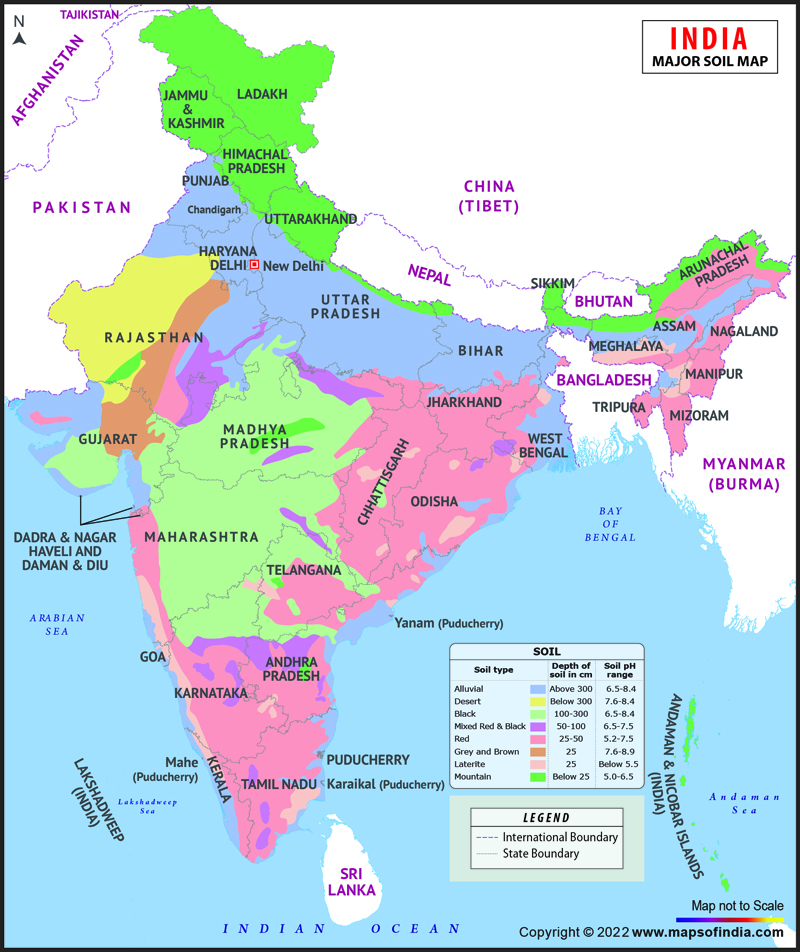
Source: India Map — Soil Map of India | Define Types of Soils in India · www.mapsofindia.com
Why Not in Rajasthan/UP
Rajasthan: Arid climate with less than 50 cm rainfall — insufficient for leaching
UP: Semi-arid to sub-humid with 50-100 cm rainfall — develops alluvial soils instead
Temperature alone isn't enough — heavy rainfall is essential for laterite formation
These states have different soil types: desert soils (Rajasthan), alluvial soils (UP)
Trap: Don't place laterites in low-rainfall states like Rajasthan, Punjab, Haryana
Trap: Remember Western Ghats = high rainfall = laterites, not Aravalli = low rainfall
Trap: UP has alluvial soils from Ganga, not laterites despite being hot
Crops Suitable for Laterite Soils
Geography tapioca cashew nuts
Crops on Laterite Soils: Tree Crops & Plantation Agriculture
Tree crops perform better than annual crops
Cashew and tapioca are ideal for laterite soils
Deep roots help trees access nutrients below leached topsoil
Rice cultivation possible with proper water management
Despite being nutrient-poor, laterite soils support specific crops that can tolerate acidic conditions and low fertility. Tree crops with deep roots perform better than shallow-rooted annual crops.
Suitable Crops
Crop Type | Examples | Why Suitable | Major Growing States |
|---|---|---|---|
Tree Crops | Cashew, coconut, arecanut | Deep roots access subsoil nutrients | Kerala, Karnataka, Goa |
Tuber Crops | Tapioca (cassava), sweet potato | Tolerates poor soil, drought-resistant | Kerala, Tamil Nadu |
Plantation Crops | Rubber, tea, coffee | Adapted to acidic soils | Kerala, Karnataka |
Spices | Pepper, cardamom, ginger | Thrives in well-drained acidic soil | Kerala, Karnataka |
Cereals | Rice (with fertilization) | Needs heavy inputs and irrigation | Goa, coastal Karnataka |
Why These Crops Work
Deep root systems of trees tap nutrients from deeper soil layers
Drought tolerance suits well-drained laterite soils
Acid tolerance essential as laterites have pH 5.0-6.5
Perennial crops don't need annual soil preparation like cereals
Good drainage prevents waterlogging that tree crops dislike
Trap: Remember tapioca and cashew grow well on laterites despite poor fertility
Trap: Don't assume laterite soils are completely barren — tree crops thrive
Trap: Rice can grow on laterites with proper inputs, but it's not the natural choice
Major Indian Soil Types Comparison
Geography
Indian Soil Types: Classification & Key Differences
Alluvial soils cover 40% of India — most fertile
Black soils ideal for cotton — found in Deccan
Red soils widespread in peninsular India
Laterite soils in high-rainfall tropical areas
Desert and mountain soils in specific terrains
Soil Types Comparison
Soil Type | Colour | Fertility | Best Crops | Major Regions |
|---|---|---|---|---|
Alluvial | Grey to brown | Highly fertile | Rice, wheat, sugarcane | Ganga-Brahmaputra plains |
Black (Regur) | Black | Very fertile | Cotton, jowar, wheat | Maharashtra, Gujarat, MP |
Red | Red to yellow | Moderately fertile | Rice, ragi, groundnut | Tamil Nadu, Karnataka, AP |
Laterite | Red to reddish-brown | Poor fertility | Cashew, tapioca, coconut | Kerala, coastal Karnataka |
Desert | Sandy yellow | Very poor | Bajra, drought-resistant crops | Rajasthan, Haryana |
Mountain | Variable | Varies | Tea, fruits, forest crops | Himalayas, Western Ghats |
Formation Basis
# Indian Soil Classification
## **By Origin**
- Transported (alluvial)
- Residual (red, laterite)
- Organic (peat, forest)
## **By Climate**
- Arid (desert)
- Semi-arid (red)
- Humid (laterite)
- Cold (mountain)
## **By Parent Rock**
- Basalt → Black soils
- Granite/Gneiss → Red soils
- Sandstone → Sandy soilsTrap: Don't confuse red soils with laterite soils — both red but different fertility
Trap: Black soils are for cotton, not rice (that's alluvial soils)
Trap: Laterite ≠ desert soils — laterites need high rainfall, deserts have low rainfall