If you travel through the Himalayas, you are likely to see which of the following plants naturally growing there? 1. Oak 2. Rhododendron 3. Sandalwood Select the correct answer using the code given below.
Contents18
- A1 and 2 only
- B3 only
- C1 and 3 only
- D1, 2 and 3
Show answer
Answer: (A) 1 and 2 only
Correct Answer: A (1 and 2 only)
1. Oak (Correct)
- The Environment: Oak trees thrive in temperate broadleaf forests.
- Himalayan Presence: They are highly characteristic of the middle altitudes of the Himalayas (between 1,500 to 3,000 meters), forming vast natural green canopies.
2. Rhododendron (Correct)
- The Environment: Rhododendrons prefer cool, moist, montane climates.
- Himalayan Presence: They are iconic to the Himalayan region, ranging from large trees in the lower ranges to dwarf shrubs at higher alpine altitudes. Their vibrant pink and red spring blooms dominate the mountain landscapes.
3. Sandalwood (Incorrect)
- The Environment: Sandalwood (Chandan) is a tropical dry deciduous tree species.
- The Reality: It requires a warm climate with distinct wet and dry seasons. It grows natively in Southern India—predominantly across the Western Ghats, Karnataka, and Tamil Nadu. It does not naturally grow in the cold, high-altitude alpine or temperate climate of the Himalayas.
Geographic Breakdown
| Plant Species | Climatic Zone | Key Indian Habitats |
|---|---|---|
| Oak / Rhododendron | Montane Temperate | Himalayas (Middle & High altitudes) |
| Sandalwood | Tropical Deciduous | South India (Deccan Plateau & Western Ghats) |
The Simple Elimination Trap
- Spot the Geographical Outlier: Sandalwood is universally famous as a product of South Indian forests (think Veerappan or Karnataka's soap industry).
- Eliminate Options: Realizing that a tropical South Indian tree like Sandalwood (Statement 3) cannot naturally grow in the freezing Himalayas immediately lets you cross out options B, C, and D. This leaves you with A (1 and 2 only) as the only logical answer.
The Himalayas have distinct vegetation zones from tropical foothills to alpine peaks, with sandalwood growing in the moist deciduous foothill forests alongside teak and sal.
Most students wrongly associate sandalwood only with South India's dry deciduous forests, missing that it also grows in Himalayan foothills receiving 100-200 cm rainfall.
UPSC is testing whether students understand altitudinal vegetation zonation rather than just memorizing which plants grow in which states.
Himalayan Vegetation Zones
Geography Himalayas Oak Rhododendron
Himalayan Vegetation Zones: Altitudinal Distribution & Key Species
Himalayas show altitudinal zonation from tropical foothills to alpine meadows
Oak and Rhododendron are classic temperate Himalayan species
Sandalwood grows in Himalayan foothills (100-200 cm rainfall zones)
Temperature decreases 6°C per 1000m altitude gain
Zonation Concept
The Himalayas act like a vertical continent — as you climb higher, temperature drops and vegetation changes dramatically. Each altitude belt has distinct plant communities adapted to specific temperature and moisture conditions.
Himalayan Vegetation Zones
Altitude | Zone | Key Species | Climate |
|---|---|---|---|
Up to 1000m | Tropical Deciduous | Sal, Teak, Shisham, Sandalwood | Hot, 100-200cm rainfall |
1000-2000m | Temperate Deciduous | Oak, Maple, Chestnut | Moderate, wet summers |
2000-3000m | Temperate Coniferous | Pine, Deodar, Fir | Cool, heavy snowfall |
3000-4000m | Alpine | Rhododendron, Juniper, Birch | Cold, short summers |
Above 4000m | Alpine Meadows | Grasses, Herbs, Mosses | Very cold, permanent snow |
Question Context
This question tests whether you know Sandalwood grows in Himalayan foothills, not just South India. The trap is assuming sandalwood is only a peninsular species.
Visual Zonation

Source: Shutterstock — Vector Illustration High-altitude Zones Himalayas Flat Stock ... · www.shutterstock.com
Trap: Assuming Sandalwood only grows in South India — it also thrives in Himalayan foothills
Trap: Confusing Rhododendron with only ornamental plants — it's a major wild Himalayan genus
Trap: Thinking Oak is only European — several oak species are native to Himalayan temperate zones
Sandalwood Distribution in India
Geography Sandalwood
Sandalwood Distribution: Beyond South India
Santalum album (White Sandalwood) is India's most valuable aromatic tree
Grows in Himalayan foothills and South Indian states
Requires 100-200 cm rainfall and well-drained soils
Distribution Pattern
Sandalwood (Santalum album) is a semi-parasitic tree that needs host plants to draw nutrients from. It thrives in moist deciduous forests with moderate rainfall.
Sandalwood Growing Regions
Region | States/Areas | Forest Type | Rainfall |
|---|---|---|---|
South India | Karnataka, Tamil Nadu, Kerala, Andhra Pradesh | Dry & Moist Deciduous | 75-200 cm |
Himalayan Foothills | Uttarakhand, Himachal Pradesh | Moist Deciduous | 100-200 cm |
Central India | Madhya Pradesh, Maharashtra | Deciduous | 100-150 cm |
Economic Importance
Karnataka produces 90% of India's sandalwood — state monopoly
Used in perfumes, cosmetics, medicines and religious ceremonies
Heartwood contains the aromatic santalol oil
Takes 15-20 years to develop commercial heartwood
Trap: Thinking sandalwood is only South Indian — it grows in multiple regions including Himalayas
Trap: Confusing with Red Sanders — that's different species, mainly Andhra Pradesh
Oak Species in India
Geography Oak
Oak Species: Himalayan Temperate Forests
Quercus genus has multiple species in Himalayan temperate zone
Grows at 1000-3000m altitude in temperate deciduous forests
Banj Oak (Q. leucotrichophora) is most common Himalayan species
Himalayan Oak Ecology
Oak forests dominate the Himalayan temperate zone between 1000-3000m altitude. These deciduous trees shed leaves in winter and regrow them in spring.
Major Indian Oak Species
Banj Oak (Quercus leucotrichophora) — most widespread, 1200-2400m
Moru Oak (Q. dilatata) — higher altitudes, 1500-3000m
Kharsu Oak (Q. semecarpifolia) — evergreen species, 2400-3600m
Holm Oak (Q. ilex) — Mediterranean species, some Himalayan areas
Ecological Importance
Watershed protection — prevents soil erosion on slopes
Fodder trees — leaves used for cattle feed
Fuel wood — primary energy source in hill areas
Wildlife habitat — supports Himalayan fauna
Trap: Assuming Oak is only European/American — India has native Himalayan oak species
Trap: Confusing deciduous and evergreen oaks — both types exist in Himalayas
Rhododendron in Himalayas
Geography Rhododendron
Rhododendron: Himalayan Alpine Beauty
Rhododendron is the state tree of Uttarakhand and state flower of Himachal Pradesh
Grows at 2000-4000m altitude in alpine and subalpine zones
60+ species found in Indian Himalayas
Alpine Specialist
Rhododendrons are perfectly adapted to harsh Himalayan conditions — thick waxy leaves resist cold winds, and brilliant flowers bloom even in short alpine summers.
Key Himalayan Species
Tree Rhododendron (R. arboreum) — red flowers, 1800-3000m, largest species
Bell Rhododendron (R. campanulatum) — purple/white flowers, 3000-4500m
Dwarf Rhododendron (R. anthopogon) — small shrub, 3500-5000m
Himalayan Rose Tree (R. barbatum) — blood-red flowers, 2400-3600m
Cultural & Economic Value
State symbols — Uttarakhand (tree), Himachal Pradesh (flower), Nagaland (flower)
Medicinal uses — traditional remedies for cold, fever, stomach ailments
Honey production — rhododendron honey has unique flavor
Tourism — flowering season attracts thousands of visitors
Himalayan Blooms
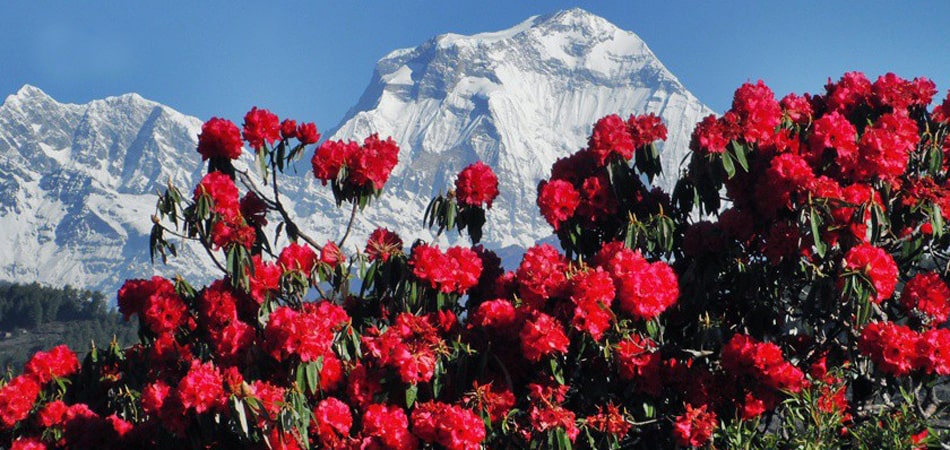
Source: TravellersQuest — National Flower Of Nepal | TravellersQuest · www.travellersquest.com
Trap: Thinking Rhododendron is only ornamental garden plant — it's a major wild Himalayan genus
Trap: Confusing state symbols — Uttarakhand (state tree), Himachal Pradesh (state flower)