In India, in which one of the following types of forests is teak a dominant tree species?
Contents11
- ATropical moist deciduous forest
- BTropical rain forest
- CTropical thorn scrub forest
- DTemperate forest with grasslands
Show answer
Answer: (A) Tropical moist deciduous forest
As per NCERT Class 11 (India: Physical Environment, pg 59):
Teak (Tectona grandis) is the most dominant and commercially valuable tree species of Tropical Moist Deciduous Forests.
These forests are found in regions receiving 100-200 cm of annual rainfall and are widespread across India — along the foothills of the Himalayas, the eastern slopes of the Western Ghats, and in states like Madhya Pradesh, Chhattisgarh, Jharkhand, Odisha, and Maharashtra.
Other important trees in moist deciduous forests include:
- sal
- shisham (rosewood)
- hurra
- mahua
- amla
- semul (silk cotton)
- kusum
These forests shed their leaves for about 6-8 weeks during the dry season (unlike evergreen forests which retain leaves year-round).
Why are the other options wrong?
(b) Tropical rain forests (>200 cm rainfall) — these are dense evergreen forests where teak is NOT a dominant species. Dominant species here include rosewood, ebony, mahogany, and rubber trees.
(c) Tropical thorn scrub forests (<50 cm rainfall) — these are dry, thorny forests found in arid/semi-arid regions (Rajasthan, Gujarat). Dominant species include babool (acacia), ber, khejri, and cactus. Far too dry for teak.
(d) Temperate forests with grasslands — found at higher altitudes in the Himalayas. Dominant species include oak, deodar, pine, and spruce. Too cold for tropical teak.
Answer: Tropical moist deciduous forest.
Memory aid: Teak and Sal = Moist Deciduous. Deodar and Pine = Temperate. Babool and Khejri = Thorn forest.
Teak is India's most commercially valuable timber tree and the dominant species in tropical moist deciduous forests, which cover the largest forest area in India.
The key trap is confusing teak with tropical rainforest trees - teak needs a dry season to shed leaves, so it cannot survive in evergreen rainforests that stay wet year-round.
Tropical Moist Deciduous Forests
Geography Tropical moist deciduous forest teak
Tropical Moist Deciduous Forests: Teak Dominance & Distribution
Teak is the dominant and most commercially valuable tree in Tropical Moist Deciduous Forests
Rainfall range: 100-200 cm annually — between rainforests and dry deciduous
Shed leaves for 6-8 weeks during dry season (February-April)
Found in Madhya Pradesh, Chhattisgarh, Jharkhand, Odisha, Maharashtra
Key Characteristics
Tropical Moist Deciduous Forests occupy the middle rainfall zone in India's forest classification. They receive 100-200 cm of annual rainfall — more than dry forests but less than rainforests. The key feature is their seasonal leaf-shedding during dry months, which distinguishes them from evergreen forests that retain leaves year-round.
Major Tree Species
Tree Species | Commercial Value | Local Names | Key Uses |
|---|---|---|---|
Teak (Tectona grandis) | Highest | Sagwan | Furniture, shipbuilding, construction |
Sal (Shorea robusta) | High | Sakhua | Railway sleepers, construction |
Shisham | Medium | Rosewood | Furniture, musical instruments |
Mahua | Medium | Madhuca | Edible flowers, oil extraction |
Semul | Low | Silk cotton | Cotton stuffing, paper pulp |
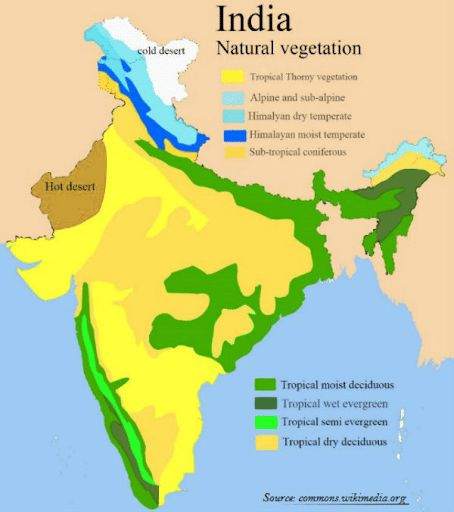
Distribution Map
Source: Prepp — Tropical Moist Deciduous Forests - Environment Notes · prepp.in
Distribution Pattern
Himalayan Foothills: From Punjab to Assam along the terai region
Western Ghats: Eastern slopes receiving orographic rainfall
Central India: Deccan Plateau margins — MP, Chhattisgarh, Jharkhand
Eastern India: Odisha hills and Chota Nagpur Plateau
Western India: Parts of Maharashtra and Sahyadri ranges
Question Anchor
This question tests forest classification based on dominant species. Teak dominance is the defining marker of Tropical Moist Deciduous Forests — UPSC's most tested forest-species pairing. The trap options represent other major forest types where teak cannot survive due to rainfall extremes or temperature conditions.
Trap: Confusing tropical rainforest with moist deciduous — teak needs seasonal dryness, not year-round moisture
Trap: Mixing dry deciduous (<100cm) with moist deciduous (100-200cm) — both are deciduous but different rainfall zones
Memory aid: Teak + Sal = Moist Deciduous, Rosewood + Ebony = Rainforest, Babool + Khejri = Thorn Scrub
Species confusion: Shisham is rosewood found in moist deciduous, different from rosewood of tropical rainforests
Indian Forest Classification by Rainfall
Geography Tropical rain forest Tropical thorn scrub forest Temperate forest
Indian Forest Types: Rainfall-Based Classification & Key Species
4 major forest types based on rainfall: Tropical Rainforest (>200cm), Moist Deciduous (100-200cm), Dry Deciduous (50-100cm), Thorn Scrub (<50cm)
Temperature-based: Tropical vs Temperate forests separated by altitude and latitude
Leaf retention: Evergreen retain leaves, Deciduous shed seasonally
Rainfall-Based Classification
Forest Type | Annual Rainfall | Dominant Species | Distribution | Leaf Pattern |
|---|---|---|---|---|
Tropical Rainforest | 200 cm | Rosewood, Ebony, Mahogany | Western Ghats, Northeast | Evergreen |
Moist Deciduous | 100-200 cm | Teak, Sal, Shisham | Central India, Foothills | Deciduous (6-8 weeks) |
Dry Deciduous | 50-100 cm | Tendu, Palas, Amaltas | Deccan Interior | Deciduous (longer) |
Thorn Scrub | <50 cm | Babool, Ber, Khejri | Rajasthan, Gujarat | Thorny/Succulent |
Temperate | Varies | Deodar, Oak, Pine | Himalayas >1000m | Coniferous |
Forest Classification Structure
# Indian Forests
## Tropical
- Rainforest (>200cm)
- Moist Deciduous (100-200cm)
- Dry Deciduous (50-100cm)
- Thorn Scrub (<50cm)
## Temperate
- Coniferous
- Deciduous
- Alpine
## Montane
- Wet Temperate
- Dry Temperate
- Subalpine
Climate-Vegetation Relationship
Rainfall determines forest type: More rain = denser, taller trees with broader leaves
Seasonal dryness: Deciduous forests shed leaves to conserve water during dry months
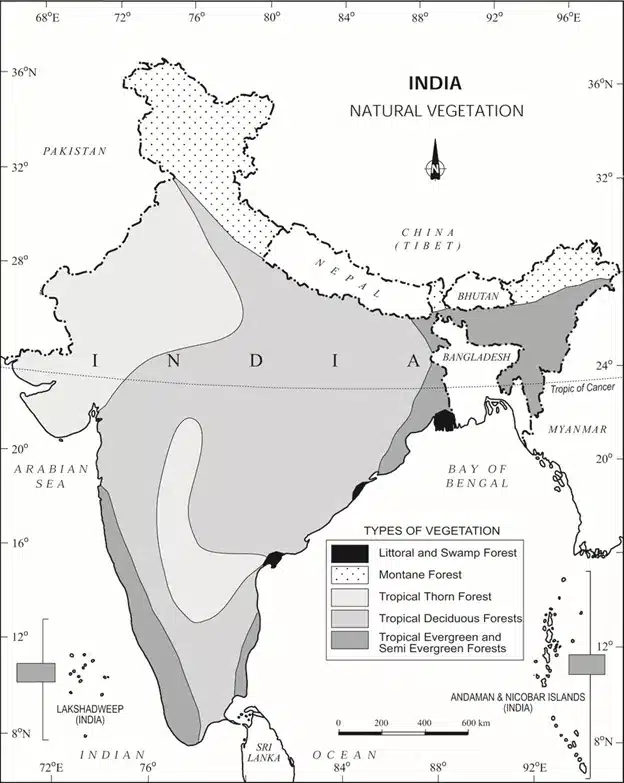
Altitude factor: Temperature decreases with height — tropical becomes temperate above 1000m
Latitude effect: Tropical forests in peninsular India, temperate in Himalayas
Human impact: Original forest cover heavily modified — only 22% forest cover remains
Forest Distribution
Source: LotusArise — Types of Forests in India - UPSC Notes » LotusArise IAS · lotusarise.com
Trap: Temperate forests have coniferous trees (deodar, pine) — not deciduous tropical species like teak
Rainfall confusion: >200cm = Rainforest, 100-200cm = Moist Deciduous — don't mix the ranges
Altitude trap: Teak is tropical species — cannot survive in temperate mountain conditions
Evergreen vs Deciduous: Rainforests are evergreen, moist deciduous shed leaves — opposite leaf patterns