In a particular region in India, the local people train the roots of living trees into robust bridges across the streams. As the time passes, these bridges become stronger. These unique 'living root bridges' are found in
Contents22
- AMeghalaya
- BHimachal Pradesh
- CJharkhand
- DTamil Nadu
Show answer
Answer: (A) Meghalaya
The famous living root bridges are found in Meghalaya, specifically in the Khasi Hills and Jaintia Hills districts of the state.
These are created by the War-Khasi and War-Jaintia tribal communities using the roots of the Indian Rubber Tree (Ficus elastica).
The process works like this: the tribes guide the pliable aerial roots of rubber trees across streams using hollowed-out betel nut trunks or bamboo scaffolding.
Over 15-30 years, the roots grow, intertwine, and strengthen, creating a natural bridge that can support the weight of 50+ people and last for centuries.
Unlike man-made bridges that weaken over time, these living bridges actually get STRONGER with age as the roots grow thicker.
Some double-decker root bridges exist near Nongriat village.
Meghalaya receives among the highest rainfall in the world (Cherrapunji/Mawsynram), making these bridges incredibly useful as wooden bridges would rot quickly in the extreme moisture.
Why are the other options wrong?
(b) Himachal Pradesh — has suspension bridges and wooden bridges in hilly terrain, but not living root bridges.
(c) Jharkhand — a plateau region with tribal populations, but not known for root bridges.
(d) Tamil Nadu — no tradition of root bridges.
This was in The Hindu newspaper and is a well-known cultural geography fact about Meghalaya's unique tribal heritage.
Living root bridges are unique to Meghalaya's Khasi and Jaintia Hills, created by War-Khasi and War-Jaintia tribes using rubber tree roots that strengthen over decades.
Meghalaya receives some of the world's highest rainfall (Cherrapunji/Mawsynram areas), making these root bridges essential since wooden bridges would rot quickly in extreme moisture.
This tests knowledge of India's unique cultural geography - how local communities adapt ingeniously to specific environmental conditions.
Living Root Bridges of Meghalaya
Geography living root bridges Meghalaya
Living Root Bridges: Meghalaya's Unique Tribal Engineering
Living root bridges are found in Meghalaya, specifically in Khasi Hills and Jaintia Hills
Created by War-Khasi and War-Jaintia tribes using Ficus elastica (Indian Rubber Tree) roots
Bridges get stronger with age unlike man-made structures
Take 15-30 years to grow and can support 50+ people
What Are They
Living root bridges are bio-engineered structures created by guiding the aerial roots of rubber trees across streams. The War-Khasi and War-Jaintia tribal communities developed this technique to cross the numerous streams in Meghalaya's high-rainfall terrain.
Roots are guided using hollowed betel nut trunks or bamboo scaffolding
Process takes 15-30 years for a functional bridge
Some bridges are centuries old and still strengthening
Construction Process
Stage | Time Period | Process | Key Material |
|---|---|---|---|
Initial Setup | Year 1-2 | Guide young aerial roots across stream | Betel nut trunk scaffolding |
Growth Phase | Year 3-15 | Roots grow and intertwine naturally | Ficus elastica aerial roots |
Functional Bridge | Year 15-30 | Bridge can bear human weight | Living root network |
Maturity | 30+ years | Bridge strengthens, supports 50+ people | Thick interconnected roots |
Why Meghalaya
Extreme rainfall - Cherrapunji and Mawsynram receive world's highest rainfall, wooden bridges rot quickly
Ficus elastica availability - Indian Rubber Trees grow naturally in this climate
Stream-rich terrain - Khasi and Jaintia Hills have numerous water crossings
Tribal knowledge - War-Khasi and War-Jaintia communities preserved this technique for centuries
Famous Examples

Source: Tripadvisor — DOUBLE DECKER LIVING ROOT BRIDGE (2026) All You SHOULD Know Before ... · www.tripadvisor.in
Question Context
This question tests knowledge of unique geographical features tied to specific states. The key was recognizing that living root bridges are exclusively associated with Meghalaya and its tribal communities.
Himachal Pradesh has mountain bridges but not living root bridges - don't confuse hilly terrain
Jharkhand has tribal populations but wrong ecological zone for this technique
Tamil Nadu has no tradition of root bridges despite having rubber trees in some areas
Ficus Elastica - Indian Rubber Tree
Geography Indian Rubber Tree Ficus elastica
Ficus Elastica: The Tree Behind Living Bridges
Ficus elastica produces strong aerial roots that can be guided and shaped
Thrives in high-rainfall tropical climate of Northeast India
Roots grow continuously and strengthen over decades
Why This Tree Works
Ficus elastica belongs to the fig family and naturally produces aerial roots that grow downward from branches to seek soil. These roots are initially pliable and can be guided horizontally across streams instead of growing downward.
Key Properties
Aerial root system - roots grow from branches, not just from base
High tensile strength - mature roots can bear significant weight
Continuous growth - roots keep thickening throughout the tree's life
Moisture adaptation - thrives in Meghalaya's extreme humidity
Ecological Requirements
Factor | Requirement | Meghalaya Context |
|---|---|---|
Rainfall | High annual precipitation | Cherrapunji/Mawsynram - world's wettest places |
Humidity | Consistently high moisture | Monsoon climate with heavy cloud cover |
Temperature | Warm tropical climate | Subtropical highland climate zone |
Soil | Well-draining but moist | Laterite soils of Khasi Hills |
Khasi & Jaintia Hills Geography
Geography Khasi Hills Jaintia Hills
Khasi & Jaintia Hills: Geography of Living Bridges
Khasi Hills and Jaintia Hills are districts in Meghalaya where root bridges are found
Part of Shillong Plateau with numerous streams and high rainfall
Home to War-Khasi and War-Jaintia tribal communities
Physical Geography
The Khasi Hills and Jaintia Hills form part of the Shillong Plateau in Meghalaya. This plateau region is dissected by numerous streams flowing down steep slopes, creating the need for frequent river crossings.
Geographic Features
Feature | Khasi Hills | Jaintia Hills | Significance for Bridges |
|---|---|---|---|
Elevation | 1,500-1,800m | 1,200-1,500m | Steep slopes create fast streams |
Rainfall | Extremely high | Very high | Wooden bridges rot quickly |
Drainage | Numerous streams | Dense stream network | Many crossing points needed |
Tribal Area | War-Khasi people | War-Jaintia people | Traditional knowledge preserved |
Regional Context
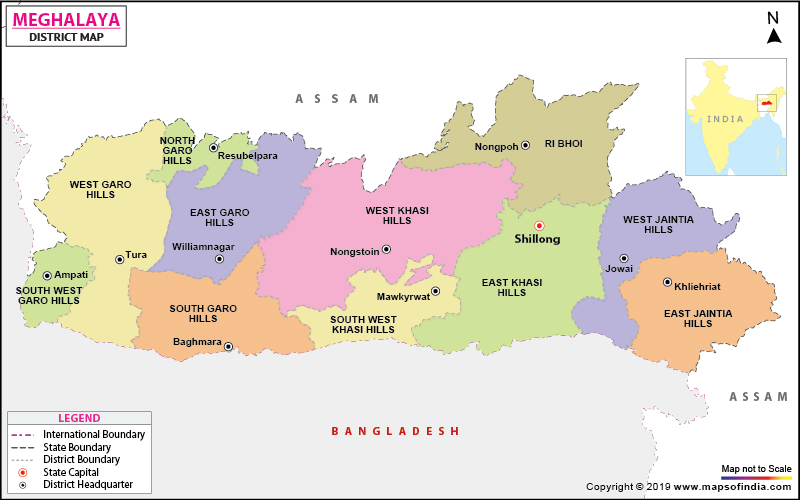
Source: India Map — Meghalaya District Map · www.mapsofindia.com
Why Here Specifically
Stream density - plateau topography creates numerous water crossings
Cherrapunji effect - world's highest rainfall makes traditional bridges impractical
Tribal preservation - War-Khasi and War-Jaintia communities maintained the technique
Forest cover - adequate Ficus elastica trees available naturally
War-Khasi & War-Jaintia Tribes
Geography War-Khasi War-Jaintia
War-Khasi & War-Jaintia: Keepers of Bridge Tradition
War-Khasi and War-Jaintia are tribal communities who created living root bridges
Preserved traditional ecological knowledge for centuries
Both follow matrilineal society structure common in Meghalaya
Cultural Context
The War-Khasi and War-Jaintia are tribal communities indigenous to Meghalaya's hills. 'War' means 'people of' in their language, so War-Khasi means 'people of Khasi Hills'. They developed root bridge technology as a practical solution to their geographic challenges.
Traditional Knowledge System
Generational transfer - bridge-building knowledge passed down orally
Community effort - entire villages participate in bridge construction and maintenance
Sustainable practices - work with nature rather than against it
Long-term thinking - willing to invest decades for permanent infrastructure
Tribal Characteristics
Aspect | War-Khasi | War-Jaintia | Bridge Connection |
|---|---|---|---|
Location | Khasi Hills district | Jaintia Hills district | Geographic knowledge of local terrain |
Language | Khasi (Mon-Khmer) | Jaintia (related to Khasi) | Oral tradition preserves techniques |
Society | Matrilineal | Matrilineal | Women often lead community decisions |
Economy | Agriculture, forest products | Coal mining, agriculture | Need bridges for economic activities |
Northeast India Geographic Features
Geography
Northeast India: Geographic Uniqueness & UPSC Relevance
Northeast India has unique geographic features often tested in UPSC
Meghalaya receives world's highest rainfall at Cherrapunji/Mawsynram
Region has tribal diversity with unique traditional practices
Why UPSC Tests This
Northeast India's unique geographic and cultural features are frequently tested because they represent India's diversity beyond the mainstream. Living root bridges exemplify traditional ecological knowledge and sustainable development - key themes in UPSC syllabus.
Northeast States - Key Geographic Facts
State | Capital | Unique Geographic Feature | UPSC Relevance |
|---|---|---|---|
Meghalaya | Shillong | World's highest rainfall, Living root bridges | Climate records, Tribal practices |
Assam | Dispur | Brahmaputra valley, Oil fields | River systems, Energy geography |
Manipur | Imphal | Loktak Lake (floating islands) | Wetland ecosystem |
Nagaland | Kohima | Dzukou Valley flowers | Biodiversity |
Mizoram | Aizawl | Bamboo flowering cycle | Forest ecology |
Don't confuse Meghalaya's living bridges with Himachal's wooden suspension bridges
Cherrapunji and Mawsynram are both in Meghalaya - not different states
War-Khasi refers to Khasi tribe, not warfare or conflict