Consider the following statements: 1. The Global Ocean Commission grants licences for seabed exploration and mining in international waters. 2. India has received licences for seabed mineral exploration in international waters. 3. 'Rare earth minerals' are present on seafloor in international waters. Which of the statements given above are correct?
Contents11
- A1 and 2 only
- B2 and 3 only
- C1 and 3 only
- D1, 2 and 3
Show answer
Answer: (B) 2 and 3 only
Statement 1 is wrong:
The Global Ocean Commission (2013-2016) was an awareness initiative, not a licensing body.
Seabed exploration and mining licenses in international waters are granted by the International Seabed Authority (ISA).
Statement 2 is correct:
India has been exploring the deep sea since 1981.
In 2017, India's exclusive rights to explore polymetallic nodules in the Central Indian Ocean Basin (CIOB) were extended by five years.
Statement 3 is correct:
The deep seabed contains polymetallic nodules (manganese, nickel, copper, cobalt, rare earth minerals) and sea-floor hydrothermal vents (releasing rare earth elements in hot fluids).
Statements 2 and 3 are correct.
Answer: (b).
India secured exclusive exploration rights in the Central Indian Ocean Basin and had these rights extended in 2017, making deep-sea mining a key part of India's mineral security strategy.
The question tests whether students can distinguish between the International Seabed Authority (which actually grants licenses) and the Global Ocean Commission (which was just a temporary awareness initiative from 2013-2016).
UPSC is checking if students understand that rare earth elements are found not just on land in China and other countries, but also in international waters through polymetallic nodules and hydrothermal vents.
International Seabed Authority (ISA)
Geography Global Ocean Commission seabed exploration mining international waters
International Seabed Authority: Deep Sea Mining Governance
ISA grants licenses for seabed exploration and mining in international waters, not Global Ocean Commission
Regulates deep seabed mining beyond 200 nautical miles from coastlines
Established under UNCLOS 1994 with headquarters in Kingston, Jamaica
The International Seabed Authority (ISA) is the only global body authorized to regulate deep sea mining in international waters. It operates under the UN Convention on the Law of the Sea framework to manage seabed resources as 'common heritage of mankind'.
ISA vs Global Ocean Commission
Aspect | International Seabed Authority | Global Ocean Commission |
|---|---|---|
Status | UN agency (1994-present) | Temporary initiative (2013-2016) |
Function | Grants mining licenses | Awareness & advocacy only |
Authority | Legal regulatory powers | No legal authority |
Headquarters | Kingston, Jamaica | London-based initiative |
ISA Key Functions
Issues exploration contracts for 15-year periods with possible extensions
Develops Mining Code for commercial deep sea mining operations
Ensures environmental protection of deep sea ecosystems
Distributes mining revenues among all UN member states
Trap: Statement 1 uses Global Ocean Commission instead of International Seabed Authority - classic name confusion
Confusion: ISA regulates international waters only - not territorial seas or EEZ
Mix-up: ISA grants licenses, not just permits or approvals
India's Deep Sea Exploration Program
Geography India licences seabed mineral exploration
India's Deep Sea Mining: CIOB Exploration Rights
India has exclusive exploration rights in Central Indian Ocean Basin since 1987
Latest contract extension granted in 2017 for additional 5 years
Exploring polymetallic nodules containing rare earth minerals
India began deep sea exploration in 1981 and secured exclusive mining rights in the Central Indian Ocean Basin (CIOB) from the International Seabed Authority. The exploration area covers approximately 75,000 sq km in international waters.
India's Deep Sea Timeline
Year | Milestone | Significance |
|---|---|---|
1981 | Deep sea exploration begins | Early research initiatives |
1987 | First ISA contract for CIOB | Exclusive exploration rights granted |
2017 | Contract extended by 5 years | Continued exploration till 2022+ |
CIOB Location Map
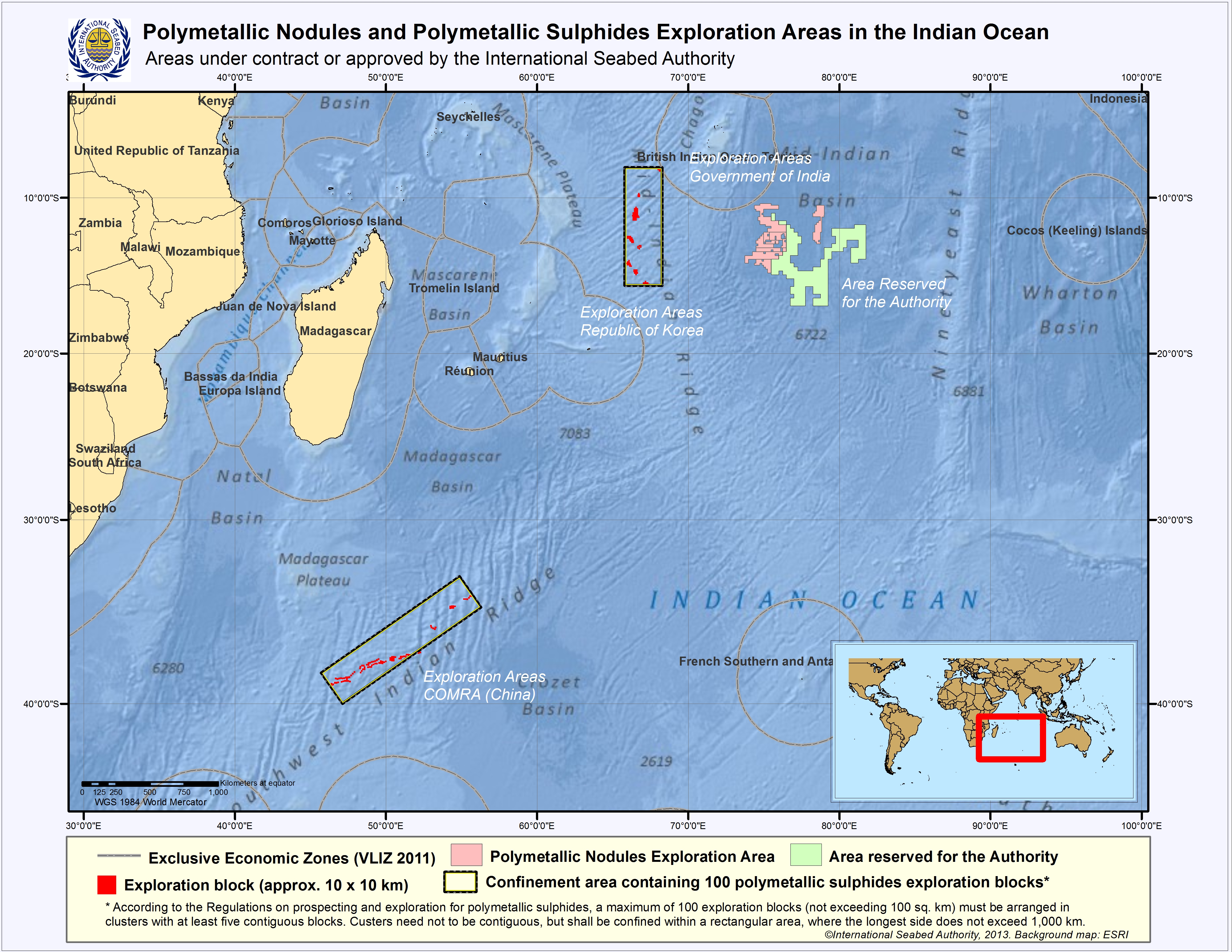
Source: DSM Observer — India's National Institute of Oceanography projects to focus ... · dsmobserver.com
India's Exploration Focus
Polymetallic nodules containing manganese, nickel, copper, cobalt
Rare earth elements crucial for technology and defense applications
Environmental impact assessment studies alongside mining research
Development of indigenous deep sea technology and mining equipment
Seafloor Rare Earth Minerals
Geography Rare earth minerals seafloor international waters
Deep Sea Rare Earth Resources: Nodules & Hydrothermal Vents
Polymetallic nodules on seafloor contain rare earth minerals and critical metals
Hydrothermal vents release rare earth elements in mineral-rich hot fluids
Deep sea contains higher concentrations than terrestrial deposits
The deep seafloor beyond national jurisdiction contains vast deposits of rare earth elements critical for modern technology. These occur primarily in two forms: polymetallic nodules scattered across abyssal plains and hydrothermal vent deposits along mid-ocean ridges.
Deep Sea Mineral Resources
Resource Type | Location | Key Minerals | Formation Process |
|---|---|---|---|
Polymetallic Nodules | Abyssal plains 4000-6000m depth | Mn, Ni, Cu, Co, REE | Slow precipitation over millions of years |
Hydrothermal Vents | Mid-ocean ridges | Cu, Zn, Pb, Au, Ag, REE | Hot fluid discharge from Earth's crust |
Cobalt Crusts | Seamount slopes | Co, Ni, Mn, REE, Pt | Chemical precipitation from seawater |
Polymetallic Nodules

Source: Eos.org — The 2-Year Countdown to Deep-Sea Mining - Eos · eos.org
Strategic Importance
Technology applications: smartphones, electric vehicles, wind turbines, defense systems
Supply security: reduces dependence on terrestrial rare earth monopolies
Higher grades: seafloor deposits often contain higher concentrations than land mines
Environmental trade-off: deep sea vs terrestrial mining environmental impacts
Correct: Rare earth minerals ARE present on seafloor - Statement 3 is true
Location: Found in international waters beyond national jurisdiction
Forms: Both nodules (widespread) and hydrothermal vents (localized) contain REE