Consider the following heavy industries: 1. Fertilizer plants 2. Oil refineries 3. Steel plants Green hydrogen is expected to play a significant role in decarbonizing how many of the above industries?
Contents18
- AOnly one
- BOnly two
- CAll three
- DNone
Show answer
Answer: (C) All three
Green hydrogen (produced from renewable energy via electrolysis)
is expected to play a major role in decarbonizing all three:
- fertilizer plants (for ammonia production)
- oil refineries
- steel plants.
These are considered 'hard-to-abate' industrial sectors where electrification alone isn't enough.
Answer is (c) All three.
Green hydrogen is crucial for decarbonizing heavy industries that cannot rely on electrification alone - fertilizer plants use it for ammonia production, oil refineries for processing, and steel plants as a replacement for coal-based processes.
India launched the National Green Hydrogen Mission in 2023 with massive funding, making green hydrogen applications in heavy industry a key current affairs topic for UPSC.
The question tests understanding of 'hard-to-abate' sectors - industries where direct electrification cannot achieve decarbonization, requiring alternative solutions like green hydrogen.
Green Hydrogen Production & Technology
Science And Technology Green hydrogen electrolysis renewable energy
Green Hydrogen: Production Methods & Clean Energy Role
Green hydrogen is produced via electrolysis using renewable electricity
Unlike grey/blue hydrogen, green hydrogen produces zero carbon emissions
Key for decarbonizing hard-to-abate industrial sectors
India's National Green Hydrogen Mission targets 5 MMT production by 2030
What is Green Hydrogen
Green hydrogen is hydrogen gas produced through electrolysis of water using electricity from renewable sources like solar or wind. This makes it completely carbon-free, unlike conventional hydrogen production methods that rely on fossil fuels.
Hydrogen Color Classification
Type | Production Method | Carbon Emissions | Current Share |
|---|---|---|---|
Grey Hydrogen | Steam methane reforming from natural gas | High CO₂ emissions | ~95% of global production |
Blue Hydrogen | Grey + carbon capture & storage | Reduced emissions | Small pilot projects |
Green Hydrogen | Electrolysis using renewable energy | Zero emissions | <1% but rapidly growing |
Green Hydrogen Production Process
%%{init: {"flowchart": {"wrappingWidth": 460}}}%%
flowchart TD
  s1["`**Renewable Energy Generation**
Solar/wind farms generate clean electricity`"]
  s2["`**Electrolysis**
Electric current splits water (H₂O) into hydrogen and oxygen`"]
  s3["`**Hydrogen Storage**
Compressed or liquefied for transport and use`"]
  s4["`**Industrial Application**
Used as fuel or feedstock in heavy industries`"]
  s1 --> s2
  s2 --> s3
s3 --> s4Trap: Confusing green hydrogen with blue hydrogen - blue still involves fossil fuels
Trap: Thinking hydrogen is always clean - grey hydrogen dominates current production and has high emissions
Key: Green hydrogen specifically requires renewable electricity for electrolysis
Hard-to-Abate Industrial Sectors
Geography heavy industries decarbonizing Fertilizer plants Oil refineries Steel plants
Hard-to-Abate Industries: Why Green Hydrogen Matters
Hard-to-abate sectors cannot be easily electrified and need alternative fuels
Steel, fertilizers, oil refining are major industrial emission sources
These industries need high-temperature processes or hydrogen as feedstock
Account for approximately 30% of global CO₂ emissions
Why These Industries Are Hard to Abate
Hard-to-abate sectors are industries where direct electrification is technically difficult or economically unfeasible. They require extremely high temperatures, use fossil fuels as chemical feedstock, or need specific fuel properties that electricity cannot provide.
Green Hydrogen Applications in Heavy Industries
Industry | Current Fossil Fuel Use | Green Hydrogen Application | Decarbonization Impact |
|---|---|---|---|
Fertilizer Plants | Natural gas for ammonia production | H₂ + N₂ → Ammonia (NH₃) | Eliminates 80%+ of process emissions |
Steel Plants | Coking coal for iron ore reduction | Direct reduction using H₂ | Can replace coal entirely in steelmaking |
Oil Refineries | Grey hydrogen for crude processing | Green H₂ for hydrocracking, desulfurization | Reduces refinery carbon footprint by 60%+ |
Technical Requirements
Fertilizers: Need pure hydrogen to synthesize ammonia via Haber-Bosch process
Steel: Requires hydrogen to reduce iron ore (Fe₂O₃ + H₂ → Fe + H₂O) instead of coal
Oil Refining: Uses hydrogen for removing sulfur and breaking heavy molecules
Temperature needs: All three require 800-1500°C processes where electrification is challenging
Connection to PYQ
The question tests understanding that all three industries can use green hydrogen for decarbonization - not just one or two. Each has specific technical applications where hydrogen is either essential (fertilizers, steel) or highly beneficial (refineries).
Trap: Thinking only steel plants can use hydrogen - fertilizers actually use more hydrogen globally
Trap: Assuming oil refineries don't need decarbonization - they're major industrial CO₂ sources
Key: All three are hard-to-abate sectors where electrification alone isn't sufficient
Industrial Decarbonization Strategies
Geography decarbonizing significant role
Industrial Decarbonization: Technologies & Pathways
Electrification works for light industries but not heavy manufacturing
Green hydrogen, CCUS, biomass are key technologies for hard-to-abate sectors
Industries need alternative fuels for high-temperature processes
Carbon pricing and regulations drive adoption of clean technologies
Decarbonization Technology Options
# Industrial Decarbonization
## Electrification
- Electric heating
- Heat pumps
- Electric vehicles
- Limited to <500°C processes
## Alternative Fuels
- Green hydrogen
- Green ammonia
- Synthetic fuels
- Biomass/biogas
## Carbon Capture
- CCUS technology
- Direct air capture
- Industrial CO₂ utilization
## Process Innovation
- New steel technologies
- Alternative cement
- Circular economy
Decarbonization by Industrial Sector
Sector | Electrification Potential | Hydrogen Role | Other Technologies |
|---|---|---|---|
Cement | Limited (needs 1400°C) | Potential fuel | CCUS, alternative materials |
Chemicals | Partial (heating) | Feedstock + fuel | Bio-based feedstocks |
Aluminum | High (already electric) | Backup power | Recycling, efficiency |
Textiles | High (lower temperatures) | Limited | Sustainable fibers, efficiency |
Policy Drivers in India
National Green Hydrogen Mission: ₹19,744 crore allocation for production and demand creation
Production Linked Incentive (PLI): Support for electrolyzer manufacturing
Carbon markets: India developing domestic carbon credit trading
Industrial parks: Green hydrogen hubs being established in Gujarat, Rajasthan
Trap: Thinking all industries can simply switch to electricity - high-temperature processes need alternative fuels
Trap: Confusing energy efficiency with decarbonization - efficiency helps but doesn't eliminate emissions
Key: Hard-to-abate vs easy-to-abate is based on technical feasibility, not cost alone
India's Green Hydrogen Mission & Policy
Indian Economy
National Green Hydrogen Mission: Targets & Implementation
National Green Hydrogen Mission launched in 2023 with ₹19,744 crore budget
Target: 5 MMT annual production by 2030
Focus on export potential and domestic industrial demand
Green Hydrogen Hubs planned in Gujarat, Rajasthan, Tamil Nadu
Mission Overview
India's National Green Hydrogen Mission aims to make India a global hub for green hydrogen production and export. The mission targets domestic demand creation while building export capabilities to become a major supplier to countries like Japan and South Korea.
Mission Targets & Components
Component | Target by 2030 | Budget Allocation | Key Focus |
|---|---|---|---|
Production Capacity | 5 Million Metric Tonnes | Strategic interventions | Domestic + export market |
Electrolyzer Manufacturing | Domestic supply chain | PLI scheme support | Reduce import dependence |
Industrial Demand | Steel, fertilizer, refining | Pilot projects | Replace grey hydrogen |
Export Infrastructure | Ports, shipping facilities | Infrastructure development | Global market access |
Implementation Strategy
Production incentives: Financial support for early green hydrogen projects
Demand creation: Mandates for fertilizer and steel sectors to use green hydrogen
R&D support: Technology development for electrolyzers and fuel cells
Skill development: Training programs for hydrogen economy workforce
Green Hydrogen Hubs
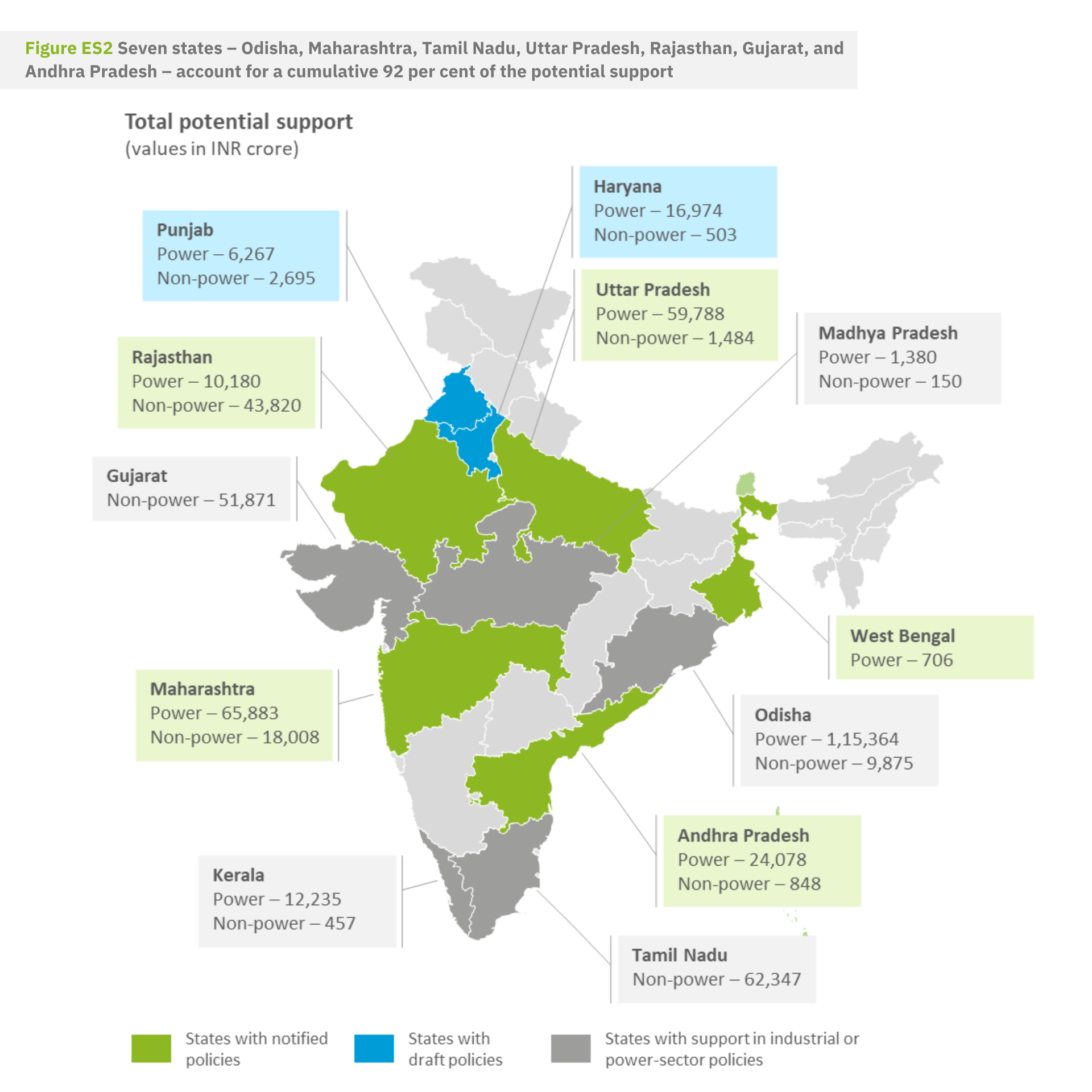
Source: GH2 India — Beyond the National Green Hydrogen Mission: India's ... · www.gh2.org.in
Trap: Confusing the National Hydrogen Mission with other renewable energy schemes
Key: Mission focuses on green hydrogen specifically - not all hydrogen production
Trap: Mixing up production targets - it's 5 MMT by 2030, not other figures