The 2004 Tsunami made people realize that mangroves can serve as a reliable safety hedge against coastal calamities. How do mangroves function as a safety hedge?
Contents17
- AThe mangrove swamps separate the human settlements from the sea by a wide zone in which people neither live not venture out
- BThe mangroves provide both food and medicines which people are in need of after any natural disaster.
- CThe mangrove trees are tall with dense canopies and serve as an excellent shelter during a cyclone or tsunami
- DThe mangrove trees do not get uprooted by storms and tides because of their extensive roots
Show answer
Answer: (D) The mangrove trees do not get uprooted by storms and tides because of their extensive roots
Mangroves act as a safety hedge primarily because of their extensive root system.
These roots spread wide and deep into the muddy soil, anchoring the trees so firmly that even powerful storms and tides cannot uproot them.
More importantly, this dense network of roots acts like a natural barrier — it absorbs and breaks the energy of incoming waves before they reach human settlements.
Option (a) is wrong because mangroves don't just create empty buffer zones — people do live near them.
Option (b) talks about post-disaster relief (food/medicine), not protection during a disaster.
Option (c) is incorrect because mangroves are actually short-to-medium height trees, not tall ones, and hiding under trees during a tsunami would be dangerous.
The key takeaway: mangroves protect coastlines through their physical root structure, not by providing shelter or supplies.
The 2004 Indian Ocean Tsunami killed over 200,000 people across multiple countries, with areas protected by mangroves suffering significantly less damage than areas without them.
UPSC is testing whether students understand the physical mechanism of coastal protection - that mangroves work through their root systems breaking wave energy, not through height, shelter, or supplies.
Mangrove Root Systems & Coastal Protection
Geography mangroves safety hedge roots storms and tides
How Mangrove Root Systems Protect Coastlines
Mangroves protect coasts through extensive root systems that anchor firmly in muddy soil
Root networks absorb and break wave energy before it reaches human settlements
Mangroves are short-to-medium height trees, not tall canopy providers
2004 Indian Ocean Tsunami highlighted mangroves' protective role
Protection Mechanism
Mangroves function as natural coastal barriers through their unique root architecture. The dense network of roots creates a physical obstacle that dissipates wave energy and reduces coastal erosion.
How Mangroves Stop Waves
%%{init: {"flowchart": {"wrappingWidth": 460}}}%%
flowchart TD
  s1["`**Incoming Wave/Tide**
Storm surge or tsunami wave approaches coast`"]
  s2["`**Root Network Contact**
Wave hits dense mangrove root system in shallow water`"]
  s3["`**Energy Absorption**
Roots break wave momentum and absorb kinetic energy`"]
  s4["`**Reduced Impact**
Weakened waves reach shore with less destructive force`"]
  s1 --> s2
  s2 --> s3
  s3 --> s4
Root System Types in Mangroves
Root Type | Function | Protection Role |
|---|---|---|
Prop roots | Support tree above water | Create dense barrier network |
Pneumatophores (breathing roots) | Gas exchange in waterlogged soil | Add to root density |
Cable roots | Horizontal spread underground | Anchor system firmly |
Mangrove Root Architecture

Source: ScienceDirect.com — Adaptive roots of mangrove Avicennia marina: Structure and ... · www.sciencedirect.com
Height confusion: Mangroves are not tall trees — they're short-to-medium height, so option C about 'tall dense canopies' is wrong
Function mix-up: Mangroves protect during disasters through roots, not after disasters through food/medicine
Buffer zone trap: People do live near mangroves — they don't create uninhabited separation zones
Mangrove Ecosystem Characteristics
Geography mangrove swamps
Mangrove Ecosystems: Features & Distribution
Mangroves grow in tropical and subtropical intertidal zones where saltwater meets freshwater
Trees adapted to high salinity through salt-excreting leaves and specialized roots
Found along 75% of tropical coastlines worldwide
Habitat Requirements
Mangroves thrive in intertidal zones where they face daily flooding by saltwater tides. They require specific conditions: warm temperatures (above 20°C), protected coastlines with low wave energy, and muddy or sandy substrates.
Mangrove Adaptations
# Mangrove Adaptations
## Salt Tolerance
- Salt-excreting leaves
- Salt-filtering roots
- Water storage in tissues
## Root Adaptations
- Prop roots for stability
- Pneumatophores for breathing
- Cable roots for anchoring
## Reproduction
- Viviparous seeds
- Floating propagules
- Tidal dispersal
Ecological Services
Nursery habitat for fish, crabs, and marine life
Carbon sequestration in both biomass and sediment
Water filtration removing pollutants from runoff
Shoreline stabilization preventing coastal erosion
Indian Mangroves & Distribution
Geography
Mangrove Forests in India: Key Locations & Significance
India has 4,975 sq km of mangrove cover across 12 coastal states and UTs
Sundarbans (West Bengal) is the largest mangrove forest in the world
Gujarat has the largest mangrove area in India
Major Mangrove Areas in India
State/UT | Key Mangrove Areas | Significance |
|---|---|---|
West Bengal | Sundarbans | Largest mangrove forest globally, Royal Bengal Tiger habitat |
Gujarat | Gulf of Kachchh, Gulf of Khambhat | Largest mangrove cover in India |
Odisha | Bhitarkanika, Mahanadi delta | Saltwater crocodile habitat |
Andaman & Nicobar | Island coastlines | High species diversity |
Maharashtra | Sindhudurg, Ratnagiri | Urban mangrove conservation |
Indian Mangrove Distribution
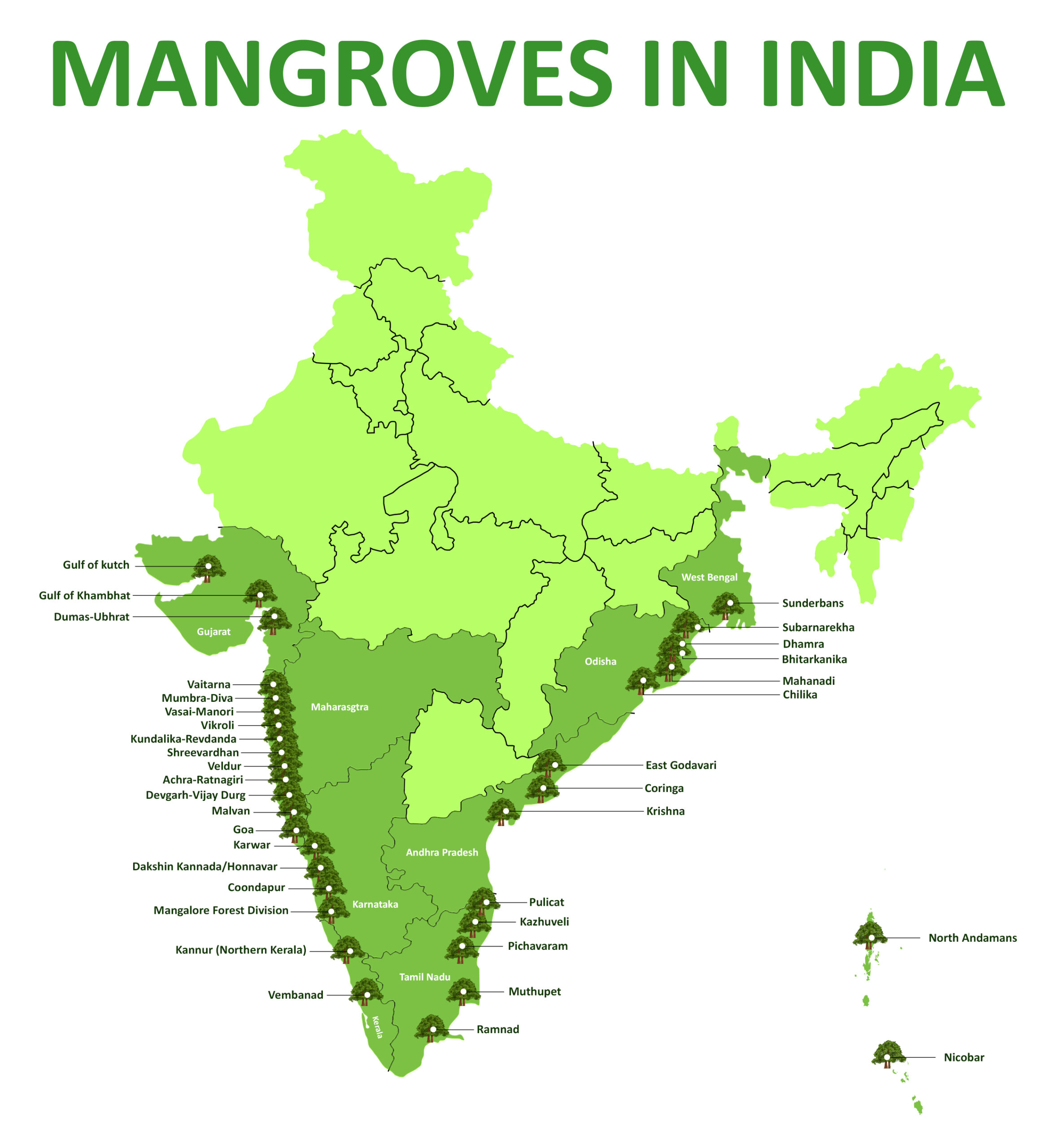
Source: StudyIQ — Mangrove Forest in India 2026: Latest Data, Maps, States and ... · www.studyiq.com
Conservation Challenges
Aquaculture expansion destroying mangrove areas for shrimp farming
Urban development pressure in Mumbai, Chennai coastal areas
Rising sea levels threatening low-lying mangrove zones
Pollution from industrial and agricultural runoff
2004 Tsunami & Coastal Protection Lessons
Geography 2004 Tsunami coastal calamities
2004 Indian Ocean Tsunami: Mangrove Protection Evidence
December 26, 2004: Magnitude 9.1 earthquake triggered tsunami affecting 14 countries
Areas with intact mangroves suffered significantly less damage than deforested coastlines
Tsunami highlighted importance of natural coastal defenses over artificial barriers
Mangrove Protection Evidence
Post-tsunami studies revealed that coastal areas with dense mangrove forests experienced reduced wave heights and less structural damage. Villages protected by mangroves had lower casualty rates compared to areas where mangroves had been cleared for development.
Coastal Protection Comparison
Protection Type | Effectiveness | Limitations | Cost |
|---|---|---|---|
Mangroves | High wave energy reduction | Need time to establish | Low maintenance |
Sea walls | Complete wave blocking | Can fail catastrophically | Very high cost |
Coral reefs | Natural wave breaking | Climate change vulnerable | Natural/no cost |
Sand dunes | Moderate wave reduction | Erosion over time | Medium maintenance |
Lessons for Disaster Management
Ecosystem-based adaptation more sustainable than hard engineering
Coastal zone management must prioritize natural buffer restoration
Early warning systems essential but insufficient without natural barriers
Community awareness about mangrove conservation critical for coastal safety