In which of the following regions of India are shale gas resources found? 1. Cambay Basin 2. Cauvery Basin 3. Krishna-Godavari Basin Select the correct answer using the code given below.
Contents16
- A1 and 2 only
- B3 only
- C2 and 3 only
- D1, 2 and 3
Show answer
Answer: (D) 1, 2 and 3
Answer: (d) 1, 2 and 3
Shale gas resources in India are found in ALL three basins mentioned: Cambay Basin, Cauvery Basin, and Krishna-Godavari Basin.
Shale gas is natural gas trapped within shale rock formations. Extracting it requires special techniques like hydraulic fracturing (fracking) and horizontal drilling.
ONGC sought permission for shale gas exploration in these basins:
- Cambay Basin (Gujarat) — 11 exploratory wells at Mehsana, Ahmedabad, and Bharuch districts
- Cauvery Basin (Tamil Nadu) — 1 well at Nagapattinam
- Krishna-Godavari (KG) Basin (Andhra Pradesh) — 5 wells at East and West Godavari districts
Other basins in India with shale gas potential:
- Gondwana Basin (including Damodar Valley)
- Ganga Basin
- Assam and Assam-Arakan Basin
This was significant as it marked the first time ONGC took up shale gas exploration on such a large scale in India. India has estimated shale gas reserves of about 96 trillion cubic feet, which could significantly boost domestic energy production.
Since all three basins have shale gas resources, the answer is (d) "1, 2 and 3".
India has estimated shale gas reserves of about 96 trillion cubic feet across multiple sedimentary basins, making it a significant potential energy source.
ONGC's large-scale shale gas exploration approvals in 2015-16 across Cambay, Cauvery, and Krishna-Godavari basins made this a current affairs topic for the 2016 exam.
The question tests knowledge of India's sedimentary basin geography and which basins contain unconventional hydrocarbon resources beyond traditional oil and gas.
Shale Gas: Formation & Extraction
Geography shale gas
Shale Gas: What It Is & How It's Extracted
Shale gas is natural gas trapped within shale rock formations
Extraction requires hydraulic fracturing (fracking) and horizontal drilling
ONGC leads shale gas exploration in India
India has estimated shale gas reserves of 96 trillion cubic feet
Shale gas is natural gas trapped in fine-grained sedimentary rocks called shales. Unlike conventional gas that flows easily from porous rocks, shale gas requires special extraction techniques because the rock has very low permeability.
Conventional vs Shale Gas
Aspect | Conventional Gas | Shale Gas |
|---|---|---|
Rock type | Porous sandstone/limestone | Fine-grained shale |
Extraction | Vertical drilling | Horizontal drilling + fracking |
Flow rate | High permeability | Low permeability |
Technology needed | Standard drilling | Advanced fracturing techniques |
Cost | Lower | Higher due to complex extraction |
Shale Gas Extraction Process
%%{init: {"flowchart": {"wrappingWidth": 460}}}%%
flowchart TD
  s1["`**Horizontal Drilling**
Drill vertically then turn horizontally through shale layers`"]
  s2["`**Hydraulic Fracturing**
Inject high-pressure water, sand, and chemicals to create fractures`"]
  s3["`**Gas Release**
Trapped gas flows through created fractures to wellbore`"]
  s4["`**Gas Collection**
Natural gas is captured and processed for commercial use`"]
  s1 --> s2
  s2 --> s3
s3 --> s4All three basins mentioned in the question have shale gas — don't eliminate any option
Don't confuse shale gas with shale oil — both are unconventional but different resources
ONGC, not private companies, leads India's shale gas exploration efforts
Cambay Basin
Geography Cambay Basin
Cambay Basin: Location, Resources & Significance
Located in Gujarat state, major sedimentary basin in western India
Contains both conventional oil/gas and shale gas resources
ONGC has 11 exploratory wells for shale gas at Mehsana, Ahmedabad, Bharuch
The Cambay Basin is a major sedimentary basin in Gujarat, formed during the rifting of the Indian subcontinent. It extends from the Rann of Kutch in the north to the Deccan Trap region in the south.
Key Features
Onshore basin covering parts of Gujarat and small portion of Rajasthan
Contains Tertiary sediments up to 7 km thick in some areas
Major oil and gas producing region — Ankleshwar, Kalol, Sanand fields
Shale formations suitable for unconventional gas extraction
Connected to Mumbai High offshore fields geologically
Basin Location
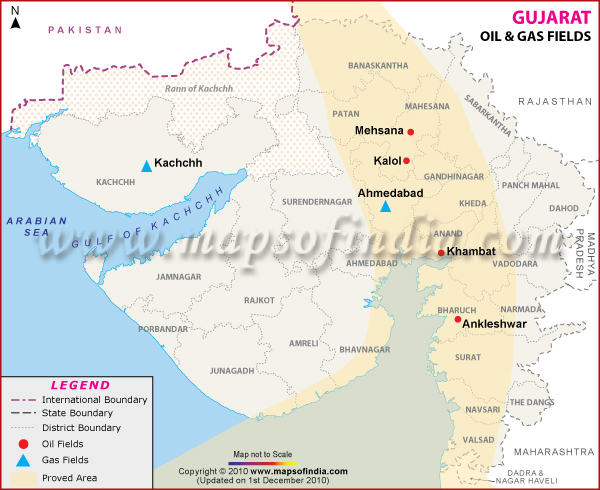
Source: India Map — Map of Major Oil and Gas Fields in Gujarat · www.mapsofindia.com
Cauvery Basin
Geography Cauvery Basin
Cauvery Basin: Southern India's Petroleum Province
Located in Tamil Nadu and Puducherry, extends offshore into Bay of Bengal
Major offshore oil and gas producer in southern India
ONGC has 1 shale gas well at Nagapattinam district
The Cauvery Basin is a pericratonic sedimentary basin located in Tamil Nadu and Puducherry. It extends from onshore areas into the Bay of Bengal, making it both an onshore and offshore petroleum province.
Basin Characteristics
Onshore-offshore basin with major production from offshore fields
Contains Cretaceous to Recent sediments up to 6 km thick
Purnea, Karaikal, and Kumbakonam are major oil and gas fields
Rich in Cretaceous shale formations suitable for shale gas
Connected to Sri Lankan sedimentary sequences across Palk Strait
Basin Extent
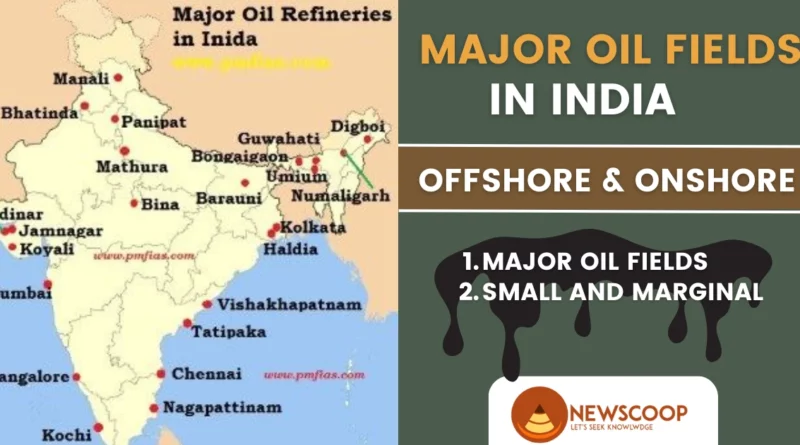
Source: Newscoop IAS — Major Oil Fields in India: Offshore & Onshore with Map » Newscoop IAS · newscoop.co.in
Krishna-Godavari Basin
Geography Krishna-Godavari Basin
Krishna-Godavari (KG) Basin: India's Major Gas Province
Located in Andhra Pradesh, India's largest sedimentary basin
Major natural gas producer — supplies significant portion of India's gas
Contains famous KG-D6 block operated by Reliance Industries
ONGC has 5 shale gas wells in East and West Godavari districts
The Krishna-Godavari Basin is India's largest sedimentary basin, named after the Krishna and Godavari rivers. It extends from onshore Andhra Pradesh into the Bay of Bengal, covering approximately 50,000 sq km onshore and 25,000 sq km offshore.
Strategic Importance
Largest gas producer in India — contributes ~40% of domestic gas production
Contains thick Permian to Recent sediments up to 10 km in offshore areas
KG-D6 block was India's largest private sector gas discovery
Rich Permian shales provide excellent source rocks for both conventional and shale gas
Dhirubhai-1 and 3 platforms are major offshore installations
KG Basin Layout

Source: CivilsDaily — Gas Production in Krishna-Godavari Basin - Civilsdaily · www.civilsdaily.com
India's Shale Gas Basins
Geography
Complete Overview: India's Shale Gas Potential
India has 96 trillion cubic feet of estimated shale gas reserves
Six major basins have shale gas potential across India
ONGC leads exploration with 17 wells across three priority basins
India's Shale Gas Basins
Basin | Location | ONGC Wells | Key Districts/Areas |
|---|---|---|---|
Cambay | Gujarat | 11 wells | Mehsana, Ahmedabad, Bharuch |
Cauvery | Tamil Nadu | 1 well | Nagapattinam |
Krishna-Godavari | Andhra Pradesh | 5 wells | East & West Godavari |
Gondwana | Central India | Potential | Damodar Valley, Jharia |
Ganga | Northern Plains | Potential | UP, Bihar basins |
Assam-Arakan | Northeast | Potential | Assam, Tripura, Mizoram |
Shale Gas Distribution
# India's Shale Gas Basins
## Active Exploration
- Cambay (11 wells)
- Cauvery (1 well)
- KG Basin (5 wells)
## Future Potential
- Gondwana Basin
- Ganga Basin
- Assam-Arakan
## Regional Spread
- Western India
- Southern India
- Eastern India
- Northern Plains
- Northeast
Strategic Context
India's 96 trillion cubic feet of shale gas reserves could transform energy security. The first large-scale exploration by ONGC marks a shift toward unconventional resources as conventional reserves decline.
Key challenge: Extracting shale gas requires advanced technology and higher costs compared to conventional gas production.
Don't confuse basin names — Cambay (Gujarat), Cauvery (Tamil Nadu), Krishna-Godavari (Andhra Pradesh)
All three basins in the question have active ONGC shale gas exploration — not just potential
Remember ONGC leads India's shale gas exploration, not private companies like in the US