Consider the following pairs:
Contents21
Consider the following pairs:
| Region | Well-known for the production of | |
|---|---|---|
| 1. | Kinnaur | Areca nut |
| 2. | Mewat | Mango |
| 3. | Coromandel | Soya bean |
Which of the above pairs is/are correctly matched?
- A1 and 2 only
- B3 only
- C1, 2 and 3
- DNone
Show answer
Answer: (D) None
All three pairs are WRONG — a rare 'None' answer.
(1) Kinnaur (Himachal Pradesh) — famous for apples, dry fruits, and chilgoza pine nuts, NOT areca nut.
Areca nut grows in warm, tropical coastal regions like Karnataka, Kerala, and Assam.
(2) Mewat (Haryana/Rajasthan border) — an arid/semi-arid region, NOT known for mango.
Mango-famous regions include Malihabad (UP), Ratnagiri (Maharashtra), and Malda (West Bengal).
(3) Coromandel (eastern coast of Tamil Nadu/Andhra Pradesh) — known for rice cultivation, NOT soybean.
Soybean is grown predominantly in central India — Madhya Pradesh is called the 'Soya State.'
When all three pairs are obviously mismatched geographically, answer 'None.'
(Ref: Khullar, India Comprehensive Geography)
This tests knowledge of specific regional agricultural specializations across India's diverse climatic zones.
All three pairs are deliberately wrong - Kinnaur produces apples not areca nut, Mewat is arid and unsuitable for mangoes, and Coromandel grows rice not soybeans.
UPSC is checking if students can match crops to their correct agro-climatic zones rather than getting confused by similar-sounding regions.
Kinnaur Region & Agricultural Products
Geography Kinnaur
Kinnaur Region: Location, Climate & Agricultural Products
Kinnaur is a district in Himachal Pradesh known for apples and dry fruits
Located in the trans-Himalayan region with cold, dry climate
NOT suitable for areca nut which needs warm tropical climate
Famous for chilgoza pine nuts and barley cultivation
Geographic Context
Kinnaur is a high-altitude district in Himachal Pradesh bordering Tibet. Its trans-Himalayan location gives it a cold, dry climate unsuitable for tropical crops like areca nut.
Kinnaur vs Areca Nut Requirements
Aspect | Kinnaur Conditions | Areca Nut Requirements |
|---|---|---|
Climate | Cold, dry (trans-Himalayan) | Warm, humid tropical |
Altitude | High altitude (3,000m+) | Low altitude coastal/plains |
Rainfall | Low rainfall (200-400mm) | High rainfall (1,500mm+) |
Temperature | Sub-zero winters | 25-35°C year-round |
Main crops | Apples, barley, chilgoza | Grown in Karnataka, Kerala, Assam |
Kinnaur Location

Source: abn397 - WordPress.com — Indo-Tibet border | abn397 · abn397.wordpress.com
Trap: Pairing Kinnaur with areca nut — wrong climate zone entirely
Remember: High altitude = apples, coastal tropics = areca nut
Chilgoza pine nuts are Kinnaur's unique specialty crop
Mewat Region & Agricultural Limitations
Geography Mewat
Mewat Region: Arid Climate & Agricultural Constraints
Mewat spans Haryana-Rajasthan border with arid/semi-arid climate
NOT suitable for mango cultivation due to water scarcity
Famous mango regions are Malihabad (UP), Ratnagiri (Maharashtra)
Mainly grows bajra, mustard, gram — drought-resistant crops
Geographic Constraints
Mewat region straddles the Haryana-Rajasthan border and experiences arid to semi-arid climate with irregular rainfall. This makes it unsuitable for water-intensive crops like mango.
Mewat vs Mango Growing Regions
Region | Climate | Rainfall (mm) | Suitable for Mango | Main Crops |
|---|---|---|---|---|
Mewat (Haryana-Rajasthan) | Arid/Semi-arid | 300-500 | NO | Bajra, mustard, gram |
Malihabad (UP) | Sub-tropical | 800-1000 | YES | Dasheri, Safeda mango |
Ratnagiri (Maharashtra) | Tropical coastal | 3000+ | YES | Alphonso mango |
Malda (West Bengal) | Sub-tropical | 1400+ | YES | Fazli, Langra mango |
Trap: Assuming arid Mewat can grow water-loving mangoes
Remember: Mango needs 750mm+ rainfall, Mewat gets 300-500mm
Malihabad-UP is the classic mango region, not Mewat
Coromandel Coast & Rice Cultivation
Geography Coromandel
Coromandel Coast: Rice Cultivation Hub, Not Soybean
Coromandel Coast covers eastern Tamil Nadu & Andhra Pradesh
Famous for rice cultivation in deltaic plains, NOT soybean
Soybean is grown in central India — Madhya Pradesh is the 'Soya State'
Coromandel has Cauvery & Krishna river deltas ideal for rice
Geographic Profile
The Coromandel Coast stretches along the eastern shores of Tamil Nadu and southern Andhra Pradesh. Its fertile deltaic plains formed by rivers like Cauvery and Krishna make it ideal for rice cultivation, not soybean.
Coromandel Coast vs Soybean Regions
Region | Location | Soil Type | Main Crop | Climate |
|---|---|---|---|---|
Coromandel Coast | Tamil Nadu/AP coast | Alluvial deltaic | Rice (paddy) | Tropical coastal |
Madhya Pradesh | Central India | Black cotton soil | Soybean (60% of India) | Sub-tropical continental |
Maharashtra | Western India | Black soil (regur) | Soybean, cotton | Semi-arid to sub-humid |
Rajasthan | Northwestern India | Alluvial | Soybean (limited areas) | Arid to semi-arid |
Coromandel Coast Location
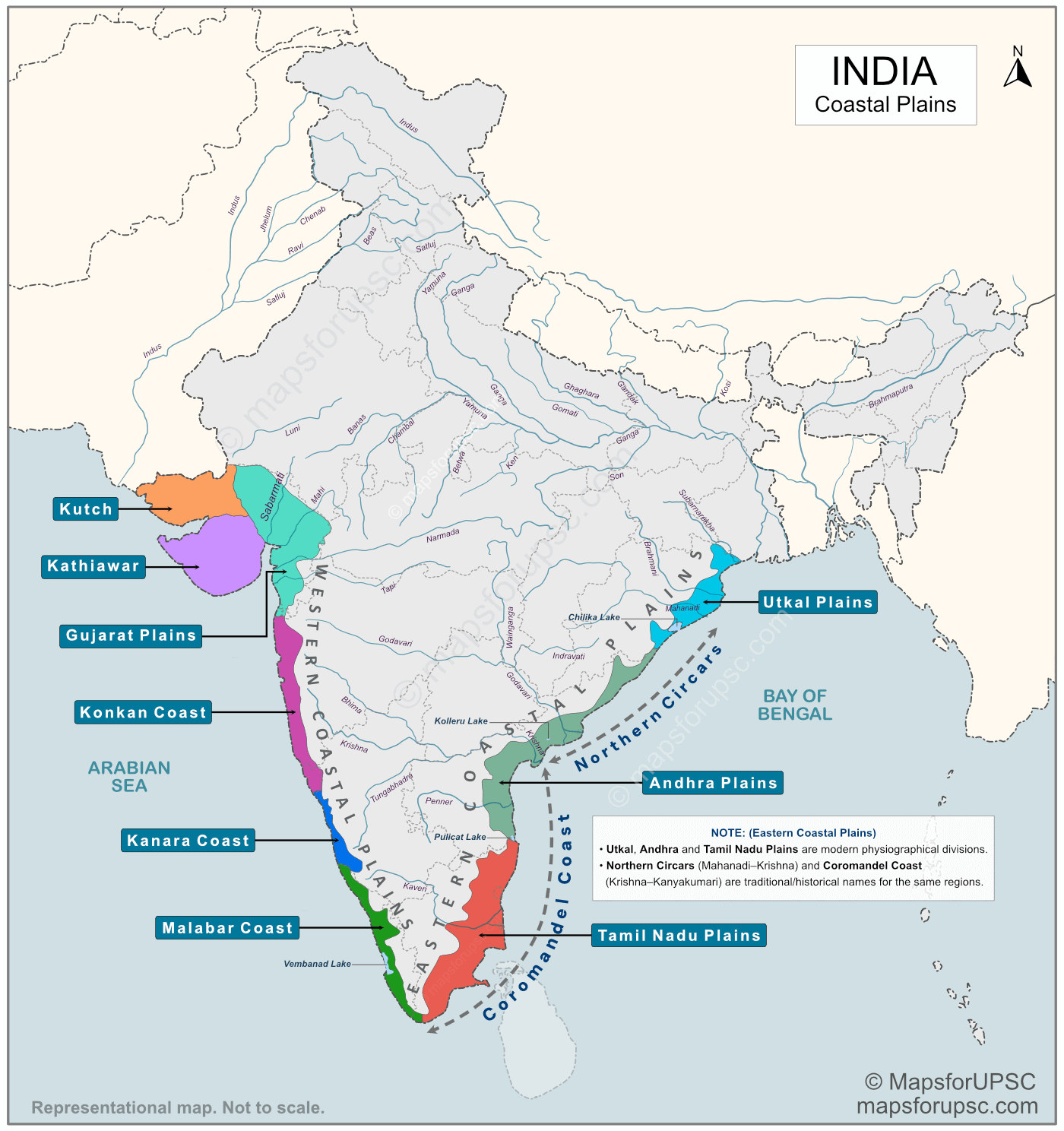
Source: MapsforUPSC — Coastal Plains of India: Map, Divisions and Key Features - UPSC · mapsforupsc.com
Trap: Linking coastal Coromandel with continental crop soybean
Remember: Deltaic coast = rice, black soil plateau = soybean
Madhya Pradesh produces 60% of India's soybean, not coastal regions
Areca Nut Cultivation Zones
Geography Areca nut
Areca Nut: Tropical Coastal Cultivation Requirements
Areca nut (betel nut) needs warm, humid tropical climate
Major producers: Karnataka (70%), Kerala, Assam
Requires 1,500mm+ rainfall and coastal/high humidity areas
Cannot grow in cold, dry regions like Kinnaur
Climatic Requirements
Areca nut (also called betel nut) is a tropical palm requiring high temperature (25-35°C), heavy rainfall (1,500mm+), and high humidity. This limits cultivation to specific coastal and northeastern regions.
Major Areca Nut Producing Regions
State | Production Share | Key Districts | Favorable Conditions |
|---|---|---|---|
Karnataka | 70% | Shimoga, Uttara Kannada, Dakshina Kannada | Western Ghats, heavy rainfall |
Kerala | 15% | Kasaragod, Kannur, Kozhikode | Coastal humidity, monsoon |
Assam | 8% | Kamrup, Nagaon | High rainfall, riverine humidity |
Tamil Nadu | 3% | Kanyakumari | Coastal tropical climate |
Trap: Confusing areca nut with walnut (which grows in Kashmir/Himachal)
Remember: Areca = coastal tropical, Walnut = temperate hills
Karnataka dominates areca production (70%), not northeastern states
Major Mango Cultivation Regions
Geography Mango
India's Premier Mango Growing Regions & Varieties
Malihabad (UP) — famous for Dasheri and Safeda varieties
Ratnagiri (Maharashtra) — Alphonso mango capital
Malda (West Bengal) — Fazli and Langra varieties
Mango needs 750mm+ rainfall and sub-tropical to tropical climate
Climatic Requirements
Mango cultivation requires sub-tropical to tropical climate with 750-1,250mm annual rainfall, well-drained soil, and warm temperatures (24-30°C). This explains why arid Mewat cannot support mango orchards.
Famous Mango Regions & Varieties
Region | State | Famous Variety | Special Feature | Harvest Season |
|---|---|---|---|---|
Malihabad | Uttar Pradesh | Dasheri, Safeda | Sweet, excellent aroma | June-July |
Ratnagiri | Maharashtra | Alphonso | King of mangoes, export quality | April-May |
Malda | West Bengal | Fazli, Langra | Large size, late variety | July-August |
Chittoor | Andhra Pradesh | Banganapalli | Golden color, fiber-free | May-June |
Krishnagiri | Tamil Nadu | Salem variety | Processing grade | May-July |
Trap: Assuming every region can grow mangoes — arid zones cannot
Remember: Malihabad-UP for Dasheri, Ratnagiri for Alphonso
Mewat's low rainfall (300-500mm) vs mango need (750mm+)
Soybean Cultivation Regions
Geography Soya bean Coromandel
Soybean Cultivation: Central India's Black Soil Belt
Madhya Pradesh is called the 'Soya State' — produces 60% of India's soybean
Black cotton soil (regur) in central India ideal for soybean
NOT grown on coastal deltaic plains like Coromandel
Other producers: Maharashtra, Rajasthan, Karnataka
Geographic Distribution
Soybean thrives in the black cotton soil belt of central India, particularly Madhya Pradesh which alone produces 60% of national output. The Coromandel coast's deltaic alluvium is unsuitable for soybean cultivation.
Soybean vs Rice Growing Conditions
Crop | Ideal Soil | Rainfall (mm) | Temperature (°C) | Major Regions | Drainage Need |
|---|---|---|---|---|---|
Soybean | Black cotton soil | 750-1,000 | 20-30 | MP, Maharashtra | Well-drained |
Rice | Alluvial/deltaic | 1,200-2,500 | 22-32 | Coromandel, Bengal | Water-logged fields |
India's Soybean Belt
# Soybean Cultivation
## **Madhya Pradesh (60%)**
- Indore
- Ujjain
- Dewas
- Sehore districts
## **Maharashtra (20%)**
- Marathwada
- Vidarbha regions
## **Rajasthan (10%)**
- Kota
- Bundi districts
## **Karnataka (5%)**
- Northern districtsTrap: Linking deltaic Coromandel with upland crop soybean
Remember: Black soil plateau = soybean, river deltas = rice
MP is Soya State — this fact appears frequently in UPSC questions