Among the following States, which one has the most suitable climatic conditions for the cultivation of a large variety of orchids with minimum cost of production, and can develop an export oriented industry in this field?
Contents16
- AAndhra Pradesh
- BArunachal Pradesh
- CMadhya Pradesh
- DUttar Pradesh
Show answer
Answer: (B) Arunachal Pradesh
The answer is (b) — Arunachal Pradesh.
Arunachal Pradesh is home to approximately 600+ species of orchids (out of India's ~1,300+ species) — the highest concentration in India.
Why Arunachal Pradesh is ideal for orchids:
(1) Climate: Cool, humid montane climate with temperatures between 10-25°C — orchids thrive in cool, moist conditions.
(2) Altitude variation: From 150m to 7,000m — different orchid species grow at different altitudes, so variety is naturally high.
(3) High rainfall: 2,000-5,000 mm annually — orchids need consistent moisture.
(4) Low cost of production: Orchids grow NATURALLY here — minimal artificial climate control needed, unlike in plains states where greenhouses would be required.
Why not others?
- Andhra Pradesh/Tamil Nadu = too hot and dry for most orchid species.
- Madhya Pradesh = landlocked, hot summers, not humid enough.
- Uttar Pradesh = extreme temperatures (hot summers, cold winters).
Northeast India (especially Arunachal Pradesh and Sikkim) is called the 'orchid paradise of India.'
Arunachal Pradesh has the highest orchid diversity in India with over 600 species out of India's 1,300+ total species, making it the natural orchid capital.
The Northeast's montane climate with cool temperatures, high humidity, and consistent rainfall allows orchids to grow naturally without expensive artificial climate control needed in plains states.
UPSC is testing whether students can connect India's biodiversity hotspots with their specific climatic advantages for commercial cultivation.
Arunachal Pradesh Orchid Paradise
Geography Arunachal Pradesh orchids
Arunachal Pradesh: India's Orchid Paradise & Export Hub
Arunachal Pradesh has 600+ orchid species — highest concentration in India
Cool humid montane climate (10-25°C) ideal for orchid cultivation
Natural growing conditions reduce production costs for export industry
Called 'Orchid Paradise of India' along with Sikkim
Why Arunachal Pradesh
Arunachal Pradesh offers the most cost-effective orchid cultivation in India because orchids grow naturally in its montane climate. Unlike plains states that require expensive greenhouses and climate control, Arunachal's natural conditions minimize artificial inputs, making it ideal for export-oriented orchid industry.
Climatic Advantages
Factor | Arunachal Pradesh | Why Orchids Thrive |
|---|---|---|
Temperature | 10-25°C year-round | Orchids need cool, stable temperatures |
Rainfall | 2,000-5,000 mm annually | High moisture essential for orchid growth |
Humidity | High due to montane climate | Orchids are epiphytes needing humid air |
Altitude Range | 150m to 7,000m | Different species grow at different elevations |
Orchid Distribution
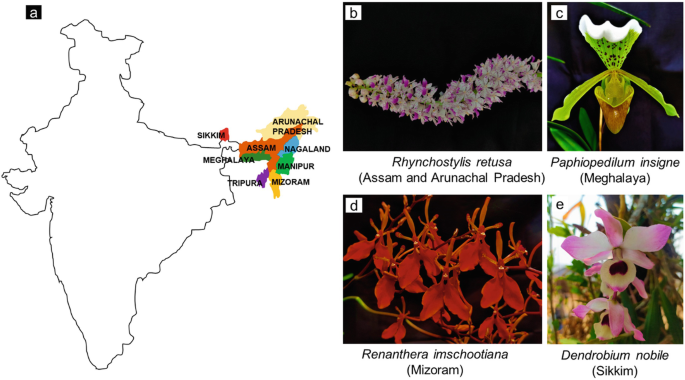
Source: Springer Nature — In Vitro Conservation and Propagation of Endangered Ethno ... · link.springer.com
Export Industry Potential
Low production costs due to natural growing conditions — no expensive greenhouses needed
High species diversity allows cultivation of rare and valuable orchid varieties
Strategic location near international borders facilitates export logistics
Government support through Orchid Mission and Northeast development schemes
Trap: Students might pick Andhra Pradesh thinking coastal = humid, but orchids need cool humidity, not hot coastal humidity
Trap: Madhya Pradesh has forests but lacks the high rainfall and cool temperatures orchids require
Trap: Uttar Pradesh has diverse agriculture but extreme temperature variations unsuitable for orchids
Key insight: Natural growing conditions = minimum cost — this eliminates all plains states
Orchid Cultivation Climate Requirements
Geography climatic conditions cultivation minimum cost
Climate Requirements for Commercial Orchid Cultivation
Orchids need cool temperatures (10-25°C) and high humidity
Consistent moisture through high rainfall (2000+ mm) essential
Most orchids are epiphytes — grow on other plants, need humid air
Orchid Biology
Most orchids are epiphytes — they grow on other plants (not parasitically) and absorb moisture from humid air through specialized aerial roots. This explains why they need consistent humidity and stable cool temperatures rather than soil-based cultivation like regular crops.
Climate vs Cost Analysis
Climate Type | Natural Conditions | Artificial Requirements | Production Cost |
|---|---|---|---|
Montane (NE India) | Cool, humid, high rainfall | Minimal — natural shade, moisture | Low |
Tropical Plains | Hot, variable humidity | Greenhouses, cooling, irrigation | High |
Arid/Semi-arid | Hot, dry, low rainfall | Complete climate control needed | Very High |
Coastal Plains | Warm, humid but hot | Cooling systems, shade houses | Medium-High |
Cost-Effective Cultivation
%%{init: {"flowchart": {"wrappingWidth": 460}}}%%
flowchart TD
  s1["`**Natural Cool Climate**
10-25°C temperature range eliminates cooling costs`"]
  s2["`**High Rainfall**
2000+ mm reduces irrigation and humidity control costs`"]
  s3["`**Natural Shade**
Forest canopy provides optimal light conditions`"]
  s4["`**Low Input Costs**
Minimal artificial climate control = export competitiveness`"]
  s1 --> s2
  s2 --> s3
s3 --> s4Cost trap: Question asks for minimum cost — this eliminates any state needing artificial climate control
Climate confusion: Humid ≠ suitable — coastal humidity is hot, orchids need cool humidity
Variety trap: 'Large variety' needs altitude variation — plains states have uniform elevation
India's Orchid Biodiversity & Distribution
Geography variety of orchids
Orchid Biodiversity Across Indian Biogeographic Zones
India has 1,300+ orchid species — 4th richest country globally
Northeast India has 70% of India's orchid species
Western Ghats and Eastern Himalayas are major orchid hotspots
State-wise Orchid Distribution
Region/State | Orchid Species | Key Features | Conservation Status |
|---|---|---|---|
Arunachal Pradesh | 600+ | Highest diversity, montane species | Many endemic, threatened |
Sikkim | 500+ | Alpine and temperate orchids | Orchid sanctuary established |
Meghalaya | 400+ | Epiphytic species, Khasi Hills | High endemism |
Western Ghats | 300+ | Tropical orchids, monsoon adapted | Habitat fragmentation threat |
Assam | 250+ | Lowland and hill species | Commercial cultivation potential |
Orchid Hotspots
# India's Orchid Regions
## Northeast India
- Arunachal Pradesh (600+)
- Sikkim (500+)
- Meghalaya (400+)
- Assam (250+)
## Western Ghats
- Kerala
- Karnataka
- Tamil Nadu
- Maharashtra
## Eastern Himalayas
- Darjeeling Hills
- Bhutan border areas
- High altitude species
Conservation Challenges
Habitat loss due to deforestation and shifting cultivation in Northeast
Illegal collection for ornamental trade threatens rare species
Climate change affecting altitude-specific orchid distributions
CITES protection for many orchid species regulates international trade
State Climate Comparison for Cultivation
Geography Andhra Pradesh Madhya Pradesh Uttar Pradesh
Why Other States Unsuitable for Orchid Cultivation
Plains states have extreme temperatures unsuitable for orchids
Hot dry climate requires expensive artificial cooling and humidity control
Montane climate is essential for natural, cost-effective orchid growing
Climate Comparison Analysis
State | Temperature Range | Rainfall | Why Unsuitable for Orchids |
|---|---|---|---|
Andhra Pradesh | 20-45°C | 600-1200 mm | Too hot and dry; needs expensive cooling |
Madhya Pradesh | 5-45°C | 800-1500 mm | Extreme temperature variation; continental climate |
Uttar Pradesh | 0-45°C | 600-1200 mm | Very extreme temperatures; hot summers, cold winters |
Arunachal Pradesh | 10-25°C | 2000-5000 mm | Ideal: Cool, humid, stable temperatures |
Cost Implications
Andhra Pradesh: Coastal areas too hot, inland areas too dry — needs climate-controlled greenhouses
Madhya Pradesh: Continental climate with 45°C summers requires expensive cooling systems
Uttar Pradesh: Extreme seasonal variation (0-45°C) needs both heating and cooling infrastructure
Plains cultivation cost: 5-10x higher due to artificial climate control requirements
Andhra Pradesh trap: Students think coastal = humid, but hot humidity kills orchids
Madhya Pradesh trap: Has forests like Northeast, but lacks cool montane climate
Uttar Pradesh trap: Large agricultural state, but temperature extremes make orchid cultivation impossible
Key elimination: Any state with summer temperatures above 30°C is automatically unsuitable