Consider the following crops of India: 1. Groundnut 2. Sesamum 3. Pearl millet Which of the above is/are predominantly rainfed crop/crops?
Contents15
- A1 and 2 only
- B2 and 3 only
- C3 only
- D1, 2 and 3
Show answer
Answer: (D) 1, 2 and 3
All three crops are predominantly rainfed in India:
Groundnut (statement 1) — mostly grown in rainfed conditions in Gujarat, Rajasthan, Andhra Pradesh, and Karnataka.
Sesamum/til (statement 2) — a dryland crop grown primarily under rainfed conditions.
Pearl millet/bajra (statement 3) — the most drought-tolerant cereal, specifically adapted to arid and semi-arid regions with low rainfall (like Rajasthan and Gujarat).
None of these crops primarily depend on irrigation for cultivation.
Answer: 1, 2 and 3.
These three crops are specifically adapted to survive in low-rainfall conditions without irrigation - groundnut in semi-arid regions, sesamum as a dryland crop, and pearl millet as the most drought-tolerant cereal.
The question tests whether students can distinguish rainfed crops (grown without irrigation) from irrigated crops like rice and sugarcane, focusing on crops suited to India's arid and semi-arid zones.
Groundnut Cultivation in India
Geography Groundnut
Groundnut: India's Major Rainfed Oilseed Crop
Groundnut is India's largest rainfed oilseed crop
Gujarat leads production (40% of India's total)
Grown as kharif crop (June-October)
Requires 500-750mm annual rainfall
Groundnut is predominantly a rainfed crop in India, thriving in areas with moderate rainfall and well-drained soils. Unlike sugarcane or rice, groundnut cultivation relies mainly on monsoon rains rather than irrigation.
Major Groundnut Producing States
State | Share in Production | Key Districts | Cropping Season |
|---|---|---|---|
Gujarat | 40% | Junagadh, Rajkot, Jamnagar | Kharif (June-Oct) |
Andhra Pradesh | 20% | Anantapur, Chittoor, Kurnool | Kharif & Rabi |
Tamil Nadu | 10% | Vellore, Dharmapuri | Kharif & Rabi |
Karnataka | 8% | Dharwad, Belgaum | Kharif |
Rajasthan | 6% | Bikaner, Churu | Kharif |
Rainfed Cultivation Features
Grows well in red, black, and alluvial soils with good drainage
500-750mm annual rainfall is optimal - excess water causes pod rot
Drought-tolerant once established, can withstand dry spells
95% of area is rainfed; only small portions use irrigation in Tamil Nadu
Peak growing season aligns with southwest monsoon (June-September)
Groundnut Growing Regions
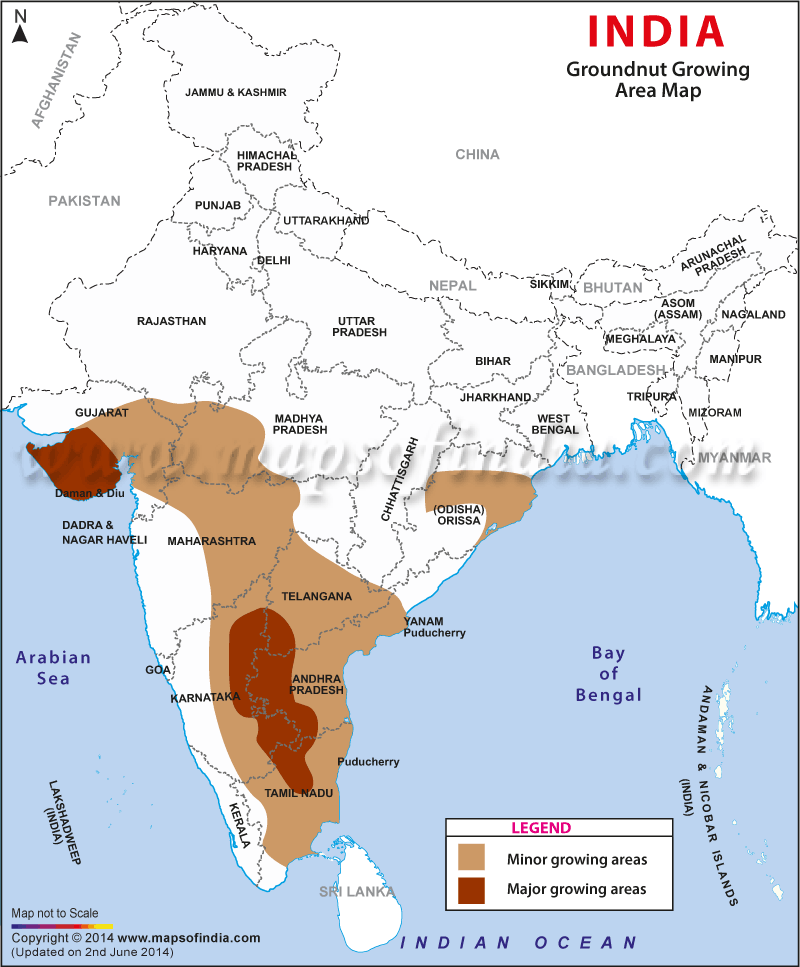
Source: India Map — Groundnut growing areas map, Groundnut growing areas in India · www.mapsofindia.com
Trap: Assuming oilseeds need irrigation - groundnut is predominantly rainfed
Trap: Confusing with sugarcane or rice which are water-intensive crops
Trap: Gujarat's high production doesn't mean irrigated - it's still rainfed
Confusion: Rabi groundnut exists but kharif (rainfed) dominates overall production
Sesamum (Til) Cultivation
Geography Sesamum
Sesamum (Til): India's Ancient Dryland Oilseed
Sesamum (Til) is a classic dryland rainfed crop
Requires only 400-600mm rainfall annually
West Bengal leads production, followed by Rajasthan
Grown in both kharif and rabi seasons
Sesamum is one of India's oldest dryland crops, specifically adapted to rainfed conditions. Known as til in Hindi, it thrives in areas with limited water availability and is rarely irrigated.
Sesamum Production Pattern
Aspect | Details | UPSC Relevance |
|---|---|---|
Water Requirement | 400-600mm annual rainfall | Low water needs = rainfed |
Soil Type | Well-drained, sandy loam | Avoids waterlogging |
Major States | West Bengal, Rajasthan, UP | Diverse agro-climatic zones |
Cropping Season | Kharif (70%) + Rabi (30%) | Monsoon-dependent |
Irrigation | <10% of total area | Predominantly rainfed |
Dryland Adaptation Features
Deep root system helps extract moisture from lower soil layers
Waxy coating on leaves reduces water loss through transpiration
Can complete lifecycle in 90-120 days before soil moisture depletes
Performs better in marginal lands where other oilseeds may fail
Traditional crop in water-scarce regions of Rajasthan and Gujarat
Trap: Thinking West Bengal = irrigation - sesamum is rainfed even there
Confusion: Sesame oil's value doesn't indicate irrigated cultivation
Trap: Associating oilseeds with modern farming - til is traditional dryland crop
Pearl Millet (Bajra) Cultivation
Geography Pearl millet
Pearl Millet (Bajra): India's Most Drought-Tolerant Cereal
Pearl millet (Bajra) is the most drought-tolerant cereal in India
Rajasthan produces 40% of India's bajra
Survives on just 250-500mm annual rainfall
100% rainfed - no irrigation required
Pearl millet is specifically evolved for arid and semi-arid regions, making it the ideal rainfed crop for India's driest areas. Unlike wheat or rice, bajra thrives where other cereals would fail completely.
Pearl Millet vs Other Cereals
Crop | Water Requirement | Drought Tolerance | Main Growing Regions | Irrigation Dependency |
|---|---|---|---|---|
Pearl Millet | 250-500mm | Highest | Rajasthan, Gujarat, Haryana | 0% (fully rainfed) |
Wheat | 450-650mm | Moderate | Punjab, UP, Haryana | 80% irrigated |
Rice | 1000-2500mm | Lowest | West Bengal, Punjab, AP | 95% irrigated |
Maize | 500-750mm | Moderate | Karnataka, AP, Bihar | 40% irrigated |
Bajra's Drought Adaptations
# Pearl Millet Drought Tolerance
## **Root System**
- **Deep taproot** (2-3 meters)
- **Extensive lateral roots**
- **Efficient water extraction**
## **Leaf Adaptations**
- **Narrow leaves** reduce water loss
- **Waxy coating**
- **Rolled leaves** in stress
## **Growth Cycle**
- **Short duration** (75-90 days)
- **Fast germination**
- **Early maturity**
## **Physiological**
- **C4 photosynthesis**
- **Heat tolerance**
- **Salt tolerance**
Bajra Growing Belt
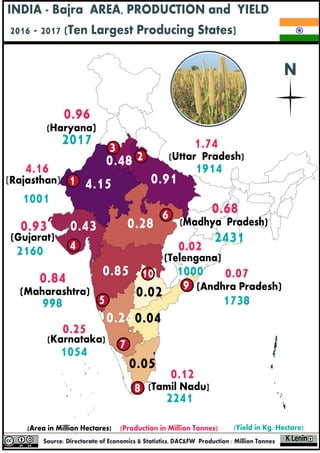
Source: Slideshare — 3.2 India Pearl Millet (Bajra) area production and yield whole map ... · www.slideshare.net
Trap: Thinking cereals need more water - bajra needs least water among all cereals
Confusion: Rajasthan = desert = no agriculture - bajra proves this wrong
Trap: Assuming food security crops are irrigated - bajra feeds millions without irrigation
Memory aid: Bajra = Barren areas - grows where nothing else can
Rainfed vs Irrigated Agriculture
Geography
Rainfed Agriculture: India's Monsoon-Dependent Farming
65% of India's cultivated area is rainfed
Rainfed crops depend entirely on monsoon rainfall
Millets, pulses, oilseeds are predominantly rainfed
Rice, wheat, sugarcane are heavily irrigated
Rainfed agriculture relies entirely on natural precipitation without artificial water supply. In India, this system covers the majority of farmland and supports crops adapted to variable rainfall patterns.
Rainfed vs Irrigated Crop Classification
Crop Category | Predominantly Rainfed Examples | Predominantly Irrigated Examples | Water Requirement |
|---|---|---|---|
Cereals | Pearl millet, Finger millet, Sorghum | Rice, Wheat | Low vs High |
Oilseeds | Groundnut, Sesamum, Sunflower | Mustard (partial) | Moderate |
Pulses | All major pulses (Arhar, Gram, Lentil) | None | Low |
Cash Crops | Cotton (dryland variety) | Sugarcane, Banana | Variable vs Very High |
Spices | Turmeric, Coriander, Cumin | Cardamom (plantation) | Low to Moderate |
Key Characteristics of Rainfed Crops
Drought tolerance - survive with limited and irregular water supply
Deep root systems - access groundwater and soil moisture efficiently
Short growing cycles - complete lifecycle before monsoon ends
Low water requirements - typically need <750mm annual rainfall
Risk resilience - adapted to rainfall variability and dry spells
How UPSC Tests This Concept
%%{init: {"flowchart": {"wrappingWidth": 460}}}%%
flowchart TD
  s1["`****Crop List Given****
Question provides 3-4 crop names`"]
  s2["`****Identify Water Needs****
Recall each crop's water requirement and farming method`"]
  s3["`****Apply Rainfed Logic****
Drought-tolerant crops = rainfed; Water-intensive crops = irrigated`"]
  s4["`****Cross-Check Geography****
Crops grown in arid regions (Rajasthan/Gujarat) are usually rainfed`"]
  s1 --> s2
  s2 --> s3
s3 --> s4Trap: High-value crops = irrigated assumption - groundnut is valuable but rainfed
Confusion: Commercial importance ≠ irrigation dependency
Trap: Gujarat/Rajasthan agriculture = must be irrigated - many crops are rainfed there
Memory trick: Millets, Pulses, Oilseeds = MPO = Mostly rainfed