The lower Gangetic plain is characterised by humid climate with high temperature throughout the year. Which one among the following pairs of crops is most suitable for this region?
Contents19
- APaddy and cotton
- BWheat and Jute
- CPaddy and Jute
- DWheat and cotton
Show answer
Answer: (C) Paddy and Jute
The lower Gangetic plain (West Bengal, Bangladesh) has a HOT and HUMID climate with heavy rainfall. The crops must match these conditions:
PADDY (rice): Needs standing water, high temperature, high humidity, heavy rainfall (>100 cm). ✓ Perfect match.
JUTE: Needs hot and humid climate, well-drained fertile soil, regular rainfall. ✓ Perfect match.
Why not the others?
WHEAT: Needs cool/cold climate, moderate rainfall (50-75 cm) — grown in Punjab, Haryana, UP. ✗
COTTON: Needs warm climate but LOW humidity, black soil, moderate rainfall — grown in Gujarat, Maharashtra. ✗
So combinations with wheat or cotton are eliminated. Only Paddy + Jute = (c) fits the hot, humid, high-rainfall conditions of the lower Gangetic plain.
The lower Gangetic plain includes West Bengal and parts of Bangladesh, receiving over 150 cm annual rainfall with year-round high humidity.
UPSC is testing whether students can match specific climate conditions (hot, humid, high rainfall) to appropriate crops rather than just memorizing crop names.
The question eliminates wheat (cool climate crop) and cotton (low humidity crop) to test understanding of agro-climatic zones.
Lower Gangetic Plain Climate
Geography lower Gangetic plain humid climate high temperature
Lower Gangetic Plain: Climate Characteristics & Agricultural Suitability
Lower Gangetic Plain has hot and humid climate with heavy rainfall throughout the year
Covers West Bengal and Bangladesh primarily
Annual rainfall exceeds 150 cm, temperature stays high year-round
Suitable for water-intensive crops like paddy and jute
Geographic Context
The Lower Gangetic Plain refers to the eastern portion of the Ganga basin, primarily covering West Bengal and extending into Bangladesh. This region experiences a tropical monsoon climate with consistently high temperatures and heavy rainfall.
Climate Characteristics
Climate Element | Lower Gangetic Plain | Comparison with Upper Plains |
|---|---|---|
Temperature | High year-round (25-35°C) | Upper plains have cooler winters |
Humidity | Very high (80%+) | Upper plains are drier |
Rainfall | 150+ cm annually | Upper plains get 50-100 cm |
Season Pattern | Heavy monsoon, mild winter | Distinct hot, cold, monsoon seasons |
Soil Moisture | High throughout year | Varies seasonally in upper plains |
Regional Location
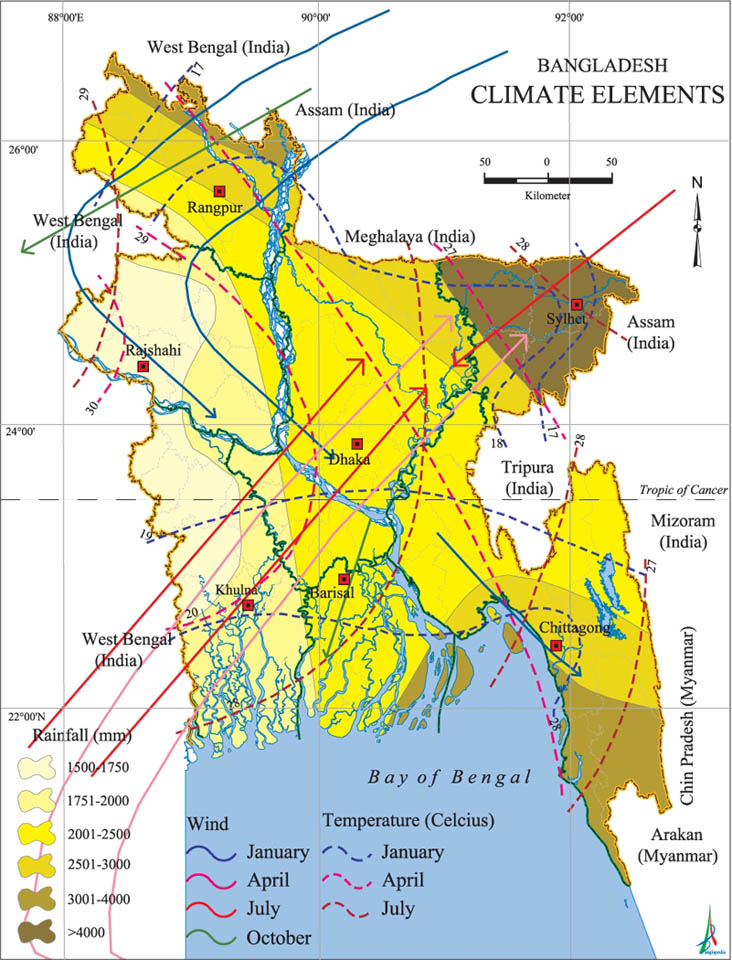
Source: Banglapedia — Climate - Banglapedia · en.banglapedia.org
Question Connection
This question tests understanding that climate determines crop suitability. The lower Gangetic plain's hot-humid conditions with heavy rainfall make it ideal for water-loving crops, eliminating options with wheat or cotton.
Trap: Confusing lower (eastern, humid) with upper (western, drier) Gangetic plain climate
Trap: Assuming wheat grows everywhere in Gangetic plains - it needs cooler, drier conditions
Trap: Missing that cotton needs low humidity despite warm temperature requirement
Paddy Cultivation Requirements
Geography Paddy
Paddy (Rice): Climatic Requirements & Distribution in India
Paddy needs standing water, high temperature (20-35°C), and heavy rainfall (100+ cm)
India's largest crop by area, grown mainly in eastern and southern states
Kharif crop sown in monsoon (June-July), harvested in winter
West Bengal is India's largest rice producer
Why Paddy Fits Lower Gangetic Plain
Paddy is perfectly suited to hot, humid, high-rainfall conditions because it requires standing water in fields during growth. The crop thrives in temperatures above 20°C and needs abundant water supply.
Paddy Growing Conditions
Requirement | Specification | Lower Gangetic Plain Match |
|---|---|---|
Temperature | 20-35°C | ✓ High year-round temperature |
Water | Standing water in fields | ✓ Heavy rainfall + rivers |
Rainfall | 100+ cm annually | ✓ 150+ cm rainfall |
Humidity | High humidity preferred | ✓ Very humid climate |
Soil | Clayey alluvial soil | ✓ Fertile Gangetic alluvium |
Growing Season | 150-180 days | ✓ Long warm season available |
Major Rice Regions in India
West Bengal - largest producer, perfect deltaic conditions
Andhra Pradesh & Telangana - coastal plains with irrigation
Tamil Nadu - Cauvery delta, multiple crops per year
Odisha - coastal plains with high rainfall
Punjab - high-yielding varieties with canal irrigation
Trap: Thinking rice needs moderate water - it actually needs standing water
Trap: Confusing paddy with wheat - wheat needs dry conditions during harvest
Jute Cultivation Requirements
Geography Jute
Jute: The Golden Fiber's Climatic Needs & Geographic Distribution
Jute needs hot and humid climate with regular rainfall and well-drained fertile soil
West Bengal produces 80%+ of India's jute, concentrated in Hooghly basin
Called Golden Fiber, used for making gunny bags, carpets, ropes
Kharif crop grown during monsoon season
Perfect Match for Lower Gangetic Plain
Jute thrives in the exact conditions found in lower Gangetic plain - hot, humid climate with abundant rainfall. Unlike cotton which needs dry conditions, jute loves moisture and humidity throughout its growing period.
Jute Cultivation Requirements
Factor | Jute Requirement | Lower Gangetic Plain |
|---|---|---|
Climate | Hot and humid | ✓ Consistently hot and humid |
Temperature | 24-35°C | ✓ High temperature year-round |
Rainfall | Regular rainfall 100+ cm | ✓ Heavy monsoon rainfall |
Humidity | High humidity essential | ✓ Very high humidity levels |
Soil | Well-drained fertile alluvial | ✓ Rich Gangetic alluvium |
Water logging | Brief flooding tolerated | ✓ Monsoon flooding common |
Jute Distribution in India
West Bengal - 80%+ production, Hooghly river basin ideal
Assam - second largest producer, humid climate
Odisha - coastal districts with suitable conditions
Bihar - small production in eastern districts
Bangladesh - world's largest jute producer globally
Question Relevance
Jute's requirement for hot-humid conditions makes it the perfect complement to paddy in lower Gangetic plain. Both crops thrive in high moisture, high temperature environments that would be unsuitable for wheat or cotton.
Trap: Confusing jute with cotton - cotton needs low humidity, jute needs high humidity
Trap: Thinking all fiber crops need similar conditions - jute is moisture-loving, cotton is drought-resistant
Wheat and Cotton Climate Requirements
Geography Wheat cotton
Why Wheat & Cotton Don't Suit Lower Gangetic Plain Climate
Wheat needs cool climate and moderate rainfall - unsuitable for hot, humid conditions
Cotton needs warm but low humidity climate - fails in humid conditions
Both crops grown in western/northwestern India, not eastern humid regions
Understanding climate-crop mismatch eliminates wrong options in UPSC questions
Climate Requirements Comparison
Crop | Temperature Need | Humidity Need | Rainfall Need | Lower Gangetic Plain Match |
|---|---|---|---|---|
Wheat | Cool winters (10-15°C) | Low to moderate | 50-75 cm | ✗ Too hot & humid |
Cotton | Warm (20-30°C) | Low humidity | 50-100 cm | ✗ Too humid |
Paddy | High (20-35°C) | High humidity | 100+ cm | ✓ Perfect match |
Jute | High (24-35°C) | High humidity | 100+ cm | ✓ Perfect match |
Wheat Distribution in India
Punjab & Haryana - largest producers, cool winters essential
Uttar Pradesh - western UP, not eastern humid districts
Madhya Pradesh - central plateau, moderate rainfall zone
Rajasthan - northern districts with canal irrigation
Rabi crop - sown in winter, harvested in spring
Cotton Distribution in India
Gujarat - largest producer, semi-arid climate ideal
Maharashtra - Deccan plateau, black cotton soil
Telangana - dry conditions, moderate rainfall
Punjab - American cotton varieties, canal irrigation
Needs black soil and low humidity for fiber quality
Crop Distribution Pattern
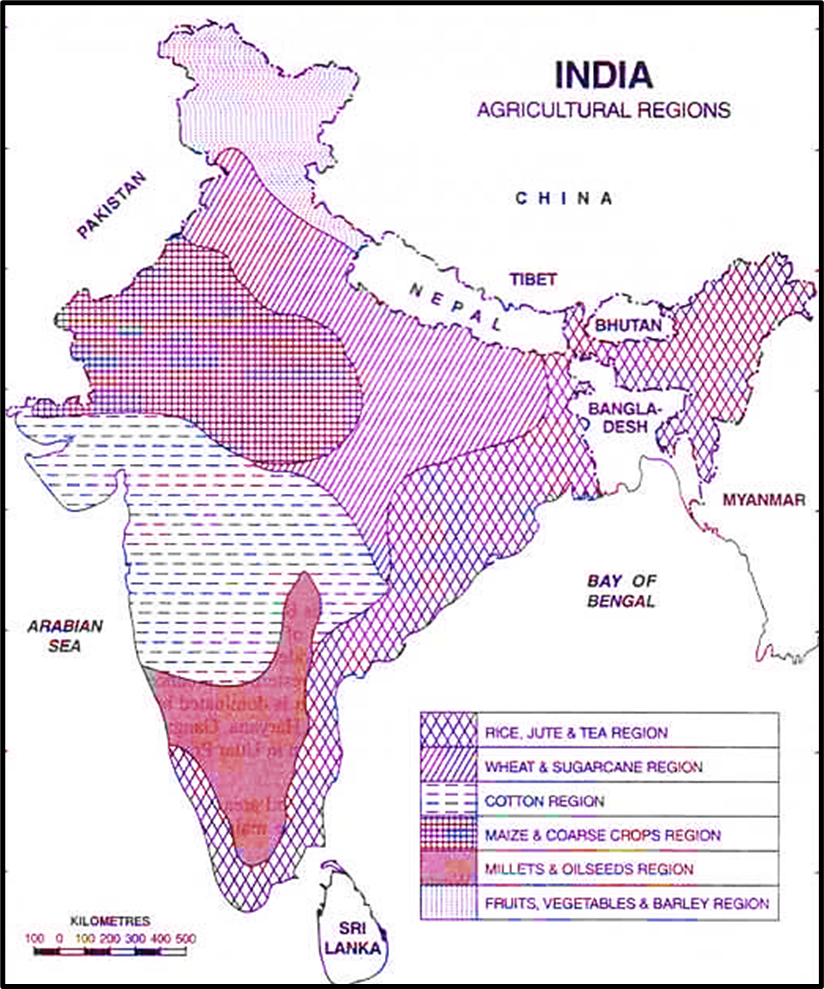
Source: CDH IAS (Clarity Desk Hub) — Agricultural Regionalisation - CDH IAS · claritydeskhub.com
Trap: Assuming warm climate means all warm-weather crops suit the region - humidity matters
Trap: Thinking Gangetic plains = wheat everywhere - eastern Gangetic plain is too humid for wheat
Trap: Missing that cotton needs dry air during fiber development despite warm temperature need