With reference to India, Didwana, Kuchaman, Sargol and Khatu are the names of
Contents13
- Aglaciers
- Bmangrove areas
- CRamsar sites
- Dsaline lakes
Show answer
Answer: (D) saline lakes
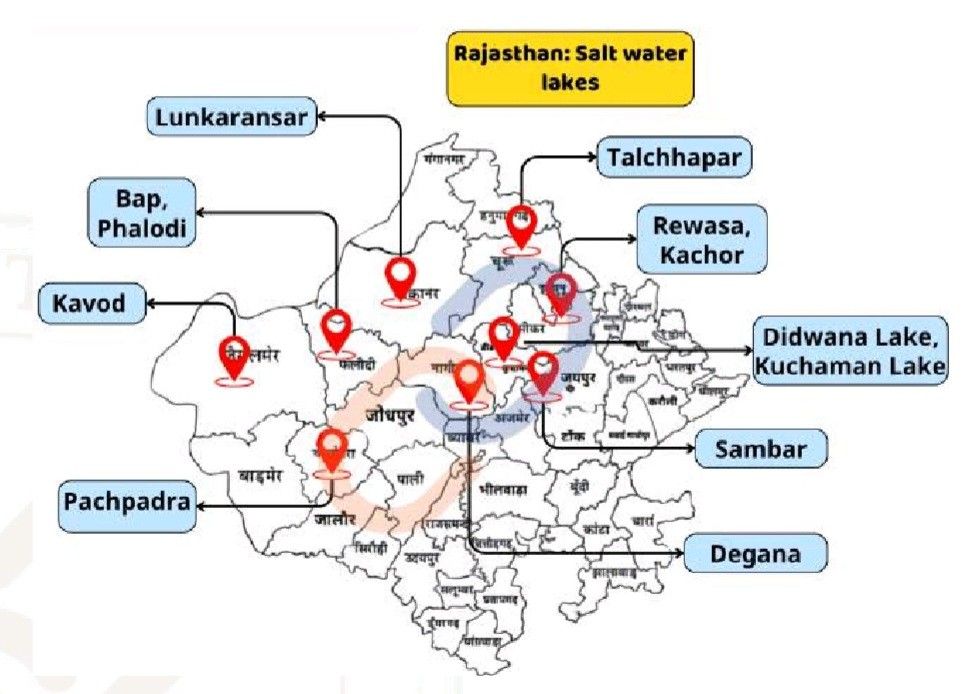
Didwana, Kuchaman, Sargol, and Khatu are all towns in the Nagaur/Sikar area of Rajasthan associated with saline (salt) lakes.
The Didwana salt lake is one of the most well-known saline lakes in Rajasthan.
Kuchaman lake covers about 8.5 sq km in Nagaur district.
These inland saline lakes formed in the arid/semi-arid climate of Rajasthan.
They are not glaciers, mangrove areas, or Ramsar sites.
Answer: (d).
These are all salt lakes in Rajasthan's arid region where high evaporation leaves behind concentrated salt deposits that have been commercially extracted for centuries.
UPSC tests specific geographical features by naming lesser-known locations to check if students have studied regional geography beyond just major rivers and mountains.
Saline Lakes of Rajasthan
Geography Didwana Kuchaman Sargol Khatu saline lakes
Saline Lakes of Rajasthan: Formation & Key Examples
Didwana, Kuchaman, Sargol, and Khatu are saline lakes in Rajasthan
Located in Nagaur and Sikar districts of Rajasthan
Didwana is the most famous salt lake in Rajasthan
Formed due to arid climate and inland drainage in Thar Desert region
What Are Saline Lakes
Saline lakes are inland water bodies with high salt concentration, typically formed in arid regions where evaporation exceeds precipitation. In Rajasthan's semi-arid climate, these lakes become natural salt pans during dry seasons.
Major Saline Lakes in Rajasthan
Lake | District | Area/Significance | Salt Production |
|---|---|---|---|
Didwana | Nagaur | Most famous salt lake | Major commercial salt extraction |
Kuchaman | Nagaur | Covers ~8.5 sq km | Active salt production |
Sargol | Sikar | Smaller lake | Local salt extraction |
Khatu | Sikar | Associated with Khatu town | Traditional salt works |
Rajasthan Salt Lakes Location
Source: RAJ RAS — Major Lakes of Rajasthan - Connect Civils · rajras.in
Formation Process
Inland drainage - rivers flow into depressions with no outlet to sea
High evaporation in arid climate concentrates dissolved salts
Seasonal variation - lakes expand in monsoon, become salt pans in summer
Geological factors - underlying rock formations contribute mineral salts
Trap: Didwana sounds like a hill station but it's actually a salt lake in desert Rajasthan
Trap: These are not Ramsar sites - they're commercially exploited salt lakes, not protected wetlands
Trap: Kuchaman is often confused with tourist places, but here it refers to the saline lake
Common mistake: Associating salt lakes only with Gujarat (Rann of Kachchh) and forgetting Rajasthan's examples
Inland Drainage Systems
Geography
Inland Drainage Systems: Formation & Indian Examples
Inland drainage means rivers don't reach the sea - flow into lakes or disappear
Common in arid and semi-arid regions like Rajasthan
Creates saline lakes due to salt accumulation over time
Luni river system is India's major inland drainage example
Inland vs External Drainage
Most Indian rivers have external drainage - they flow to the sea (Bay of Bengal, Arabian Sea). Inland drainage occurs where rivers flow into enclosed depressions with no outlet, typically in arid regions where evaporation is high.
Drainage Types Comparison
Feature | External Drainage | Inland Drainage |
|---|---|---|
Final destination | Sea or ocean | Lakes or disappears |
Water quality | Fresh water | Saline accumulation |
Climate | Humid to semi-humid | Arid to semi-arid |
Indian example | Ganga, Godavari | Luni, Ghaggar |
Lake formation | Rare | Common (salt lakes) |
Inland Drainage in India
# Indian Inland Drainage
## Rajasthan
- **Luni River**
- **Didwana Lake**
- **Kuchaman Lake**
- Seasonal streams
## Haryana-Punjab
- **Ghaggar River**
- Seasonal lakes
- Lost rivers
## Ladakh
- **Pangong Tso**
- **Tso Moriri**
- High altitude lakesTrap: All rivers in India don't reach the sea - Luni, Ghaggar are major exceptions
Confusion: Inland drainage ≠ peninsular drainage - peninsular rivers mostly reach the sea
Wrong assumption: Desert areas have no rivers - they have inland drainage systems
Ramsar Wetland Sites
Environment Ramsar sites
Ramsar Convention & India's Wetland Sites
Ramsar Convention protects wetlands of international importance
India has 75+ Ramsar sites as of 2023
Chilika Lake (Odisha) was India's first Ramsar site
Sites are chosen for biodiversity, migratory birds, ecological services
Ramsar Convention Basics
The Ramsar Convention on Wetlands (1971) is an international treaty for wetland conservation. Countries designate Wetlands of International Importance that provide critical habitat for waterfowl and maintain ecological character.
Major Indian Ramsar Sites
Ramsar Site | State | Type | Key Feature |
|---|---|---|---|
Chilika Lake | Odisha | Lagoon | Largest coastal lagoon, migratory birds |
Keoladeo Ghana | Rajasthan | Wetland | Bharatpur Bird Sanctuary |
Wular Lake | J&K | Freshwater lake | Largest freshwater lake in India |
Loktak Lake | Manipur | Freshwater lake | Floating islands (phumdis) |
Sundarbans | West Bengal | Mangrove | Tiger reserve, largest mangrove forest |
Why Saline Lakes Aren't Ramsar Sites
Commercial exploitation - salt extraction disturbs natural ecosystem
Seasonal drying - many become salt pans, losing wetland character
Limited biodiversity - high salinity restricts species diversity
Lack of migratory bird habitat - unlike freshwater wetlands that attract waterfowl
Trap: Not all important wetlands are Ramsar sites - commercial lakes like Didwana aren't protected
Confusion: Ramsar sites must maintain ecological character - heavily exploited wetlands don't qualify
Wrong assumption: All lakes in India are Ramsar sites - only 75+ out of thousands qualify