With reference to 'Changpa' community of India, consider the following statements: 1. They live mainly in the State of Uttarakhand 2. They rear the Pashmina goats that yield a fine wool 3. They are kept in the category of Scheduled Tribes Which of the statements given above is/are correct?
Contents17
- A1 only
- B2 and 3 only
- C3 only
- D1, 2 and 3
Show answer
Answer: (B) 2 and 3 only
The Changpa are nomadic pastoralists from the Changthang plateau in Ladakh (now a Union Territory, earlier part of J&K).
Statement 1 — WRONG: They live in Ladakh, NOT Uttarakhand. This is the most common trick in this question.
Statement 2 — CORRECT: They rear Changra goats (Pashmina goats) that produce the world-famous Pashmina wool — one of the finest and most expensive wools.
Statement 3 — CORRECT: Changpas are classified as a Scheduled Tribe.
Memory aid:
Changpa → Changthang → Ladakh → Pashmina.
The Changpa are the only community in India that produces genuine Pashmina wool from their Changra goats in Ladakh's Changthang plateau.
UPSC commonly tests tribal communities by mixing up their locations - here the trap is confusing Ladakh with Uttarakhand.
This tests knowledge of India's high-altitude pastoral communities and their traditional occupations linked to specific geographic regions.
Changpa Tribe of Ladakh
Geography Changpa
Changpa Tribe: Location, Lifestyle & UPSC Traps
Changpa tribe lives in Changthang plateau of Ladakh, not Uttarakhand
They are nomadic pastoralists who rear Changra goats for Pashmina wool
Classified as Scheduled Tribe in Ladakh
Live at altitudes above 4,500 meters in harsh cold desert conditions
Who Are Changpas
The Changpa are nomadic pastoralists who inhabit the Changthang plateau in Ladakh. They are one of the most high-altitude dwelling communities in the world, living above 4,500 meters in extreme cold desert conditions.
Key Facts About Changpas
Aspect | Details |
|---|---|
Location | Changthang plateau, Ladakh (formerly J&K) |
Altitude | Above 4,500 meters |
Lifestyle | Nomadic pastoralists |
Primary Occupation | Rearing Changra goats for Pashmina wool |
Classification | Scheduled Tribe |
Climate | Cold desert with temperatures below -40°C in winter |
Question Connection
This question tests geographic location knowledge. Statement 1 is the main trap - confusing Ladakh (correct) with Uttarakhand (wrong). The connection to Pashmina goats and ST status are factual checks.
Location trap: Changpas live in Ladakh, not Uttarakhand - this is the most tested confusion
Name similarity: Don't confuse Changpa with other tribal names like Chakma or Changthang with Chhattisgarh
Wool confusion: They rear Changra goats (not sheep) for Pashmina (not ordinary wool)
Pashmina Wool & Changra Goats
Geography Pashmina goats fine wool
Pashmina Production: From Changra Goats to Luxury Shawls
Changra goats produce the finest wool called Pashmina
Kashmir is famous for Pashmina shawls made from this wool
Pashmina fiber is 12-16 microns thick - finer than human hair
One goat yields only 80-170 grams of Pashmina per year
What Is Pashmina
Pashmina is the world's finest natural fiber, obtained from Changra goats reared by Changpa nomads. The fiber grows as an undercoat to protect goats from extreme cold at high altitudes.
Pashmina vs Other Wools
Type | Source | Fiber Thickness | Quality | Price Range |
|---|---|---|---|---|
Pashmina | Changra goats (Ladakh) | 12-16 microns | Finest, softest | Very expensive |
Cashmere | Cashmere goats | 15-19 microns | Fine | Expensive |
Shahtoosh | Chiru antelope | 9-12 microns | Finest but banned | Illegal |
Regular Wool | Sheep | 25-40 microns | Coarse | Moderate |
Pashmina Production Process
%%{init: {"flowchart": {"wrappingWidth": 460}}}%%
flowchart TD
  s1["`**Combing Changra Goats**
Fine undercoat fibers collected during molting season (spring)`"]
  s2["`**Fiber Sorting**
Separating finest Pashmina from coarser guard hair`"]
  s3["`**Spinning into Yarn**
Traditional spinning wheels (charkha) used by artisans`"]
  s4["`**Weaving Shawls**
Hand-woven on traditional looms in Kashmir`"]
  s1 --> s2
  s2 --> s3
s3 --> s4Animal confusion: Pashmina comes from goats (Changra), not sheep or yaks
Geographic mix-up: Changra goats are in Ladakh, but Pashmina weaving industry is in Kashmir valley
Banned vs Legal: Shahtoosh (from Chiru) is banned, Pashmina (from goats) is legal
Scheduled Tribes in India
Indian Polity Scheduled Tribes
Scheduled Tribes: Constitutional Framework & Classification
Article 342 empowers President to specify Scheduled Tribes for each state/UT
Parliament can modify the ST list through law, not President alone
STs get reservation in education, jobs, and legislatures
India has over 700 ST communities across different states
Constitutional Basis
Scheduled Tribes are tribal communities listed under Article 342 of the Constitution. The President specifies STs for each state/UT after consultation with state governments, but only Parliament can modify this list.
ST Classification Process
Step | Authority | Process |
|---|---|---|
Initial Specification | President | Consults state governments, issues notification |
Modification | Parliament | Only Parliament can add/remove communities through law |
Criteria Used | Various factors | Primitive traits, geographical isolation, social backwardness |
State-wise Lists | Different for each state | Same community may be ST in one state, not in another |
Key Features of ST Status
Reservation: 7.5% in Lok Sabha, state assemblies, and central/state jobs
Special protections: Land alienation restrictions, forest rights recognition
Welfare schemes: Tribal Sub-Plan, special development programs
Cultural protection: Traditional practices and customs safeguarded
Authority confusion: President specifies initial ST list, but Parliament modifies it (not President alone)
State-specific: Same tribe can be ST in one state but not in another (e.g., Gujjars are ST in J&K but not in Punjab)
Percentage mix-up: STs are 7.5% reservation (not 15% like SCs or 27% like OBCs)
Ladakh Union Territory
Geography
Ladakh: Geography, Climate & Strategic Importance
Ladakh became separate UT in 2019, carved out from J&K
Contains Changthang plateau - world's highest cold desert
Borders China (Aksai Chin) and Pakistan (PoK) - strategically sensitive
Leh is the largest town and administrative center
Geographic Overview
Ladakh is India's largest Union Territory by area, located in the trans-Himalayan region. It includes the Changthang plateau where Changpa nomads live - one of the world's highest and most remote inhabited areas.
Ladakh Location
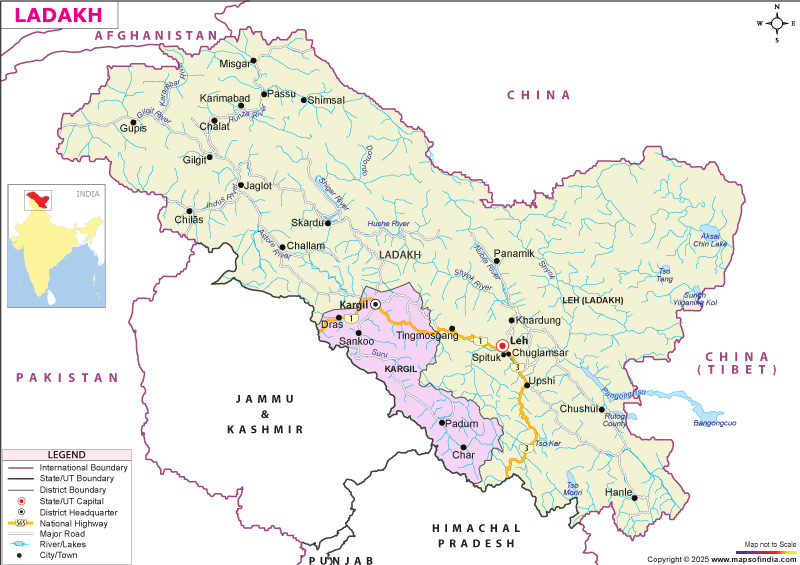
Source: India Map — Ladakh Map - Union Territory Information, Facts and Tourism · www.mapsofindia.com
Ladakh's Geographic Zones
Region | Altitude | Climate | Key Features |
|---|---|---|---|
Changthang Plateau | Above 4,500m | Cold desert | Changpa nomads, Pashmina goats, lakes |
Indus Valley | 3,000-3,500m | Arid | Main settlements, agriculture, Leh town |
Zanskar Range | 4,000-6,000m | Alpine | Glaciers, trekking routes, Buddhist monasteries |
Strategic Importance
Border sensitivity: Shares disputed boundaries with China (Aksai Chin) and Pakistan (PoK)
Military significance: Houses key army bases, airfields for border security
Water resources: Source region for Indus river system
Trade routes: Historical Silk Route passes through Ladakh