Which of the following phenomena might have influenced the evolution of organisms? 1. Continental drift 2. Glacial cycles Select the correct answer using the code given below.
Contents13
- A1 only
- B2 only
- CBoth 1 and 2
- DNeither 1 nor 2
Show answer
Answer: (C) Both 1 and 2
Both continental drift and glacial cycles have profoundly influenced evolution:
Continental drift — as continents moved apart over millions of years, populations of organisms got isolated on different landmasses.
This geographic isolation led to independent evolution (e.g., marsupials evolved uniquely in Australia after it separated from other continents).
Glacial cycles — repeated ice ages caused habitats to expand, contract, and shift.
Species had to adapt, migrate, or go extinct.
Glaciation also created land bridges (like the Bering Strait) that allowed species to cross between continents.
Both are well-established drivers of evolution.
Neither can be excluded.
(Ref: NCERT Class 11 Geography)
Continental drift isolated species on different landmasses for millions of years, forcing independent evolution like marsupials in Australia.
Glacial cycles repeatedly changed habitats and created temporary land bridges like the Bering Strait, driving species migration and adaptation.
The question tests whether students can connect geological processes to biological evolution across deep time.
Continental Drift and Evolution
Geography Continental drift
Continental Drift: How Moving Continents Drive Evolution
Continental drift isolates species on different landmasses, leading to independent evolution
Australia's marsupials evolved uniquely after separation from Gondwana
Geographic isolation prevents gene flow between populations
Continental movement creates new habitats and eliminates others
Continental drift — the movement of Earth's landmasses over geological time — creates geographic barriers that profoundly shape evolution. When continents separate, species populations become isolated and evolve independently.
Continental Drift Effects on Evolution
Process | Mechanism | Example | Evolutionary Result |
|---|---|---|---|
Geographic Isolation | Continents separate | Australia splits from Gondwana | Marsupials evolve uniquely |
Habitat Creation | New environments form | Atlantic Ocean opens | Marine species diversify |
Climate Change | Landmass positions shift | India moves north | Himalayan uplift affects monsoons |
Barrier Formation | Mountain ranges/oceans form | Andes rise, Pacific widens | Species on either side diverge |
Key Evolutionary Mechanisms
Allopatric speciation — populations separated by continental drift evolve into different species
Adaptive radiation — isolated groups diversify to fill available ecological niches
Endemic evolution — continents develop unique flora and fauna (Australia, Madagascar)
Vicariance — widespread species split when continents drift apart
Gondwana Breakup
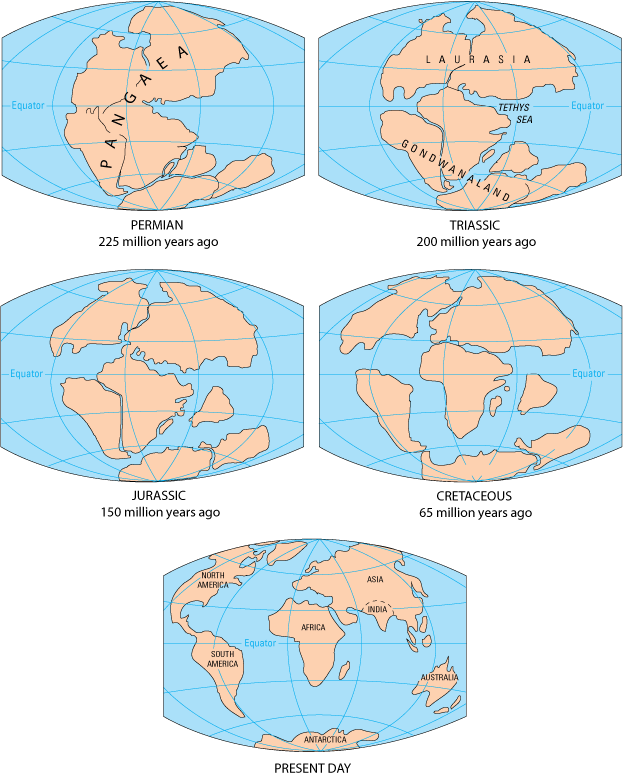
Source: Earthguide — Earthguide: Online Classroom - Definition: Pangaea · earthguide.ucsd.edu
UPSC tests whether students know both continental drift and glacial cycles influence evolution
Don't confuse continental drift (geological) with genetic drift (biological process)
Remember: Australia's marsupials are the classic example of continental drift driving evolution
Glacial Cycles and Evolution
Geography Glacial cycles
Glacial Cycles: Ice Ages as Evolutionary Drivers
Glacial cycles repeatedly expanded and contracted habitats, forcing adaptation
Land bridges during ice ages allowed species migration between continents
Bering land bridge connected Asia and North America during glaciation
Species had to migrate, adapt, or go extinct during climate swings
Glacial cycles — repeated ice ages over the past 2.6 million years — dramatically altered Earth's climate and habitats. These cycles forced species to constantly adapt, migrate, or face extinction.
Glacial Cycle Effects on Evolution
Phase | Environmental Change | Species Response | Evolutionary Impact |
|---|---|---|---|
Glacial Maximum | Ice sheets expand, sea levels drop | Migration via land bridges | Bering Bridge connects Asia-America |
Interglacial Period | Ice melts, sea levels rise | Populations get isolated again | Independent evolution resumes |
Habitat Contraction | Cold-adapted areas shrink | Species crowd into refugia | Genetic bottlenecks occur |
Habitat Expansion | Warming opens new territories | Rapid population growth | Adaptive radiation in new niches |
Glacial Cycle Process
%%{init: {"flowchart": {"wrappingWidth": 460}}}%%
flowchart TD
  s1["`****Ice Age Begins****
Global cooling, ice sheets grow`"]
  s2["`****Sea Levels Drop****
Water locked in ice, land bridges emerge`"]
  s3["`****Species Migration****
Animals cross newly exposed land bridges`"]
  s4["`****Warming Period****
Ice melts, sea levels rise`"]
  s5["`****Populations Isolated****
Land bridges flood, independent evolution begins`"]
  s1 --> s2
  s2 --> s3
  s3 --> s4
  s4 --> s5
Major Evolutionary Consequences
Megafauna extinction — large mammals like mammoths couldn't adapt to rapid climate change
Human migration — Homo sapiens spread globally using glacial land bridges
Species refugia — small populations survived ice ages in warmer pockets, then recolonized
Rapid evolution — climate instability accelerated natural selection pressures
Bering Land Bridge
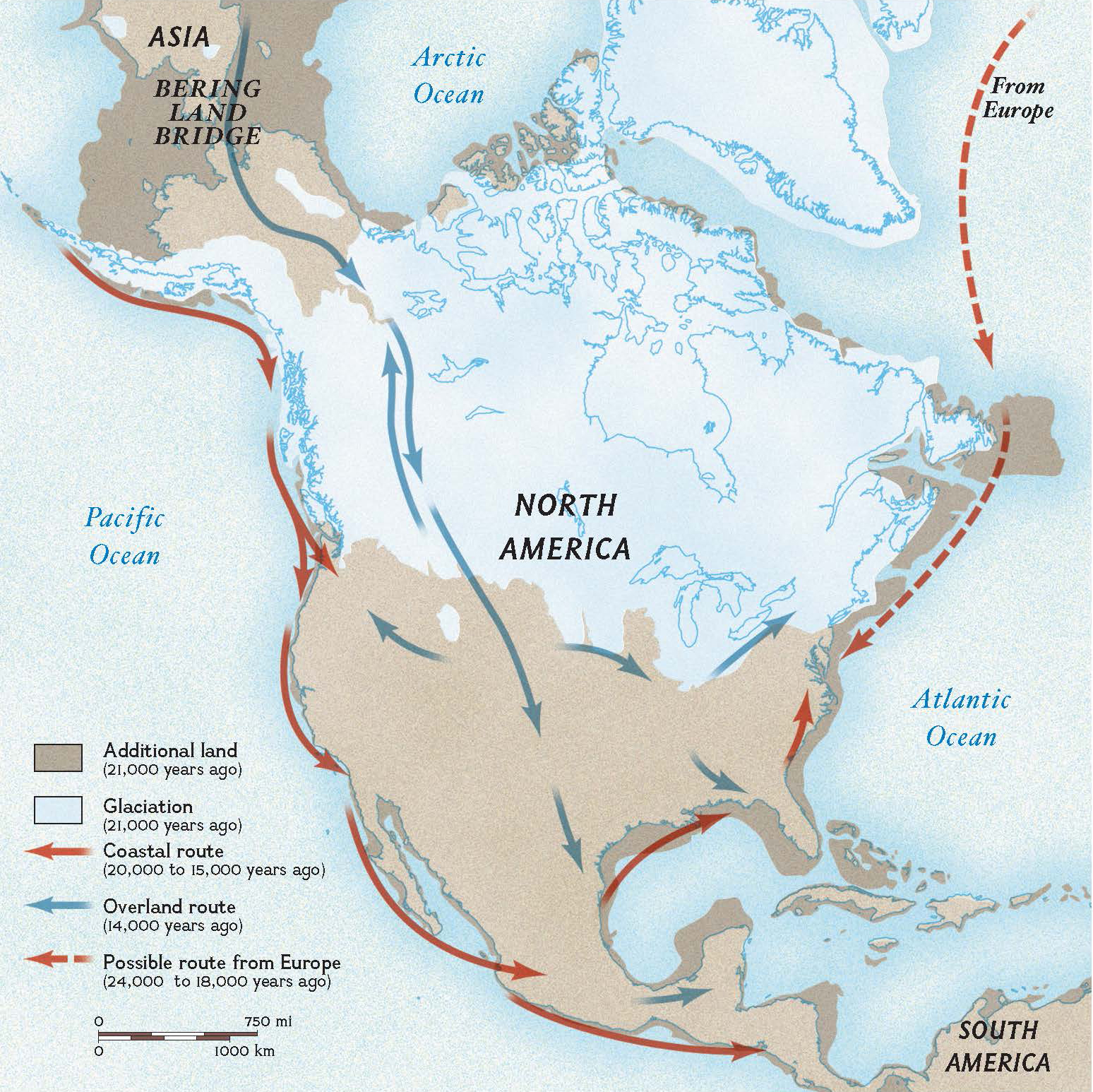
Source: National Geographic Education - National Geographic Society — Bering Land Bridge · education.nationalgeographic.org
Don't pick 'neither' — both continental drift and glacial cycles clearly influenced evolution
Remember: Land bridges form during glaciation when sea levels drop, not when they rise
Pleistocene ice ages (last 2.6 million years) had the strongest impact on current species
Geographic Isolation and Speciation
Geography
Geographic Isolation: The Primary Driver of Speciation
Geographic isolation prevents gene flow, leading to separate evolution
Allopatric speciation occurs when physical barriers separate populations
Islands and isolated landmasses show highest endemic species diversity
Geographic isolation is the most common mechanism driving speciation. When physical barriers separate populations, they evolve independently and can become distinct species.
Types of Geographic Barriers
# Geographic Isolation
## **Continental Drift**
- Ocean formation
- Continent separation
- Australia-Gondwana split
## **Mountain Building**
- Andes formation
- Himalayan uplift
- Valley isolation
## **Sea Level Changes**
- Island formation
- Land bridge emergence
- Glacial flooding
## **Climate Barriers**
- Desert expansion
- Forest fragmentation
- Ice sheet advance
Classic Examples of Geographic Speciation
Region | Barrier Type | Species Example | Time Scale |
|---|---|---|---|
Australia | Ocean separation | Marsupials vs placental mammals | 180 million years |
Galápagos Islands | Ocean isolation | Darwin's finches | 2-3 million years |
Madagascar | Continental drift | Lemurs | 160 million years |
Andes Mountains | Mountain barrier | Separate bird species on each side | 10 million years |
Mechanisms of Isolated Evolution
No gene flow — isolated populations cannot interbreed with original population
Different selection pressures — each group faces unique environmental challenges
Genetic drift — random changes accumulate differently in small isolated populations
Founder effect — small founding population may not represent full genetic diversity
Geographic isolation ≠ genetic isolation — geographic comes first, genetic follows
Sympatric speciation (same location) is possible but much rarer than allopatric (different locations)
Time scales matter: continental drift effects take millions of years, island isolation can work faster