Consider the following statements: 1. In a seismograph, P waves are recorded earlier than S waves. 2. In P waves, the individual particles vibrate to and fro in the direction of wave propagation whereas in S waves, the particles vibrate up and down at right angles to the direction of wave propagation. Which of the statements given above is/are correct?
Contents12
- A1 only
- B2 only
- CBoth 1 and 2
- DNeither 1 nor 2
Show answer
Answer: (C) Both 1 and 2
Both statements are correct.
Statement 1: P-waves travel faster than S-waves, so they arrive at seismographs first (that's why they're called Primary).
Statement 2: In P-waves, particles vibrate parallel to the wave direction, creating compression and stretching (density differences) in the material. S-waves vibrate perpendicular to wave direction.
Answer is (c) Both 1 and 2.
P waves travel faster than S waves, which is why seismologists can calculate earthquake distance by measuring the time gap between when each wave type arrives.
The key difference is particle motion direction: P waves push-pull along the wave path (like sound waves), while S waves shake side-to-side perpendicular to the wave path (like a rope being shaken).
P-Waves (Primary Waves)
Geography P waves Primary
P-Waves: Speed, Motion & Detection
P-waves are the fastest seismic waves, arriving first at seismographs
Particles vibrate parallel to wave direction (compression motion)
Travel through solids, liquids, and gases
P-waves (Primary waves) are compression waves that travel fastest through the Earth's interior. They create alternating zones of compression and rarefaction as they move.
Key Characteristics
Speed: 6-8 km/second in Earth's crust
Motion: Particles vibrate to and fro in the same direction as wave travel
Can pass through all states of matter - solids, liquids, and gases
First to be recorded on seismographs due to higher velocity
How P-Waves Work
%%{init: {"flowchart": {"wrappingWidth": 460}}}%%
flowchart TD
  s1["`**Earthquake occurs**
Energy released at focus/hypocenter`"]
  s2["`**P-waves generated**
Compression waves radiate outward`"]
  s3["`**Rock particles compress**
Material squeezed then stretched alternately`"]
  s4["`**Wave reaches seismograph**
Recorded as first arrival due to high speed`"]
  s1 --> s2
  s2 --> s3
s3 --> s4P stands for Primary, not 'Push' - they arrive first, not because they push
P-waves vibrate parallel to direction - remember P for Parallel
Don't confuse with surface waves - P-waves travel through Earth's interior
S-Waves (Secondary Waves)
Geography S waves Secondary
S-Waves: Shear Motion & Properties
S-waves arrive second at seismographs (slower than P-waves)
Particles vibrate perpendicular to wave direction (shear motion)
Cannot travel through liquids - blocked by outer core
S-waves (Secondary waves) are shear waves that create side-to-side motion. They travel slower than P-waves and cannot pass through liquid layers.
Key Characteristics
Speed: 3-4 km/second in Earth's crust (slower than P-waves)
Motion: Particles vibrate up and down at right angles to wave direction
Travel only through solids - cannot pass through liquids or gases
Create more destructive ground motion than P-waves
Wave Motion Comparison

Source: Science Learning Hub — Seismic waves — Science Learning Hub · www.sciencelearn.org.nz
S stands for Secondary, not 'Shake' - they arrive second after P-waves
S-waves vibrate perpendicular to direction - remember S for Sideways
S-waves cannot travel through Earth's liquid outer core - this creates shadow zones
P-Wave vs S-Wave Comparison
Geography seismograph recorded earlier
P-Waves vs S-Waves: Speed, Motion & Detection
P-waves arrive first at seismographs due to higher speed
Particle motion differs: P-waves (parallel), S-waves (perpendicular)
Time gap between P and S arrivals helps calculate earthquake distance
The fundamental differences between P and S waves determine how earthquakes are detected and analyzed by seismographs worldwide.
P-Wave vs S-Wave Properties
Property | P-Waves | S-Waves |
|---|---|---|
Speed in crust | 6-8 km/sec | 3-4 km/sec |
Arrival order | First (Primary) | Second (Secondary) |
Particle motion | Parallel to wave direction | Perpendicular to wave direction |
Wave type | Compression waves | Shear waves |
Can travel through | Solids, liquids, gases | Solids only |
Seismograph detection | Earlier arrival | Later arrival |
UPSC Connection: Statement 1 is correct because P-waves' higher velocity means they reach seismographs before S-waves. Statement 2 is correct about the directional differences in particle vibration.
Don't reverse the motion: P = Parallel, S = Sideways/perpendicular
P-waves are faster, not stronger - they arrive first but may cause less damage
Both statements in the question are correct - this tests if you know both speed and motion differences
Seismograph & Earthquake Detection
Geography seismograph
Seismographs: Recording Earthquake Waves
Seismographs record ground motion during earthquakes
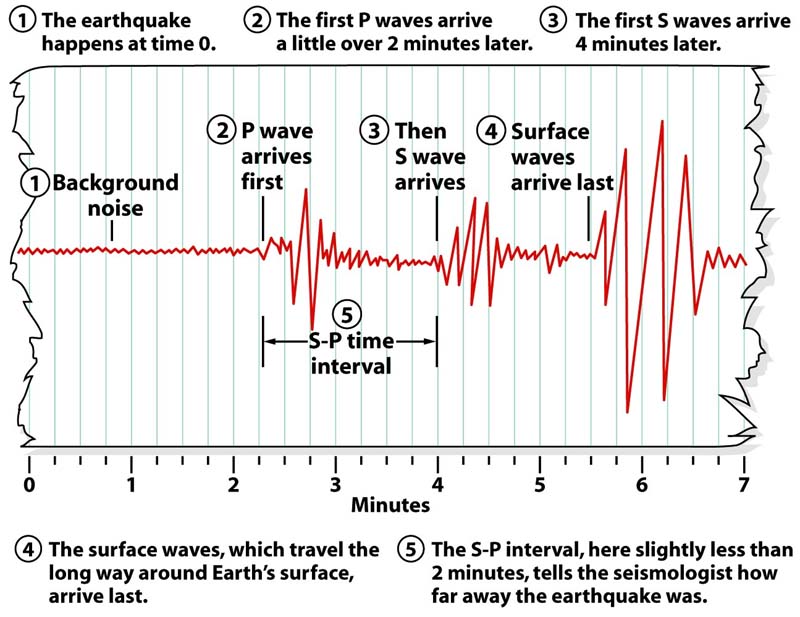
P-waves appear first on seismogram, followed by S-waves
Time difference helps determine earthquake distance
A seismograph is an instrument that detects and records seismic waves. The characteristic pattern of P-waves arriving before S-waves is key to earthquake analysis.
Earthquake Detection Process
%%{init: {"flowchart": {"wrappingWidth": 460}}}%%
flowchart TD
  s1["`**Earthquake occurs**
Seismic waves radiate from epicenter`"]
  s2["`**P-waves arrive first**
Seismograph records initial compression waves`"]
  s3["`**S-waves arrive later**
Secondary waves recorded with time gap`"]
  s4["`**Surface waves arrive**
Slower but more destructive waves recorded last`"]
  s1 --> s2
  s2 --> s3
  s3 --> s4
How Seismographs Work
Pendulum principle: Heavy mass stays stationary while ground moves
Three components: Record vertical and two horizontal motions
Digital recording: Modern seismographs store data electronically
Global network: Worldwide stations share earthquake data instantly
Seismogram Reading
Source: Plate Tectonics - A Scientific Revolution — Plate Tectonics - A Scientific Revolution · academic.brooklyn.cuny.edu