Normally, the temperature decreases with the increase in height from the Earth's surface, because 1. The atmosphere can be heated upwards only from the Earth's surface 2. There is more moisture in the upper atmosphere 3. The air is less dense in the upper atmosphere Select the correct answer using the codes given below:
Contents19
- A1 only
- B2 and 3 only
- C1 and 3 only
- D1, 2 and 3
Show answer
Answer: (C) 1 and 3 only
Temperature decreases with altitude (called the normal lapse rate) for two reasons:
Statement 1 correct — the atmosphere is heated primarily from below.
The Earth's surface absorbs solar radiation and re-emits it as heat, warming the air nearest to it.
Higher up, the air is farther from this heat source.
Statement 3 correct — air at higher altitudes is less dense (lower pressure), so it has fewer molecules to absorb and retain heat.
Statement 2 is WRONG — there is actually LESS moisture in the upper atmosphere, not more.
Moisture content generally decreases with altitude.
Answer: 1 and 3 only.
The atmosphere is heated from below by Earth's surface, which absorbs solar radiation and re-emits it as heat, making surface air warmest.
Statement 2 is the trap - moisture actually decreases with altitude, not increases, making upper air drier and less able to retain heat.
UPSC is testing whether students understand the physical mechanism behind temperature lapse rate, not just memorizing that temperature decreases with height.
Atmospheric Temperature & Lapse Rate
Geography temperature decreases increase in height Earth's surface
Atmospheric Temperature & Normal Lapse Rate: Why Temperature Decreases with Altitude
Normal lapse rate: Temperature decreases by 6.5°C per 1000m of altitude in troposphere
Atmosphere is heated from below by Earth's surface, not directly by sun
Higher altitude = lower air density = fewer molecules to retain heat
Moisture content decreases with altitude in troposphere
Why Temperature Falls with Height
The normal lapse rate explains why mountaintops are colder than valleys. This happens because the atmosphere works like a blanket heated from underneath, not from above.
Two key factors drive this temperature pattern:
Bottom-up heating: Earth's surface absorbs solar energy and re-radiates heat upward
Density differences: Thinner air at high altitudes cannot hold as much heat
Atmospheric Heating Process
%%{init: {"flowchart": {"wrappingWidth": 460}}}%%
flowchart TD
  s1["`**Solar radiation reaches Earth**
Sun's energy passes through atmosphere with minimal absorption`"]
  s2["`**Earth's surface absorbs energy**
Land and water heat up during the day`"]
  s3["`**Surface re-radiates heat**
Earth emits longwave infrared radiation upward`"]
  s4["`**Lower atmosphere gets heated**
Air near surface warms up through conduction and radiation`"]
  s5["`**Temperature decreases upward**
Heat source effect weakens with distance from surface`"]
  s1 --> s2
  s2 --> s3
  s3 --> s4
  s4 --> s5
Statement Analysis from Question
Statement | Verdict | Scientific Reason |
|---|---|---|
Atmosphere heated upwards from Earth's surface | CORRECT | Surface absorbs solar energy and re-radiates heat upward |
More moisture in upper atmosphere | WRONG | Moisture decreases with altitude - most water vapor stays near surface |
Air less dense in upper atmosphere | CORRECT | Lower pressure at height means fewer air molecules per unit volume |
Key Mechanisms Explained
Surface heating dominance: Only 23% of incoming solar radiation is absorbed by atmosphere directly - rest reaches Earth's surface
Density-temperature link: At sea level, air density is ~1.225 kg/m³; at 10km altitude, it drops to ~0.414 kg/m³
Moisture distribution: About 75% of atmospheric water vapor exists below 3km altitude
Heat capacity effect: Denser air (lower altitude) can store more thermal energy than thinner air (higher altitude)
Trap: Statement 2 says 'more moisture in upper atmosphere' - this is backwards. Water vapor decreases with altitude
Common confusion: Students think sun directly heats upper atmosphere more - actually, atmosphere is largely transparent to incoming solar radiation
Density misconception: Less dense air doesn't just mean 'lighter' - it means fewer molecules available to absorb and retain heat energy
Lapse rate vs inversion: Normal lapse rate is cooling with height - but temperature inversions can occur in special conditions
Atmospheric Moisture Distribution
Geography moisture upper atmosphere
Atmospheric Moisture Distribution: Why Water Vapor Decreases with Altitude
75% of water vapor exists below 3km altitude in troposphere
Moisture content decreases exponentially with height
Condensation occurs when rising air cools beyond saturation point
Why Moisture Decreases Upward
Water vapor is heaviest at Earth's surface because that's where evaporation occurs from oceans, lakes, and vegetation. As air rises and cools, it loses its capacity to hold moisture, leading to condensation and precipitation.
Moisture Content by Altitude
Altitude Range | Water Vapor Content | Key Characteristics |
|---|---|---|
0-2 km | Highest (up to 4% by volume) | Surface evaporation, high humidity zones |
2-8 km | Rapidly decreasing | Cloud formation zone, most precipitation |
8-12 km | Very low (<0.1%) | Tropopause region, minimal water vapor |
Above 12 km | Negligible | Stratosphere - extremely dry conditions |
Moisture Reduction Process
%%{init: {"flowchart": {"wrappingWidth": 460}}}%%
flowchart TD
  s1["`**Surface evaporation**
Water evaporates from oceans, rivers, lakes into lower atmosphere`"]
  s2["`**Air rises and expands**
Warm, moist air moves upward due to convection`"]
  s3["`**Cooling occurs**
Rising air expands and cools as pressure decreases`"]
  s4["`**Saturation reached**
Cool air cannot hold as much water vapor`"]
  s5["`**Condensation begins**
Excess moisture condenses into water droplets`"]
  s6["`**Precipitation removes moisture**
Rain/snow falls, removing water from upper air`"]
  s1 --> s2
  s2 --> s3
  s3 --> s4
  s4 --> s5
s5 --> s6Major trap: UPSC often tests the opposite of moisture distribution - remember it's maximum at surface, minimum at height
Confusion with clouds: Seeing clouds at high altitude doesn't mean 'more moisture' - those clouds formed from rising surface moisture
Stratosphere misconception: Upper atmosphere (stratosphere) is extremely dry - most water vapor is trapped in troposphere
Air Density & Altitude Relationship
Geography air is less dense upper atmosphere
Air Density & Altitude: How Atmospheric Density Changes with Height
Air density decreases exponentially with altitude due to gravity
Sea level density: ~1.225 kg/m³; at 10km: ~0.414 kg/m³
Lower density = fewer molecules = less heat retention capacity
Density-Altitude Physics
Gravity pulls air molecules toward Earth's surface, creating maximum density at sea level. As altitude increases, there are fewer molecules above pressing down, so atmospheric pressure drops and air becomes less dense.
This directly affects temperature because fewer molecules mean less capacity to absorb and retain thermal energy.
Density & Pressure at Different Altitudes
Altitude | Air Density (kg/m³) | Atmospheric Pressure | Temperature Effect |
|---|---|---|---|
Sea Level | 1.225 | 1013.25 mb (100%) | Maximum heat retention |
3 km | 0.909 | 687 mb (68%) | Noticeable cooling |
6 km | 0.660 | 472 mb (47%) | Significant temperature drop |
9 km | 0.467 | 308 mb (30%) | Very cold conditions |
12 km | 0.312 | 194 mb (19%) | Extreme cold at tropopause |
Why Density Affects Temperature
Molecular heat capacity: Denser air has more molecules per unit volume to absorb thermal energy
Collision frequency: More molecules = more collisions = better heat transfer and retention
Pressure-temperature link: Lower pressure at altitude means air expands and cools (adiabatic cooling)
Gravity effect: Earth's gravity creates the density gradient - strongest pull at surface, weaker at height
Atmospheric Density Profile
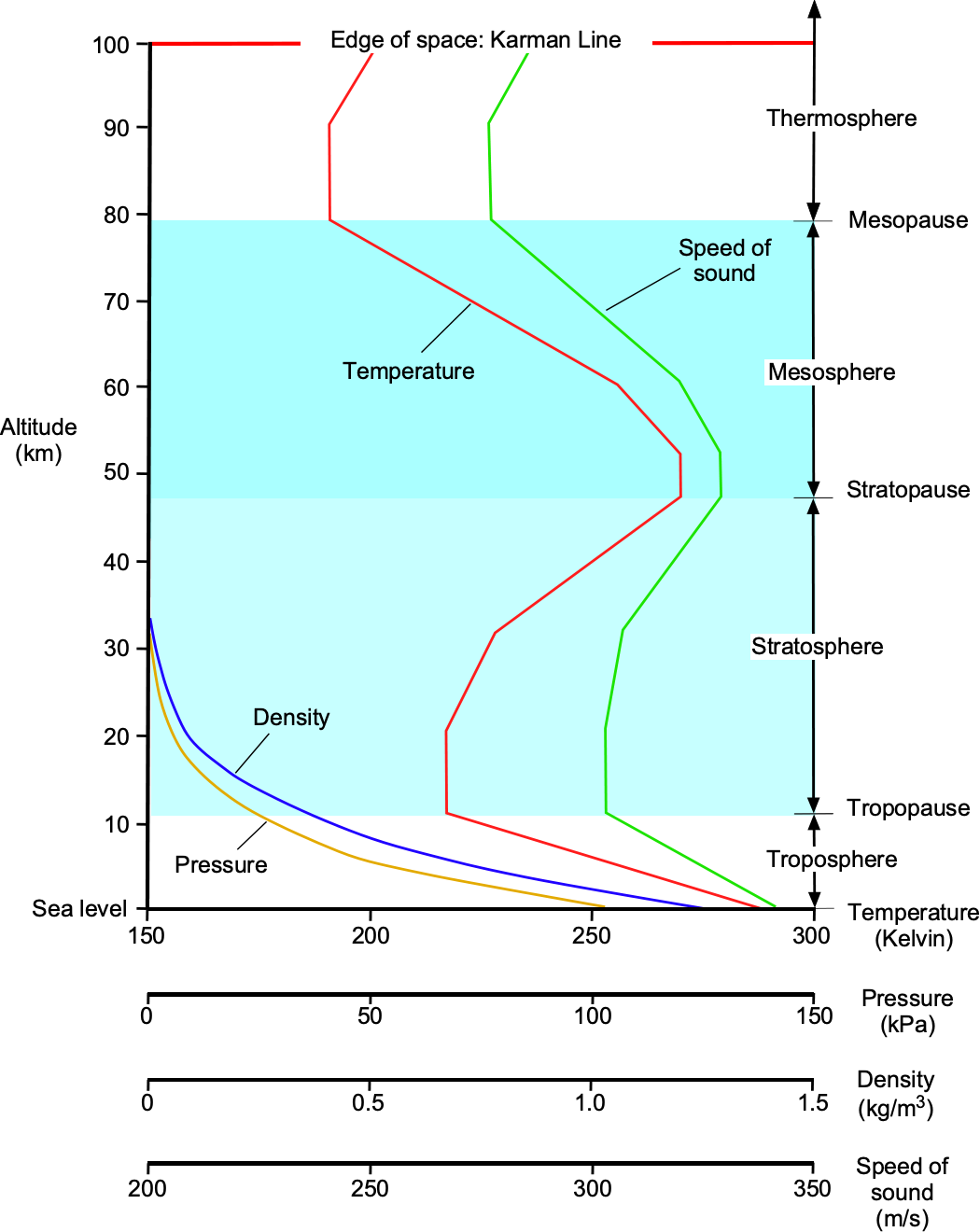
Source: Eagle Pubs — Atmospheric Properties – Introduction to Aerospace Flight Vehicles · eaglepubs.erau.edu
Higher = closer to sun trap: Students think higher altitude should be warmer because it's 'closer to sun' - but density effect dominates over distance
Linear decrease assumption: Density doesn't decrease linearly - it follows an exponential curve due to gravitational effects
Pressure vs density confusion: Both decrease with altitude, but they're related - lower pressure means lower density
Tropospheric Structure & Atmospheric Layers
Geography
Atmospheric Layers & Tropospheric Structure: Where Weather and Temperature Patterns Occur
Troposphere: 0-12km, contains 75% of atmospheric mass and all weather
Normal lapse rate: 6.5°C decrease per 1000m in troposphere
Tropopause: Temperature stops decreasing, marks troposphere-stratosphere boundary
Stratosphere: Temperature increases with altitude due to ozone absorption
Atmospheric Layer Structure
# Earth's Atmosphere
## **Troposphere** (0-12km)
- Weather phenomena
- Temperature decreases
- Maximum density
- 75% of atmospheric mass
## **Stratosphere** (12-50km)
- Ozone layer
- Temperature increases
- Commercial flights
- Stable air
## **Mesosphere** (50-85km)
- Coldest layer
- Meteors burn up
- Temperature decreases
- Very thin air
## **Thermosphere** (85-600km)
- Hottest layer
- Aurora phenomena
- Satellite orbits
- Temperature increases
Troposphere vs Stratosphere Comparison
Characteristic | Troposphere | Stratosphere |
|---|---|---|
Altitude Range | 0-12 km | 12-50 km |
Temperature Pattern | Decreases with height | Increases with height |
Lapse Rate | 6.5°C per 1000m | Negative (temperature inversion) |
Weather Activity | All weather phenomena | No weather, very stable |
Air Movement | Vertical mixing, turbulent | Horizontal layers, stratified |
Key Features | Clouds, precipitation, winds | Ozone layer, jet streams |
Why Troposphere is Unique
Weather zone: All precipitation, clouds, and storms occur only in troposphere
Vertical mixing: Unlike stratosphere, troposphere has active convection currents that mix air vertically
Mass concentration: Contains 99% of water vapor and 75% of atmospheric mass
Variable height: Troposphere extends to ~18km at equator, only ~8km at poles due to temperature differences
Atmospheric Temperature Profile
Vertical cross-section diagram showing temperature changes through troposphere, tropopause, and stratosphere with altitude markers
Temperature decreases in troposphere but increases in stratosphere - understanding this pattern is crucial for UPSC
Layer boundary confusion: Tropopause is the boundary between troposphere and stratosphere - temperature gradient reverses here
Stratosphere trap: In stratosphere, temperature increases with altitude due to ozone layer - opposite of troposphere pattern
Weather location: All weather occurs in troposphere only - stratosphere is too stable for weather formation