The jet aircrafts fly very easily and smoothly in the lower stratosphere. What could be the appropriate explanation? 1. There are no clouds or water vapour in the lower stratosphere. 2. There are no vertical winds in the lower stratosphere. Which of the statements given above is/are correct in this context?
Contents18
- A1 only
- B2 only
- CBoth 1 and 2
- DNeither 1 nor 2
Show answer
Answer: (C) Both 1 and 2
Both statements are CORRECT — the lower stratosphere (above ~12 km) is ideal for jet aircraft because:
Statement 1:
- The stratosphere has almost NO water vapor and NO clouds.
- All weather phenomena (clouds, rain, storms, turbulence) occur in the TROPOSPHERE below.
- The tropopause acts as a 'ceiling' for weather.
- No clouds = no weather-related turbulence = smoother flight.
Statement 2:
- There are NO significant vertical winds (convection currents) in the stratosphere.
- In the troposphere, the ground heats unevenly → air rises and falls → turbulence.
- But in the stratosphere, temperature actually INCREASES with altitude (due to ozone absorbing UV), creating a stable layer where air doesn't move vertically.
- No vertical movement = no turbulence = smooth flying.
Bonus fact: This is also why the ozone layer is stable — the stratosphere's temperature inversion prevents mixing.
The stratosphere has a temperature inversion where temperature increases with altitude due to ozone absorption, creating atmospheric stability that prevents vertical air movement.
Commercial aviation relies on the stratosphere's lack of weather phenomena since all clouds, storms and turbulence are confined to the troposphere below the tropopause boundary.
This tests understanding of atmospheric layering and why temperature profiles determine air stability and flight conditions.
Atmospheric Layers & Structure
Geography stratosphere troposphere jet aircrafts
Atmospheric Layers: Structure, Temperature & Aviation Relevance
Troposphere extends 0-12 km, contains all weather phenomena
Stratosphere extends 12-50 km, temperature increases with altitude
Tropopause is the boundary that acts as weather ceiling
Commercial jets fly in lower stratosphere for smooth conditions
Why Layer Structure Matters
Earth's atmosphere has distinct layers with different temperature patterns and characteristics. The troposphere is where we live and where all weather occurs, while the stratosphere above provides stable flying conditions for aircraft.
Key Atmospheric Layers
Layer | Altitude Range | Temperature Pattern | Key Features |
|---|---|---|---|
Troposphere | 0-12 km | Decreases with height | All weather, clouds, water vapor |
Tropopause | ~12 km | Constant | Weather ceiling, jet stream location |
Stratosphere | 12-50 km | Increases with height | Ozone layer, no weather, stable |
Temperature Inversion Process
%%{init: {"flowchart": {"wrappingWidth": 460}}}%%
flowchart TD
  s1["`**Ground Level**
Earth's surface heated by sun`"]
  s2["`**Troposphere**
Temperature **decreases** ~6.5°C per km altitude`"]
  s3["`**Tropopause**
Temperature becomes **constant** around -56°C`"]
  s4["`**Stratosphere**
Temperature **increases** due to ozone absorbing UV radiation`"]
  s1 --> s2
  s2 --> s3
  s3 --> s4
Atmospheric Structure
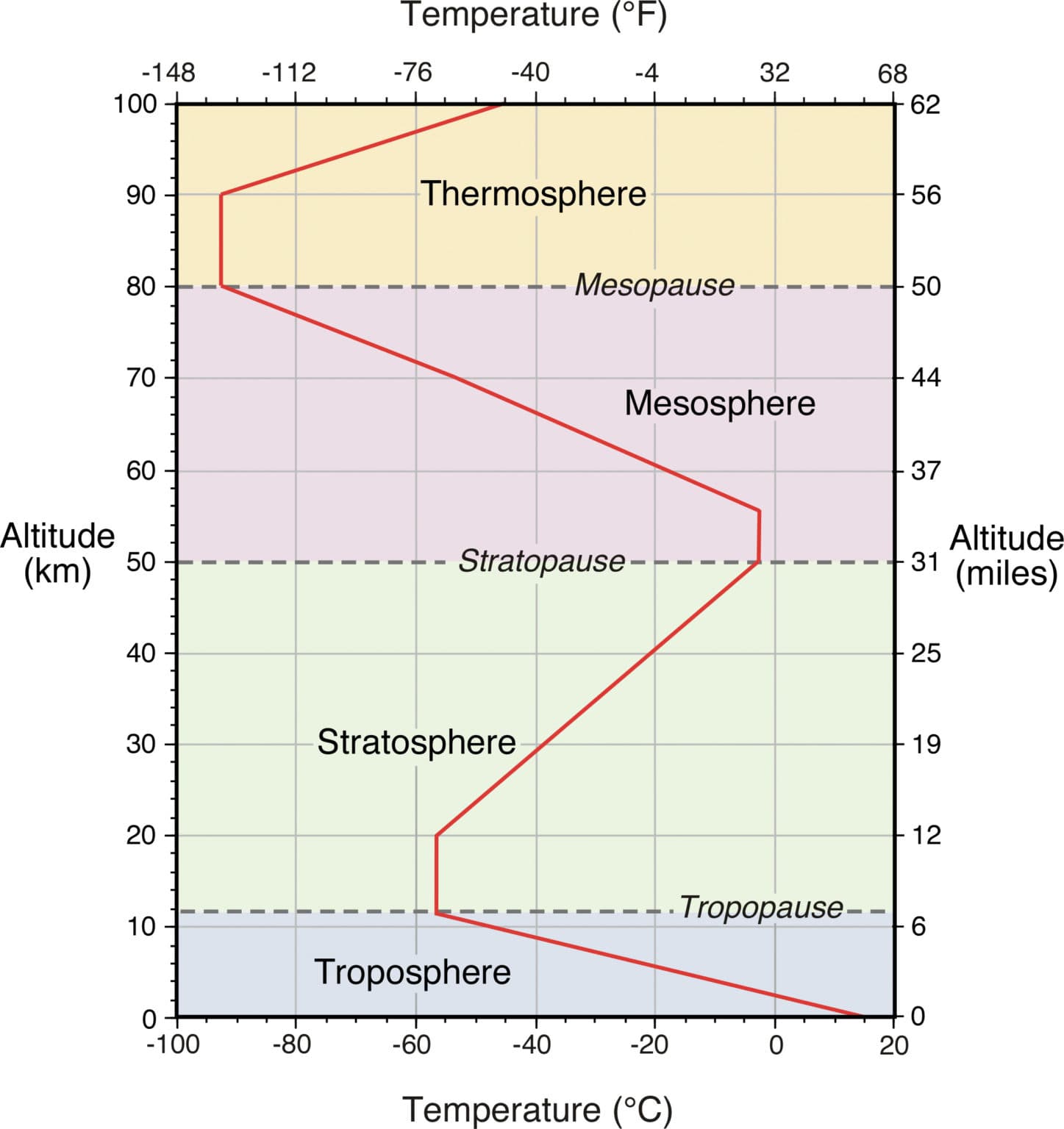
Source: Fiveable — Vertical structure and properties of atmospheric layers ... · fiveable.me
Stratosphere Aviation Conditions
Geography jet aircrafts lower stratosphere smoothly
Why Jets Fly in Lower Stratosphere: Weather-Free Zone
No clouds or water vapor in stratosphere = no weather turbulence
No vertical winds due to temperature inversion = smooth flight
Commercial jets cruise at 9-12 km (lower stratosphere)
Stratosphere Flight Advantages
The lower stratosphere provides ideal conditions for jet aircraft because it's completely free from weather phenomena and vertical air movements that cause turbulence in the troposphere below.
Troposphere vs Stratosphere Flying
Atmospheric Zone | Weather Conditions | Vertical Air Movement | Flight Experience |
|---|---|---|---|
Troposphere (0-12 km) | Clouds, rain, storms | Strong convection currents | Turbulent, bumpy |
Lower Stratosphere (12+ km) | No weather phenomena | No vertical winds | Smooth, stable |
Specific Advantages
Tropopause ceiling: Weather cannot penetrate above ~12 km altitude
Stable air mass: Temperature inversion prevents convection and mixing
Fuel efficiency: Thinner air reduces drag, jet engines work efficiently
Clear visibility: No clouds or precipitation to obstruct navigation
Question Connection
Both statements in the question correctly identify why jets fly smoothly in the stratosphere: absence of weather (Statement 1) and lack of vertical air movement (Statement 2) eliminate the main sources of flight turbulence.
Trap: Confusing stratosphere with troposphere - weather occurs in troposphere only
Trap: Thinking stratosphere has some clouds - it has virtually zero water vapor
Trap: Missing that temperature inversion prevents vertical air movement
Trap: Assuming jets fly in troposphere - commercial aircraft cruise above weather zone
Ozone Layer & UV Absorption
Geography
Ozone Layer: Location, Formation & Temperature Effects
Ozone layer located in stratosphere absorbs harmful UV radiation
UV absorption heats the stratosphere, creating temperature inversion
Temperature inversion makes stratosphere stable with no mixing
Ozone-Temperature Connection
The ozone layer in the stratosphere absorbs ultraviolet radiation from the sun, which heats this atmospheric layer and creates the temperature inversion that makes stratospheric air so stable.
Ozone Heating Mechanism
%%{init: {"flowchart": {"wrappingWidth": 460}}}%%
flowchart TD
  s1["`**Solar UV Radiation**
High-energy ultraviolet rays enter atmosphere`"]
  s2["`**Ozone Absorption**
**O₃ molecules** absorb UV energy in stratosphere`"]
  s3["`**Heat Generation**
UV energy converts to **thermal energy**`"]
  s4["`**Temperature Inversion**
Stratosphere becomes **warmer** than troposphere below`"]
  s5["`**Atmospheric Stability**
Warm air above cold air = **no convection**`"]
  s1 --> s2
  s2 --> s3
  s3 --> s4
  s4 --> s5
Ozone Layer Facts
Peak concentration: 20-25 km altitude in stratosphere
Formation: O₂ + UV → O₃ (oxygen to ozone conversion)
Protection: Blocks 97-99% of harmful UV-B radiation
Stability: Temperature inversion prevents ozone from mixing downward
Trap: Placing ozone layer in troposphere - it's in stratosphere
Trap: Thinking ozone cools the atmosphere - it actually heats it
Trap: Missing the connection between UV absorption and flight stability
Atmospheric Turbulence & Convection
Geography vertical winds water vapour clouds
Atmospheric Turbulence: Causes & Aviation Impact
Convection currents in troposphere create vertical air movement
Uneven heating of ground causes rising and falling air masses
Weather phenomena (clouds, storms) generate turbulence
Turbulence Formation
Turbulence occurs when air masses move vertically due to temperature differences. The troposphere experiences constant vertical air movement, while the stratosphere remains stable due to its inverted temperature profile.
Turbulence Sources
# Atmospheric Turbulence
## **Thermal Turbulence**
- Uneven ground heating
- Rising warm air
- Convection currents
- Daytime effect
## **Weather Turbulence**
- Thunderstorms
- Cloud formation
- Wind shear
- Pressure systems
## **Mechanical Turbulence**
- Mountain waves
- Surface friction
- Jet streams
- Wind obstacles
Vertical Air Movement Comparison
Atmospheric Layer | Temperature Gradient | Vertical Movement | Stability |
|---|---|---|---|
Troposphere | Decreases upward | Strong convection | Unstable, turbulent |
Stratosphere | Increases upward | No convection | Highly stable |
Trap: Confusing horizontal winds with vertical winds - vertical motion causes turbulence
Trap: Thinking stratosphere has some vertical movement - it has virtually none
Trap: Missing that temperature inversion is key to preventing convection