The most important fishing grounds of the world are found in the regions where
Contents20
- AWarm and cold atmospheric currents meet
- BRivers drain out large amounts of freshwater into the sea
- CWarm and cold oceanic currents meet
- DContinental shelf is undulating
Show answer
Answer: (C) Warm and cold oceanic currents meet
The world's most important fishing grounds are found where warm and cold oceanic currents meet (not atmospheric currents).
When these currents converge, they bring nutrients to the surface, causing plankton to flourish abundantly.
Plankton is the base of the marine food chain, so fish populations thrive in these zones.
Examples include the Grand Banks (Labrador Cold + Gulf Stream Warm) and the seas around Japan (Oyashio + Kuroshio).
The other options — river drainage, atmospheric currents, or undulating continental shelf — do not explain the pattern of major global fishing grounds as well.
Major fishing grounds like Grand Banks off Newfoundland and seas around Japan exist where warm currents like Gulf Stream meet cold currents like Labrador Current.
Convergence of warm and cold oceanic currents brings deep nutrients to surface waters, creating plankton blooms that form the base of marine food chains.
The question tests understanding of upwelling and nutrient cycling in oceans, not just memorization of current names and locations.
Oceanic Current Convergence Zones
Geography warm and cold oceanic currents meet
Oceanic Current Convergence Zones: Why Fish Thrive Where Currents Meet
Major fishing grounds occur where warm and cold oceanic currents meet
Convergence zones bring nutrients to surface through upwelling
Plankton flourishes in nutrient-rich waters, supporting entire food chain
Examples: Grand Banks (Labrador + Gulf Stream), Japan seas (Oyashio + Kuroshio)
Why Convergence Creates Fishing Grounds
When warm and cold oceanic currents meet, they create convergence zones where different water masses interact. Cold currents carry nutrient-rich water from polar regions, while warm currents bring different water properties from tropical areas. This meeting creates ideal conditions for marine life to flourish.
Marine Food Chain Process
%%{init: {"flowchart": {"wrappingWidth": 460}}}%%
flowchart TD
  s1["`**Current Convergence**
Warm and cold oceanic currents meet`"]
  s2["`**Upwelling Effect**
Nutrients rise to surface from deep waters`"]
  s3["`**Plankton Bloom**
Phytoplankton multiplies rapidly in nutrient-rich surface water`"]
  s4["`**Food Chain Growth**
Zooplankton feeds on phytoplankton, fish feed on zooplankton`"]
  s5["`**Rich Fishing Grounds**
Large fish populations attract commercial fishing fleets`"]
  s1 --> s2
  s2 --> s3
  s3 --> s4
  s4 --> s5
Major Global Fishing Grounds
Fishing Ground | Cold Current | Warm Current | Region |
|---|---|---|---|
Grand Banks | Labrador Current | Gulf Stream | North Atlantic (Newfoundland) |
North Sea | Norwegian Current | North Atlantic Drift | Europe |
Japan Coast | Oyashio (Kuril) | Kuroshio (Japan) | North Pacific |
Peru Coast | Peru (Humboldt) | El Niño effects | South Pacific |
Argentina Coast | Falkland Current | Brazil Current | South Atlantic |
Global Ocean Currents
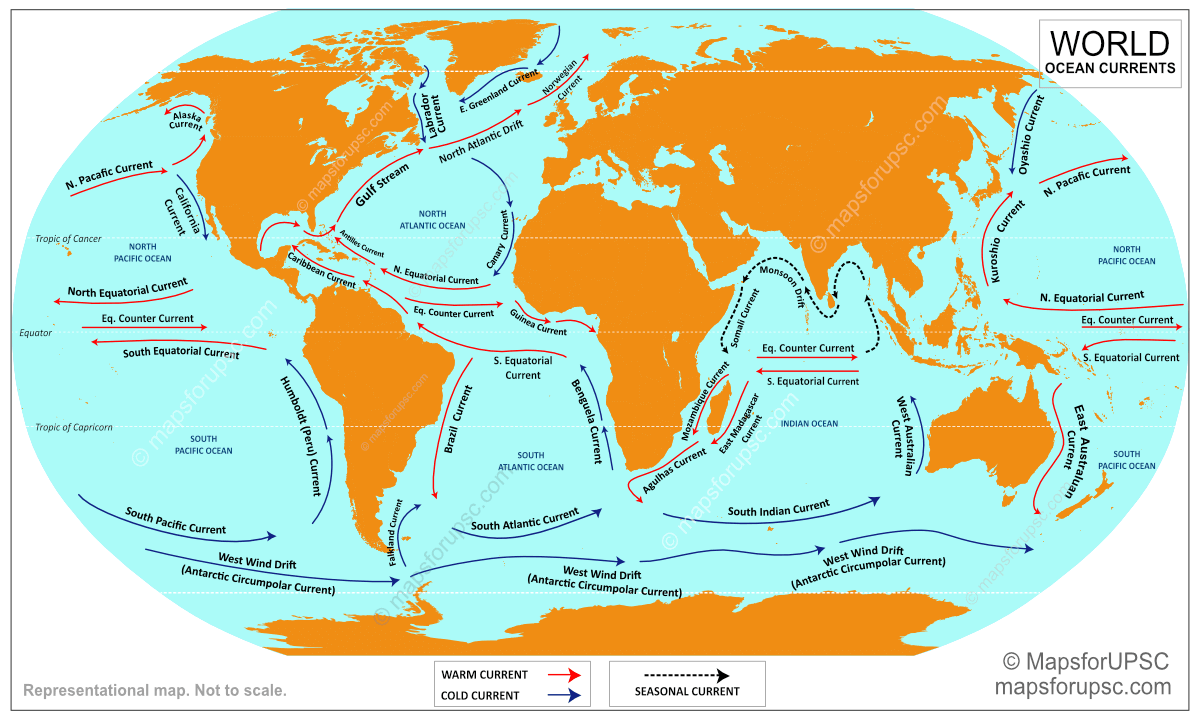
Source: MapsforUPSC — Ocean Currents: Map, Types, Causes & Key Facts – UPSC · mapsforupsc.com
Why Other Options Don't Work
River drainage creates brackish water that dilutes salinity but doesn't guarantee rich fishing grounds
Atmospheric currents affect weather patterns but don't directly control marine nutrient distribution
Undulating continental shelf provides habitat variety but isn't the primary factor for world's richest fishing zones
Trap: Atmospheric vs Oceanic currents - UPSC tests this distinction frequently
Trap: Don't confuse upwelling (vertical water movement) with convergence (horizontal current meeting)
Trap: Continental shelf is important for fishing but not the PRIMARY reason for world's richest grounds
Oceanic vs Atmospheric Currents
Geography atmospheric currents oceanic currents
Oceanic vs Atmospheric Currents: Key Differences for UPSC
Oceanic currents are water movements in seas/oceans
Atmospheric currents are air movements in the atmosphere
Only oceanic current convergence creates major fishing grounds
Oceanic vs Atmospheric Currents
Aspect | Oceanic Currents | Atmospheric Currents |
|---|---|---|
Medium | Water movement in oceans | Air movement in atmosphere |
Examples | Gulf Stream, Kuroshio, Labrador | Trade Winds, Westerlies, Monsoons |
Temperature Types | Warm currents, Cold currents | Hot air masses, Cold air masses |
Impact on Fishing | Direct - brings nutrients to surface | Indirect - affects weather patterns |
Convergence Effect | Creates upwelling and nutrient zones | Creates weather fronts and precipitation |
UPSC Focus | Current names, directions, fishing grounds | Wind patterns, monsoon mechanism |
Why Only Oceanic Currents Matter for Fishing
Oceanic convergence physically brings deep-water nutrients to the surface where sunlight enables photosynthesis
Atmospheric convergence creates rain and storms but doesn't transport marine nutrients
Water density differences in oceanic currents create upwelling - air cannot do this
Trap: UPSC deliberately uses 'atmospheric currents meet' as distractor - always check if question asks about marine/oceanic phenomena
Trap: Both oceanic and atmospheric currents can be warm/cold - temperature alone doesn't indicate the type
Upwelling and Marine Productivity
Geography
Upwelling Process: How Deep Nutrients Reach Surface Waters
Upwelling brings nutrient-rich deep water to surface
Phytoplankton forms base of marine food chain in upwelling zones
High marine productivity occurs in upwelling areas
What is Upwelling
Upwelling is the vertical movement of deep, cold, nutrient-rich water to the ocean surface. This process is crucial for marine ecosystems because surface waters are typically nutrient-poor, while deep waters contain dissolved nutrients from decomposed organic matter that has sunk from above.
Types of Upwelling
# Upwelling Types
## Coastal Upwelling
- Wind-driven
- Peru Coast
- California Coast
- Seasonal variation
## Equatorial Upwelling
- Trade wind effects
- Pacific Ocean
- Year-round process
## Convergence Upwelling
- Current meeting zones
- Grand Banks type
- Most productive
Nutrients in Upwelling Waters
Nutrient | Source | Role in Marine Life |
|---|---|---|
Nitrates | Decomposed organic matter | Essential for phytoplankton growth |
Phosphates | Deep water sediments | Cell metabolism and DNA formation |
Silicates | Dissolved minerals | Diatom shell formation |
Iron | Terrestrial runoff, dust | Chlorophyll production |
Marine Productivity Chain
%%{init: {"flowchart": {"wrappingWidth": 460}}}%%
flowchart TD
  s1["`**Deep Water Nutrients**
Cold, nutrient-rich water in ocean depths`"]
  s2["`**Upwelling Process**
Current convergence or wind brings nutrients to surface`"]
  s3["`**Sunlight + Nutrients**
Surface water has both sunlight and nutrients`"]
  s4["`**Phytoplankton Bloom**
Primary producers multiply rapidly`"]
  s5["`**Zooplankton Growth**
Primary consumers feed on phytoplankton`"]
  s6["`**Fish Population Boom**
Secondary consumers thrive in food-rich environment`"]
  s1 --> s2
  s2 --> s3
  s3 --> s4
  s4 --> s5
  s5 --> s6
Why Surface Waters Need Upwelling
Surface waters have sunlight but lack nutrients - most nutrients sink to deep waters
Deep waters have abundant nutrients but no sunlight for photosynthesis
Upwelling solves this by bringing nutrients to where sunlight is available
Factors Affecting Fishing Grounds
Geography rivers drain continental shelf undulating
Factors Affecting Fishing Grounds: Primary vs Secondary Influences
Current convergence is the PRIMARY factor for world's richest fishing grounds
Continental shelf, river drainage are secondary supporting factors
Depth, temperature, salinity all influence fish populations
Fishing Ground Factors Comparison
Factor | Impact Level | How it Helps Fishing | Examples |
|---|---|---|---|
Current Convergence | Primary | Nutrient upwelling, plankton blooms | Grand Banks, Japan coast |
Continental Shelf | Secondary | Shallow waters, sunlight penetration | North Sea, Dogger Bank |
River Discharge | Secondary | Nutrients from land, brackish mixing | Amazon mouth, Ganges delta |
Undulating Seabed | Minor | Habitat variety, current turbulence | Georges Bank |
Temperature Zones | Supporting | Species diversity, migration routes | Tropical-temperate boundaries |
Why Continental Shelf Matters
Shallow depths (less than 200m) allow sunlight to reach seabed, supporting marine plants
Easier fishing operations - nets can be deployed more effectively in shallow areas
Coastal accessibility - fishing fleets can operate closer to ports, reducing costs
Role of River Discharge
Terrestrial nutrients from rivers fertilize coastal waters with nitrogen and phosphorus
Brackish water zones create unique ecosystems where freshwater and saltwater species mix
Seasonal variations in river flow affect fish migration patterns and breeding
Continental Shelf Profile

Source: Shutterstock — Ocean Zones Division Depth Light Penetration Stock Vector (Royalty ... · www.shutterstock.com
Trap: Continental shelf is important but not the PRIMARY reason for world's most important fishing grounds
Trap: River drainage helps local fishing but doesn't explain global pattern of major fishing zones
Trap: All factors work together, but UPSC asks for the most important - that's current convergence