"Each day is more or less the same, the morning is clear and bright with a sea breeze; as the Sun climbs high in the sky, heat mounts up, dark clouds form, then rain comes with thunder and lightning. But rain is soon over." Which of the following regions is described in the above passage?
Contents14
- ASavannah
- BEquatorial
- CMonsoon
- DMediterranean
Show answer
Answer: (B) Equatorial
The passage describes the daily weather pattern of the Equatorial climate (also called Wet Equatorial or Tropical Rainforest climate).
Let us break down the clues in the passage and match them:
'Each day is more or less the same' — Equatorial regions have almost NO seasonal variation because they are near the equator where the sun is nearly overhead all year. The same weather pattern repeats daily.
'Morning is clear and bright with a sea breeze' — mornings start with clear skies as the land heats up and convection begins.
'As the Sun climbs high, heat mounts up, dark clouds form' — the intense equatorial sun heats the ground, causing strong convectional currents. Warm, humid air rises rapidly, cools, and forms towering cumulonimbus clouds by afternoon.
'Rain comes with thunder and lightning. But rain is soon over' — this describes the typical afternoon convectional thunderstorm that is short but intense, usually lasting 1-2 hours before the skies clear again. This is called the '4 o'clock rain' in equatorial regions.
Why not the other climates?
(a) Savannah — has distinct wet and dry SEASONS (not daily rain pattern). Rain is seasonal, not an everyday routine.
(c) Monsoon — has a prolonged rainy season for months (not brief daily showers). Monsoon rain can last all day, not just a short afternoon burst.
(d) Mediterranean — has dry, hot summers and wet winters. Rain comes in winter, not daily.
The key giveaway is 'each day is more or less the same' + 'afternoon rain that is soon over' = Equatorial convectional rainfall pattern.
Equatorial regions have the same daily weather pattern year-round because the sun is nearly overhead throughout the year, creating predictable afternoon convectional rainfall.
The question tests whether students can distinguish between daily convectional rainfall (equatorial) versus seasonal rainfall patterns (savannah, monsoon, Mediterranean).
UPSC uses descriptive passages like this to check if students understand climate mechanisms, not just memorized climate names and locations.
Equatorial Climate Zone
Geography Equatorial thunder and lightning sea breeze
Equatorial Climate: Daily Weather Pattern & UPSC Identification
Equatorial climate has uniform weather year-round with daily afternoon thunderstorms
Located between 10°N to 10°S latitude around the equator
Daily pattern: clear morning → afternoon heat → convectional rain → evening clearing
Also called Wet Equatorial or Tropical Rainforest climate
The equatorial climate occurs in regions closest to the equator where the sun remains nearly overhead throughout the year. This creates a predictable daily weather cycle driven by intense heating and convectional processes, not seasonal variations.
Daily Weather Cycle
Time | Weather Condition | Process |
|---|---|---|
Morning (6-10 AM) | Clear skies, sea breeze | Cool air from previous night, land begins heating |
Midday (10 AM-2 PM) | Intense heat, humidity rises | Sun overhead, strong surface heating |
Afternoon (2-4 PM) | Dark clouds, thunderstorms | Convectional uplift, cumulonimbus formation |
Evening (4-6 PM) | Rain stops, skies clear | Cooling begins, convection weakens |
Convectional Rainfall Process
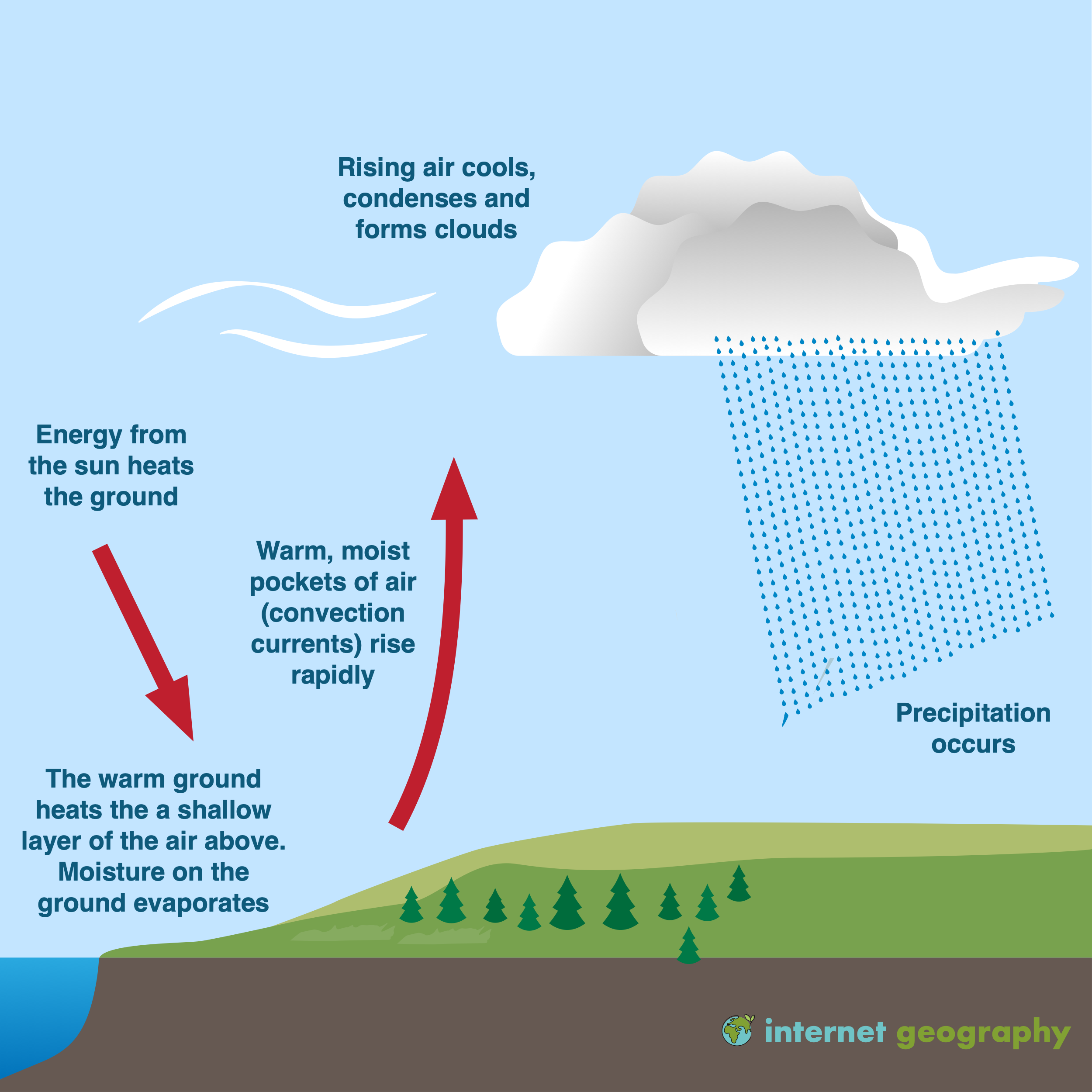
Source: Internet Geography — What is convectional rainfall? - Internet Geography · www.internetgeography.net
Key Characteristics
Temperature: 25-27°C year-round with minimal variation (2-3°C)
Rainfall: 2000-2500mm annually, distributed throughout the year
Humidity: Very high (80-90%) due to constant evaporation
Seasonality: NO distinct seasons - 'each day is more or less the same'
Vegetation: Dense tropical rainforests with multiple canopy layers
Global Distribution

Source: IAS Exam — Equatorial Region UPSC - Iasexam.com · www.iasexam.com
Question Connection
The passage's key phrase 'each day is more or less the same' immediately eliminates seasonal climates like Savannah and Monsoon. The brief afternoon thunderstorm pattern is the signature of equatorial convectional rainfall, not the prolonged rains of monsoon regions.
Trap: Confusing equatorial daily rain with monsoon seasonal rain - monsoons last months, not hours
Trap: Mixing savannah (distinct wet/dry seasons) with equatorial (no seasons)
Trap: Mediterranean climate has dry summers and wet winters - opposite of daily rain pattern
Key phrase: 'Each day is more or less the same' = equatorial climate indicator in UPSC questions
Major World Climate Types
Geography Savannah Monsoon Mediterranean
World Climate Types: UPSC-Tested Distinctions & Seasonal Patterns
Four major climate types tested in UPSC: Equatorial, Monsoon, Savannah, Mediterranean
Each has distinct rainfall timing and seasonal patterns
UPSC often tests through descriptive passages rather than direct definitions
Climate Type Comparison
Climate | Seasonal Pattern | Rainfall Timing | Key Identifier | Example Regions |
|---|---|---|---|---|
Equatorial | No seasons | Daily afternoon showers | 'Same every day' | Amazon, Congo Basin |
Monsoon | Wet + Dry seasons | 4-6 month rainy season | Seasonal wind reversal | Indian subcontinent |
Savannah | Distinct wet/dry | Single rainy season | Grasslands with scattered trees | East Africa, Brazil |
Mediterranean | Wet winter, dry summer | Winter rains only | 'Hot dry summers' | Southern Europe, California |
UPSC Testing Pattern
Descriptive questions: Passage describes daily/seasonal weather, asks to identify climate type
Vegetation clues: Dense rainforest = Equatorial; Grasslands = Savannah; Scrub vegetation = Mediterranean
Seasonal indicators: 'No seasons' = Equatorial; 'Wet and dry seasons' = Monsoon/Savannah
Rainfall pattern: Daily brief showers = Equatorial; Months-long rain = Monsoon
Geographic location: Often combined with asking about specific countries or regions
Climate Classification Framework
# World Climate Types
## Tropical (Hot)
- Equatorial (Af)
- Monsoon (Am)
- Savannah (Aw)
## Temperate
- Mediterranean (Cs)
- Humid Continental
- Marine West Coast
## Arid
- Hot Desert (BWh)
- Cold Desert (BWk)
- Semi-arid (BS)Trap: All tropical climates are NOT the same - Equatorial has no seasons, Monsoon has distinct seasons
Trap: Mediterranean ≠ tropical - it's temperate with hot dry summers and mild wet winters
Trap: Savannah vs Monsoon confusion - both have wet/dry seasons but different vegetation patterns
Memory aid: EQMS - Equatorial (daily), Monsoon (seasonal), Savannah (grassland)
Convectional Rainfall Process
Geography heat mounts up dark clouds form thunder and lightning
Convectional Rainfall: Mechanism & Geographic Distribution
Convectional rainfall occurs when heated air rises, cools, and precipitates
Common in equatorial regions and summer afternoons in continental interiors
Creates cumulonimbus clouds with thunder and lightning
Usually short duration (1-2 hours) but high intensity
Convectional rainfall is the primary precipitation mechanism in equatorial regions. When intense solar heating warms the ground, the overlying air becomes unstable and rises rapidly, creating the characteristic afternoon thunderstorms.
Formation Process
%%{init: {"flowchart": {"wrappingWidth": 460}}}%%
flowchart TD
  s1["`**Surface Heating**
Intense sun heats land/water surface`"]
  s2["`**Air Warming**
Surface air becomes hot and humid`"]
  s3["`**Convectional Rise**
Warm air rises rapidly due to lower density`"]
  s4["`**Cooling & Condensation**
Rising air cools at **6.5°C per 1000m** (lapse rate)`"]
  s5["`**Cloud Formation**
Water vapor condenses into **cumulonimbus** clouds`"]
  s6["`**Precipitation**
Heavy rain with thunder and lightning`"]
  s7["`**Cooling**
Surface cools, convection weakens, rain stops`"]
  s1 --> s2
  s2 --> s3
  s3 --> s4
  s4 --> s5
  s5 --> s6
  s6 --> s7
Types of Rainfall Comparison
Type | Cause | Cloud Type | Duration | Intensity | Example Regions |
|---|---|---|---|---|---|
Convectional | Surface heating | Cumulonimbus | 1-2 hours | Heavy | Equatorial regions |
Orographic | Mountain barrier | Stratus/Nimbus | Long | Moderate-Heavy | Western Ghats, Himalayas |
Cyclonic | Pressure systems | Various | Days | Light-Moderate | Temperate regions |
Geographic Occurrence
Equatorial belt: Daily occurrence throughout the year
Continental interiors: Summer afternoon thunderstorms (Delhi, Rajasthan)
Tropical islands: Enhanced by land-sea temperature contrast
Urban heat islands: Cities experience more convectional activity than surroundings
ITCZ movement: Follows the seasonal migration of maximum heating
Trap: Convectional ≠ cyclonic rainfall - convectional is local heating, cyclonic is pressure systems
Trap: Not all equatorial rain is convectional - some coastal areas also get orographic rainfall
Key phrase: 'Heat mounts up, dark clouds form' = classic convectional process description
Timing trap: Convectional rain is typically afternoon (2-4 PM), not morning or night