Consider the following States: 1. Arunachal Pradesh 2. Himachal Pradesh 3. Mizoram In which of the above States do 'Tropical Wet Evergreen Forests' occur?
Contents18
- A1 only
- B2 and 3 only
- C1 and 3 only
- D1, 2 and 3
Show answer
Answer: (C) 1 and 3 only
As per NCERT Class 11 (India: Physical Environment, pg 58):
Tropical wet evergreen forests are found in regions receiving more than 200 cm of annual rainfall, with a short or no dry season.
In India, they occur along the western slopes of the Western Ghats (Kerala, Karnataka, Maharashtra), in the northeastern states, and in the Andaman and Nicobar Islands.
Arunachal Pradesh (Statement 1) — CORRECT.
The lower elevations of Arunachal Pradesh, particularly the foothills receiving heavy rainfall, support tropical wet evergreen forests.
Despite being a Himalayan state, its southern foothills are at low enough elevation and receive enough rain for tropical evergreen vegetation.
Himachal Pradesh (Statement 2) — INCORRECT.
Himachal Pradesh is a Himalayan state at relatively high altitude (mostly above 1000m).
It has temperate forests (deodar, oak, pine, rhododendron), sub-alpine forests, and alpine meadows.
The climate is far too cold and dry for TROPICAL evergreen forests.
The keyword 'tropical' eliminates Himachal Pradesh — tropical forests need consistently warm temperatures found at lower elevations.
Mizoram (Statement 3) — CORRECT.
Mizoram, in the northeastern region, receives heavy rainfall (over 250 cm annually) and has suitable warm temperatures at its lower elevations, supporting tropical wet evergreen forests.
The NCERT specifically lists northeastern states including Nagaland, Arunachal Pradesh, Meghalaya, and Mizoram as having these forests.
Answer: 1 and 3 only.
Key tip: 'Tropical' forests need warm temperatures + heavy rainfall.
Himachal Pradesh is too cold (temperate/alpine climate) for tropical forests.
Tropical wet evergreen forests need both heavy rainfall (over 200 cm annually) and consistently warm temperatures throughout the year.
The key trap is Himachal Pradesh - despite being mountainous like Arunachal Pradesh, it is too cold and high in elevation for tropical forests, having temperate forests instead.
Students must distinguish between elevation-based climate zones: lower elevations in northeastern states can support tropical forests while higher Himalayan states cannot.
Tropical Wet Evergreen Forests in India
Geography Tropical Wet Evergreen Forests 200 cm rainfall
Tropical Wet Evergreen Forests: Distribution & Characteristics
Found in areas with 200+ cm annual rainfall and warm temperatures throughout the year
Occur in Western Ghats, Northeastern states, and Andaman & Nicobar Islands
Require no dry season or very short dry period
Multi-layered canopy with dense vegetation and high biodiversity
Essential Requirements
Tropical wet evergreen forests need two critical conditions: heavy rainfall (200+ cm annually) and consistently warm temperatures. The term 'tropical' specifically means warm climate zones, eliminating high-altitude Himalayan regions where temperatures drop significantly.
Rainfall pattern: Must be well-distributed with short or no dry season
Temperature range: 20-30°C throughout the year
Humidity: High atmospheric moisture levels
Regional Distribution
Region | States/Areas | Rainfall (cm) | Key Features |
|---|---|---|---|
Western Ghats | Kerala, Karnataka, Maharashtra | 250-400 | Windward slopes, Western slopes |
Northeast India | Arunachal Pradesh, Mizoram, Meghalaya, Nagaland | 200-300 | Lower elevations, foothills |
Islands | Andaman & Nicobar | 300+ | Coastal and interior areas |
Eastern Ghats | Limited patches in Odisha | 150-200 | Very restricted distribution |
Forest Characteristics
Multi-tiered canopy structure with trees reaching 45-60 meters in height
Dense undergrowth with climbers, epiphytes, and lianas creating impenetrable vegetation
High species diversity including rosewood, mahogany, ebony, and bamboo
Evergreen nature means trees retain leaves throughout the year due to continuous moisture
Rich soil layer from constant leaf litter decomposition in humid conditions
Distribution Map
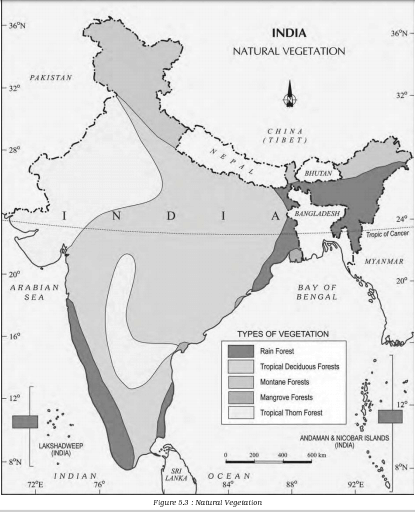
Source: BYJU'S — Tropical Evergreen Forests of India – Characteristics, Plant and ... · byjus.com
Altitude trap: Himachal Pradesh has heavy snowfall, not tropical rainfall - 'tropical' eliminates high-altitude states
Rainfall confusion: Don't assume all northeastern states have the same vegetation - Ladakh and Sikkim have different climates
Western vs Eastern Ghats: Tropical evergreen forests are mainly on Western Ghats (windward side), not Eastern Ghats
Seasonal forests vs Evergreen: Tropical deciduous forests need 100-200 cm rainfall, evergreen need 200+ cm
Arunachal Pradesh Natural Vegetation
Geography Arunachal Pradesh
Arunachal Pradesh: Vegetation Zones by Altitude
Tropical evergreen forests occur in southern foothills below 1000m elevation
Receives 250+ cm annual rainfall in southern regions from monsoons
Has five distinct vegetation zones based on altitude from tropical to alpine
Altitudinal Vegetation Zones
Elevation (m) | Vegetation Type | Key Species | Location in State |
|---|---|---|---|
Below 1000 | Tropical Evergreen | Hollong, Nahar, Simul | Southern foothills, Tirap |
1000-2000 | Subtropical | Sal, Teak, Bamboo | Central valleys |
2000-3000 | Temperate | Oak, Pine, Rhododendron | Middle hills |
3000-4000 | Sub-Alpine | Silver Fir, Juniper | Upper reaches |
Above 4000 | Alpine Meadows | Grasses, Herbs | Near Tibet border |
Why Tropical Forests Exist
Despite being a Himalayan state, Arunachal Pradesh's southern foothills are at low enough elevation to maintain tropical conditions. The Brahmaputra valley influence and heavy monsoon rainfall create warm, humid conditions suitable for tropical evergreen vegetation in areas below 1000 meters.
Don't assume all of Arunachal Pradesh is tropical - only the southern foothills have tropical evergreen forests
Elevation matters: Higher areas of Arunachal have temperate and alpine vegetation, not tropical
Himachal Pradesh Natural Vegetation
Geography Himachal Pradesh
Himachal Pradesh: Temperate & Alpine Forest Zones
No tropical evergreen forests due to high altitude and cold temperatures
Dominated by temperate coniferous forests with deodar, pine, and fir
Altitude ranges from 300m to 7000m with distinct vegetation zones
Vegetation Zones
Elevation (m) | Vegetation Type | Dominant Species | Climate |
|---|---|---|---|
300-1000 | Subtropical | Sal, Shisham, Khair | Warm, dry |
1000-2000 | Temperate Deciduous | Oak, Maple, Horse Chestnut | Cool, moderate rainfall |
2000-3000 | Temperate Coniferous | Deodar, Pine, Fir | Cold, snowy winters |
3000-4000 | Sub-Alpine | Silver Fir, Spruce, Juniper | Very cold, heavy snow |
Above 4000 | Alpine Scrub | Rhododendron, Birch | Extremely cold, sparse |
Why No Tropical Forests
Himachal Pradesh's high average elevation and cold Himalayan climate make tropical evergreen forests impossible. Even the lowest areas experience winter temperatures below 10°C, while tropical forests need year-round warmth above 20°C. The state receives 70-150 cm rainfall, which is also insufficient for tropical evergreen vegetation.
Temperature trap: The word 'tropical' eliminates Himachal Pradesh - tropical means warm year-round
Rainfall trap: Himachal gets adequate rainfall but temperature is the limiting factor for tropical forests
Mizoram Natural Vegetation
Geography Mizoram
Mizoram: Tropical Forests & Bamboo Dominance
Tropical wet evergreen forests occur in valleys and lower slopes below 1000m
Receives 200-300 cm annual rainfall from southwest monsoons
Bamboo forests cover nearly 90% of the state's forest area
Forest Types Distribution
Forest Type | Coverage (%) | Location | Key Species |
|---|---|---|---|
Bamboo Forests | 90 | Throughout state | Melocanna bambusoides |
Tropical Evergreen | 5 | Valleys, lower slopes | Hollong, Nahar, Garjan |
Semi-Evergreen | 3 | Mid-slopes | Teak, Mahogany, Bamboo mix |
Grasslands | 2 | Hilltops, cleared areas | Imperata, Saccharum |
Climate Factors
Heavy monsoon rainfall from June to September supports dense tropical vegetation
Warm temperatures throughout the year (15-30°C) maintain tropical conditions
High humidity (80-90%) during monsoon season creates evergreen forest conditions
Hilly terrain with valleys providing suitable microclimates for tropical species
Bamboo Dominance
Mizoram is known as the 'Bamboo State of India' due to extensive bamboo coverage. The Melocanna bambusoides species flowers every 48-50 years, causing ecological and economic impacts when the bamboo dies after flowering.
Northeastern States Forest Distribution
Geography northeastern states
Northeast India: Forest Types & Rainfall Patterns
Four northeastern states have tropical wet evergreen forests: Arunachal Pradesh, Mizoram, Meghalaya, Nagaland
Region receives 150-400 cm annual rainfall creating diverse forest types
Part of Indo-Burma biodiversity hotspot with high species endemism
State-wise Forest Distribution
State | Tropical Evergreen | Rainfall (cm) | Special Features |
|---|---|---|---|
Arunachal Pradesh | Yes | 200-300 | Altitudinal zones, Hollong forests |
Mizoram | Yes | 200-300 | 90% bamboo coverage |
Meghalaya | Yes | 200-400 | Highest rainfall areas |
Nagaland | Yes | 180-250 | Hill slopes and valleys |
Manipur | Limited | 140-180 | Mainly in valleys |
Tripura | Limited | 200-250 | Fragmented patches |
Assam | Patches | 150-300 | Mainly semi-evergreen |
Sikkim | No | 200-400 | Too high altitude, temperate |
Northeast Forest Map
Map of northeastern states showing forest cover distribution with tropical evergreen forests highlighted in Arunachal Pradesh, Mizoram, Meghalaya, and Nagaland
Tropical evergreen forests concentrate in four northeastern states with heavy monsoon rainfall
Not all northeastern states have tropical evergreen forests - Sikkim is too high, Assam mainly has semi-evergreen
Don't confuse with deciduous forests - Northeast has both tropical evergreen (200+ cm rainfall) and deciduous (100-200 cm)