Which of the following leaf modifications occurs/occur in desert areas to inhibit water loss? 1. Hard and waxy leaves 2. Tiny leaves or no leaves 3. Thorns instead of leaves Select the correct answer using the codes given below.
Contents14
- A1 and 2 only
- B2 only
- C1 and 3 only
- D1, 2 and 3
Show answer
Answer: (D) 1, 2 and 3
Desert plants (xerophytes) have evolved multiple leaf modifications to minimize water loss through transpiration.
All three are valid adaptations:
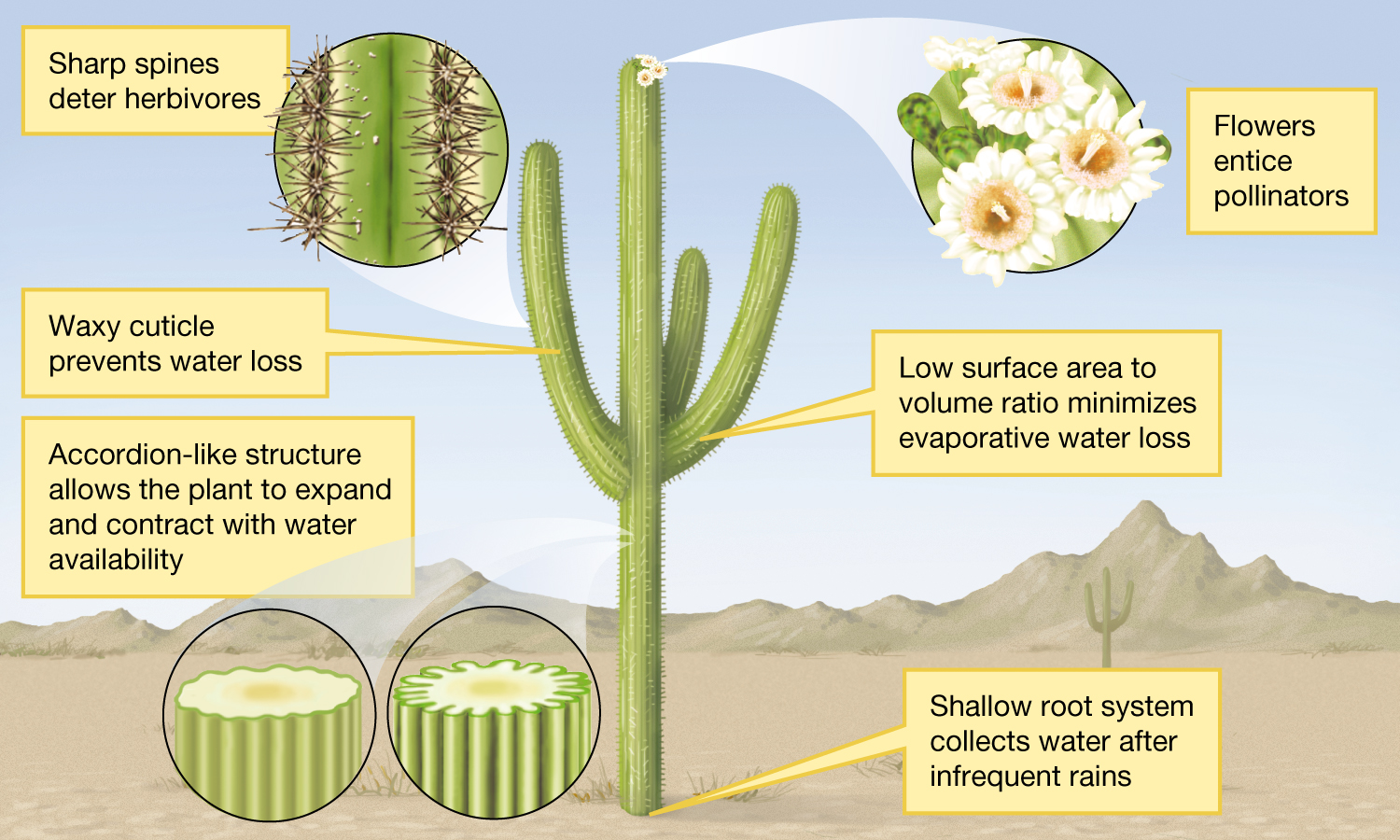
(1) Hard and waxy leaves — the thick, waxy cuticle on leaves reduces evaporation by creating a waterproof barrier (e.g., in many cacti and desert shrubs).
(2) Tiny leaves or no leaves — reducing leaf surface area directly reduces transpiration. Some plants like cacti have almost no leaves at all, performing photosynthesis through their green stems instead.
(3) Thorns instead of leaves — in many desert plants (like cacti), leaves have been modified into thorns/spines, which have negligible surface area and thus lose almost no water, while also protecting the plant from grazing animals.
So all three modifications are correct.
Desert plants use three main leaf modifications to survive in water-scarce environments: waxy coatings to prevent evaporation, reduced leaf size to minimize transpiration surface area, and thorns instead of leaves to eliminate water loss entirely.
This tests understanding of xerophytic adaptations - plants evolved specific structural changes to conserve water in arid climates.
Students often miss that all three adaptations work together in desert plants, not just one or two mechanisms.
Xerophytic Plant Adaptations
Geography desert areas inhibit water loss leaf modifications
Xerophytic Adaptations: How Desert Plants Conserve Water
Xerophytes are plants adapted to survive in water-scarce environments
Primary goal is to minimize transpiration (water loss through leaves)
All three leaf modifications mentioned in the question are valid adaptations
Cacti are classic examples showing multiple adaptations simultaneously
What Are Xerophytes
Xerophytes are plants that have evolved to survive in arid environments with limited water availability. The term comes from Greek words meaning 'dry plants'. These adaptations primarily target reducing transpiration — the process by which plants lose water through their leaves.
Three Key Leaf Modifications
Modification | Mechanism | Examples | Water Saving Principle |
|---|---|---|---|
Hard & waxy leaves | Thick waxy cuticle coating | Desert shrubs, some cacti | Waterproof barrier reduces evaporation |
Tiny/no leaves | Reduced leaf surface area | Cacti, some acacias | Less surface = less transpiration |
Thorns instead of leaves | Leaves modified into spines | Prickly pear, barrel cactus | Near-zero surface area for water loss |
Additional Xerophytic Features
Succulent stems — thick, fleshy stems store water and perform photosynthesis when leaves are absent
Deep root systems — tap roots extend deep to access groundwater
CAM photosynthesis — stomata open only at night to reduce daytime water loss
Silvery/light-colored surfaces — reflect sunlight to reduce heat and water stress
Cactus Adaptations
Source: W.W. Norton — 3.2 Adaptations · nerd.wwnorton.com
Question Connection
This question tests understanding that desert plants use multiple simultaneous adaptations rather than just one strategy. The correct answer D includes all three modifications because real xerophytes often combine several water-conservation methods for maximum survival advantage.
Trap: Thinking only one type of leaf modification occurs — desert plants use multiple strategies together
Trap: Confusing thorns as defense only — they're primarily water conservation adaptations
Trap: Missing that no leaves (option 2) includes plants that photosynthesize through green stems
Common error: Eliminating hard waxy leaves thinking they're not desert-specific — many xerophytes have this feature
Transpiration & Water Loss
Geography water loss
Transpiration: How Plants Lose Water & Why It Matters
Transpiration is water loss from plants through leaf surfaces
Occurs mainly through stomata (leaf pores) during gas exchange
Essential for plant function but problematic in water-scarce environments
The Transpiration Process
Transpiration is the process by which plants lose water vapor through their leaves. It occurs mainly through stomata — tiny pores on leaf surfaces that open to allow carbon dioxide in for photosynthesis but simultaneously allow water vapor to escape.
How Transpiration Works
%%{init: {"flowchart": {"wrappingWidth": 460}}}%%
flowchart TD
  s1["`**Water uptake**
Roots absorb water from soil`"]
  s2["`**Water transport**
Water travels up through stem to leaves`"]
  s3["`**Stomatal opening**
Leaf pores open for CO₂ intake during photosynthesis`"]
  s4["`**Water evaporation**
Water vapor escapes through open stomata`"]
  s5["`**Water loss**
Plant loses moisture to atmosphere`"]
  s1 --> s2
  s2 --> s3
  s3 --> s4
  s4 --> s5
Factors Affecting Transpiration Rate
Temperature — higher heat increases evaporation rate
Humidity — dry air increases water loss gradient
Wind speed — air movement carries away water vapor faster
Light intensity — bright light causes stomata to open more
Leaf surface area — larger leaves mean more transpiration sites
Trap: Thinking transpiration is always bad — it's essential for nutrient transport and cooling
Trap: Confusing with respiration — transpiration is water loss, respiration is gas exchange
Remember: Desert plants must balance photosynthesis needs with water conservation
Desert Vegetation Examples
Geography desert areas
Major Desert Plants & Their Adaptations Worldwide
Cacti are the most recognizable xerophytes with multiple adaptations
Succulents store water in thick, fleshy tissues
Different deserts have evolved similar water-conservation strategies independently
Desert Plant Examples by Region
Desert Region | Key Plants | Primary Adaptations | Notable Features |
|---|---|---|---|
North American Deserts | Saguaro cactus, Prickly pear | Thorns, succulent stems, waxy coating | Can live 200+ years |
African Deserts | Baobab, Welwitschia | Water storage, minimal leaves | Baobab stores 32,000 gallons |
Australian Deserts | Sturt's desert pea, Mallee scrub | Small leaves, deep roots | Drought-deciduous behavior |
Asian Deserts | Saxaul, Camel thorn | Salt tolerance, tiny leaves | Survive extreme temperature ranges |
Plant Survival Strategies
Water storage — succulents can survive months without rainfall using stored water
Drought dormancy — some plants shed leaves and become dormant during dry periods
Salt tolerance — many desert plants can process saline groundwater
Rapid growth after rain — ephemeral plants complete life cycle quickly when water is available
Global Desert Plants

Source: Pinterest — Desert Plants Names | Top 10 Desert Plants Names & Pictures - EngDic · www.pinterest.com