Which of the following is/are unique characteristic/characteristics of equatorial forests? 1. Presence of tall, closely set trees with crowns forming a continuous canopy 2. Coexistence of a large number of species 3. Presence of numerous varieties of epiphytes Select the correct answer using the codes given below:
Contents15
- A1 only
- B2 and 3 only
- C1 and 3 only
- D1, 2 and 3
Show answer
Answer: (D) 1, 2 and 3
All three are unique characteristics of equatorial (tropical evergreen) forests.
(1) These forests have tall, closely set trees whose crowns interlock to form a continuous canopy, blocking most sunlight from reaching the ground.
(2) Due to the warm, wet climate year-round, these forests support an enormous number of coexisting species — the highest biodiversity of any terrestrial biome.
(3) Epiphytes (plants that grow on other plants, like orchids and ferns) are extremely abundant because of the high humidity and rainfall.
So all three statements are correct.
Equatorial forests contain more than half of all terrestrial species despite covering only about 6% of Earth's land surface.
The question tests whether students can distinguish truly unique features of equatorial forests from characteristics shared with other forest types like temperate or boreal forests.
Equatorial Forest Characteristics
Geography equatorial forests tall, closely set trees continuous canopy coexistence epiphytes
Equatorial Forest Characteristics: Structure, Biodiversity & Adaptations
Continuous canopy formed by tall, closely set trees blocking ground sunlight
Highest biodiversity of any terrestrial biome with thousands of coexisting species
Abundant epiphytes like orchids and ferns growing on tree trunks and branches
Found between 10°N to 10°S in Amazon, Congo Basin, and Southeast Asia
What Are Equatorial Forests
Equatorial forests are tropical evergreen forests located near the equator where temperature stays 25-27°C year-round and rainfall exceeds 2000mm annually. Also called tropical rainforests, they represent Earth's most complex terrestrial ecosystem.
Three Key Characteristics
Characteristic | Description | Why It's Unique |
|---|---|---|
Continuous Canopy | Tall trees (30-60m) with interlocking crowns | Blocks 95% of sunlight, creating distinct forest layers |
Species Coexistence | Thousands of species in small areas | Highest biodiversity density on Earth - more species per hectare than any other biome |
Abundant Epiphytes | Plants growing on other plants (orchids, ferns, bromeliads) | Unique adaptation to high humidity - over 30,000 epiphyte species globally |
Forest Structure
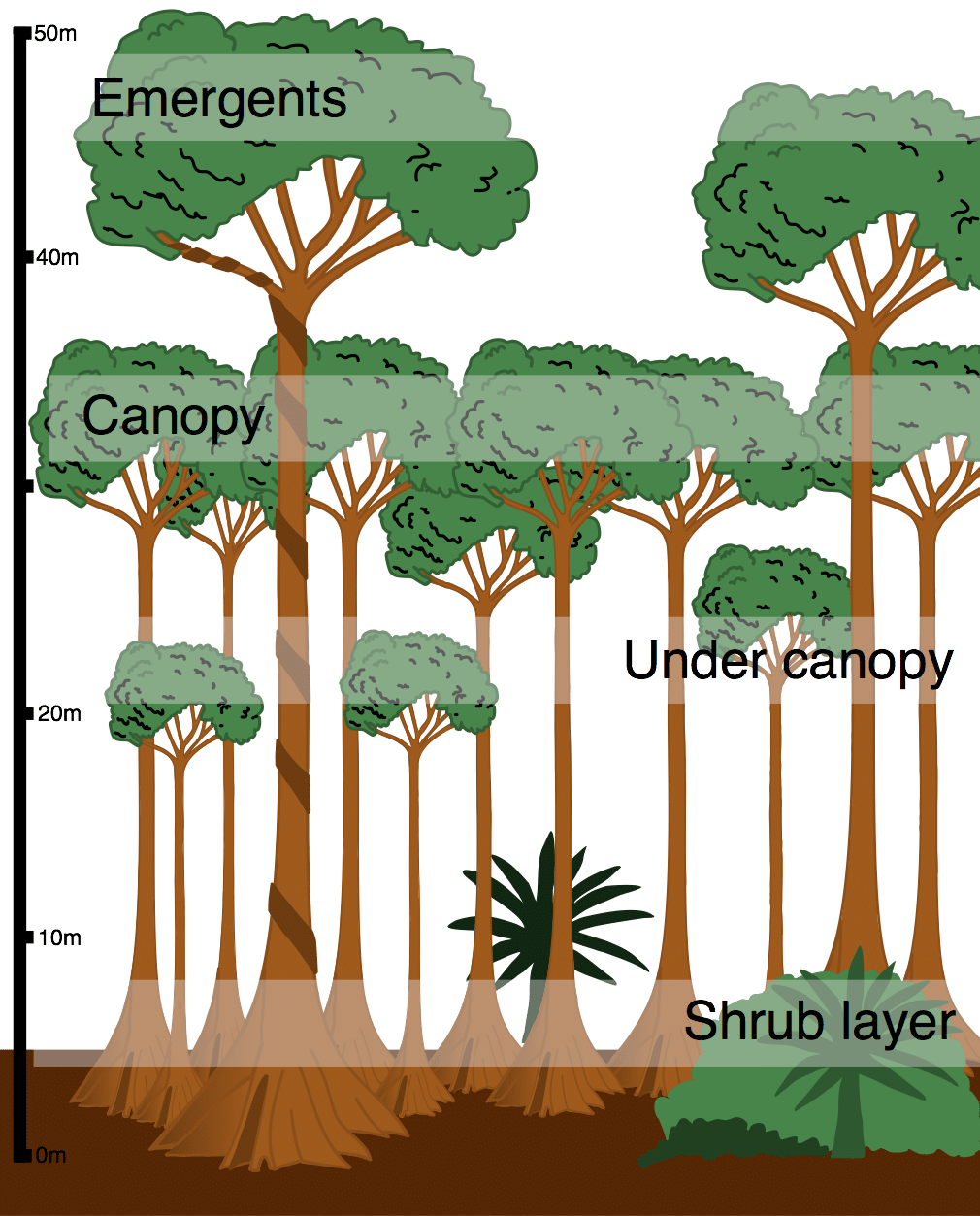
Source: Internet Geography — What is the structure of the tropical rainforest? - Internet Geography · www.internetgeography.net
Why These Features Exist
The year-round warm, wet climate (no dry season) creates perfect growing conditions. Trees compete for sunlight by growing tall and forming dense canopies. High humidity supports epiphytes that don't need soil. Stable climate allows specialization - creating biodiversity.
Don't confuse equatorial forests with monsoon forests - monsoon forests have a dry season and are deciduous
Epiphytes are not parasites - they only use trees for support, not nutrition
The canopy blocks light to the ground - understory plants are adapted to low light, not absence of plants
All three characteristics in this question are unique to equatorial forests - not found together in other forest types
Global Equatorial Forest Regions
Geography
Major Equatorial Forest Regions: Amazon, Congo & Southeast Asia
Amazon Basin - largest tropical rainforest covering 60% of global equatorial forest area
Congo Basin - Africa's largest rainforest, second globally in area
Southeast Asian forests in Indonesia, Malaysia, Philippines - highest species diversity per area
Major Equatorial Forest Regions
Region | Countries | Area (approx) | Key Feature |
|---|---|---|---|
Amazon Basin | Brazil, Peru, Colombia, Venezuela, others | 5.5 million km² | Largest - produces 20% of world's oxygen |
Congo Basin | DRC, Cameroon, CAR, Gabon | 2 million km² | Africa's lungs - critical for global climate |
Southeast Asia | Indonesia, Malaysia, Philippines, Thailand | 1.5 million km² | Highest species density - many endemic species |
Others | Madagascar, Western Ghats (India), Central America | Smaller patches | Unique endemic species and regional adaptations |
Global Distribution
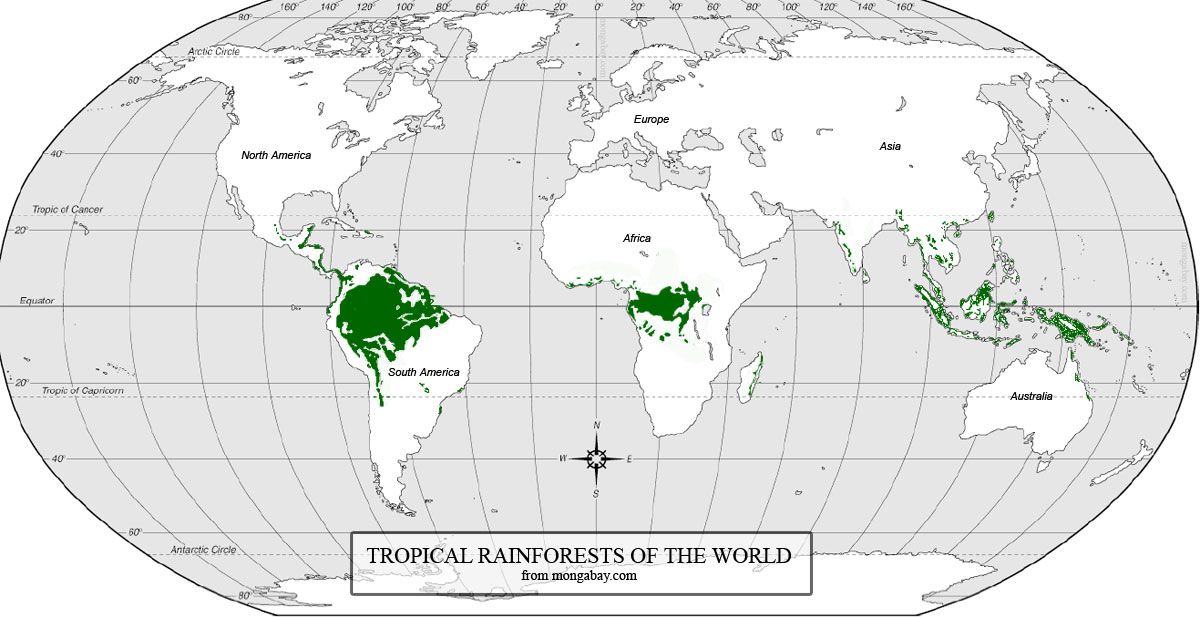
Source: The Tropical Rainforest — Location of Rainforests · worldrainforests.com
Climate Requirements
Temperature: Constant 25-27°C with minimal seasonal variation
Rainfall: Over 2000mm annually with no distinct dry season
Humidity: 80-95% relative humidity throughout the year
Location: Between 10°N to 10°S latitude for consistent solar energy
Forest Types Comparison
Geography
Forest Types Comparison: Equatorial vs Monsoon vs Temperate
Equatorial forests - evergreen, continuous canopy, highest biodiversity
Monsoon forests - deciduous, shed leaves in dry season, lower biodiversity
Temperate forests - seasonal changes, moderate biodiversity, distinct seasons
Key Forest Type Differences
Forest Type | Climate | Leaf Type | Biodiversity | Example Location |
|---|---|---|---|---|
Equatorial/Tropical Evergreen | Hot, wet year-round | Evergreen - no leaf shedding | Highest - thousands of species | Amazon, Congo Basin |
Tropical Monsoon | Hot with dry season | Deciduous - shed leaves in dry season | Moderate-High | Western Ghats, Southeast Asia |
Temperate Deciduous | Moderate, 4 seasons | Deciduous - shed in autumn | Moderate | Europe, Eastern USA |
Temperate Coniferous | Cool, moderate rainfall | Evergreen needles | Lower | Canada, Northern Europe |
Boreal (Taiga) | Cold, short summers | Evergreen needles | Lowest | Siberia, Northern Canada |
Don't confuse tropical evergreen with temperate evergreen - tropical has broad leaves, temperate has needle leaves
Monsoon forests are NOT equatorial - they have a distinct dry season and deciduous trees
Deciduous means seasonal leaf fall - not the same as evergreen forests
Biodiversity decreases as you move away from the equator toward poles
Equatorial Forests in India
Geography
Equatorial-Type Forests in India: Western Ghats & Northeast
Western Ghats - India's largest tropical evergreen forest region
Northeast India - high rainfall areas with evergreen characteristics
Andaman & Nicobar - island tropical forests with unique species
India's Tropical Evergreen Context
India has tropical evergreen forests (similar to equatorial forests) in areas receiving over 2000mm annual rainfall. While not exactly equatorial, they share key characteristics: evergreen trees, high biodiversity, and continuous canopy in undisturbed areas.
India's Evergreen Forest Regions
Region | States | Rainfall | Key Species | Special Feature |
|---|---|---|---|---|
Western Ghats | Kerala, Karnataka, Maharashtra, Tamil Nadu | 2000-3000mm | Teak, Rosewood, Mahogany | UNESCO World Heritage - 325 globally threatened species |
Northeast India | Assam, Meghalaya, Arunachal Pradesh | 2000-4000mm | Sal, Bamboo, Orchids | Wettest region - Cherrapunji effect |
Andaman & Nicobar | Island territory | 3000mm+ | Padauk, Gurjan, Mangroves | Endemic species - isolated evolution |
Indian Forest Characteristics
Monsoon influence: Unlike true equatorial forests, Indian forests have monsoon patterns
Biodiversity hotspots: Western Ghats and Northeast India are global biodiversity hotspots
Endemic species: High percentage of plants and animals found nowhere else
Epiphyte abundance: Especially orchids - India has 1300+ orchid species