About three-fourths of world's cobalt, a metal required for the manufacture of batteries for electric motor vehicles, is produced by
Contents14
- AArgentina
- BBotswana
- CThe Democratic Republic of the Congo
- DKazakhstan
Show answer
Answer: (C) The Democratic Republic of the Congo
The Democratic Republic of Congo (DRC) produces about 70% of the world's cobalt and holds half of known reserves.
Cobalt is essential for rechargeable batteries used in electric vehicles.
Answer is (c) Democratic Republic of the Congo.
The Democratic Republic of Congo produces approximately 70% of the world's cobalt, making it the dominant supplier for electric vehicle battery production.
Electric vehicle adoption accelerated globally in 2021-2023, making cobalt supply chains a critical geopolitical and economic issue.
UPSC is testing awareness of resource geography in the context of green energy transition and supply chain dependencies.
Democratic Republic of Congo - Cobalt Production
Geography Democratic Republic of the Congo cobalt three-fourths
Democratic Republic of Congo: World's Cobalt Powerhouse
DRC produces 70% of world's cobalt supply
Holds 50% of global cobalt reserves
Katanga Province is the main cobalt mining region
Major mines include Mutanda and Tenke Fungurume
Global Dominance
The Democratic Republic of Congo controls the world's cobalt supply more than any single country controls oil. This African nation sits on the Katanga Copperbelt, a geological formation rich in copper-cobalt ores formed millions of years ago.
Top Cobalt Producers
Country | Global Share | Key Mining Regions | Notable Feature |
|---|---|---|---|
Democratic Republic of Congo | ~70% | Katanga Province | Artisanal & industrial mining |
Australia | ~4% | Western Australia | Nickel mine by-product |
Russia | ~4% | Norilsk region | Nickel-copper operations |
Cuba | ~3% | Moa Bay | Lateritic deposits |
Cobalt Mining Belt

Source: Mongabay — Impunity and pollution abound in DRC mining along the road ... · news.mongabay.com
Why DRC Dominates
Geological advantage: Sedimentary copper-cobalt deposits formed in ancient rift basin
Artisanal mining: Thousands of small-scale miners extract cobalt by hand
Industrial operations: Large companies like Glencore and China Molybdenum operate major mines
Infrastructure challenges: Poor roads and political instability affect consistent supply
Trap: Students might guess Argentina thinking of lithium (Argentina is a lithium producer, not cobalt)
Trap: Kazakhstan is known for uranium production, not cobalt
Trap: Botswana is famous for diamonds, not cobalt
Memory aid: DRC = Dominates Rechargeable battery Cobalt
Cobalt in Battery Manufacturing
Science And Technology cobalt batteries electric motor vehicles
Cobalt: The Critical Battery Metal for Electric Vehicles
Cobalt is essential for lithium-ion battery cathodes
Prevents thermal runaway and battery fires
60-70% of cobalt goes to battery manufacturing
Companies are researching cobalt-free alternatives due to supply concerns
Why Cobalt Matters
Cobalt acts as a stabilizing agent in lithium-ion battery cathodes, preventing dangerous overheating. Without cobalt, batteries would be prone to thermal runaway - a chain reaction that causes fires and explosions.
Battery Metals Comparison
Metal | Primary Function | Top Producer | Substitution Difficulty |
|---|---|---|---|
Cobalt | Cathode stabilizer | DRC (70%) | Very difficult |
Lithium | Ion conductor | Australia (50%) | Nearly impossible |
Nickel | Energy density | Indonesia (35%) | Moderate |
Graphite | Anode material | China (65%) | Difficult |
Cobalt Supply Chain
%%{init: {"flowchart": {"wrappingWidth": 460}}}%%
flowchart TD
  s1["`**Mining**
**DRC** extracts cobalt ore from copper-cobalt deposits`"]
  s2["`**Processing**
**China** refines 80% of cobalt into battery-grade chemicals`"]
  s3["`**Battery Manufacturing**
**China, Japan, South Korea** produce lithium-ion batteries`"]
  s4["`**EV Assembly**
Global automakers integrate batteries into electric vehicles`"]
  s1 --> s2
  s2 --> s3
  s3 --> s4
India's Position
No domestic cobalt: India imports 100% of its cobalt requirements
Growing EV market: India's electric vehicle push increases cobalt demand
PLI schemes: Government incentives for battery manufacturing to reduce import dependence
Strategic partnerships: India exploring cobalt supply agreements with DRC
Trap: Don't confuse cobalt with lithium - both are battery metals but serve different functions
Trap: Argentina is the lithium triangle member, not a cobalt producer
Key link: Electric vehicle growth → cobalt demand → DRC's strategic importance
Africa's Strategic Mineral Resources
Geography
Africa's Dominance in Global Mineral Production
Africa produces 60% of world's minerals by value
South Africa leads in platinum, gold, and chromium
Botswana produces 20% of world's diamonds
Nigeria and Angola dominate oil production in Africa
Africa's Mineral Giants
Country | Key Minerals | Global Rank | Major Mining Regions |
|---|---|---|---|
South Africa | Gold, Platinum, Chromium | #1 in multiple minerals | Witwatersrand, Bushveld |
DRC | Cobalt, Copper, Diamonds | #1 cobalt producer | Katanga Province |
Botswana | Diamonds | #2 diamond producer | Orapa, Jwaneng mines |
Ghana | Gold, Bauxite | Major African gold producer | Ashanti region |
Zambia | Copper | Major copper producer | Copperbelt Province |
African Mining Belt
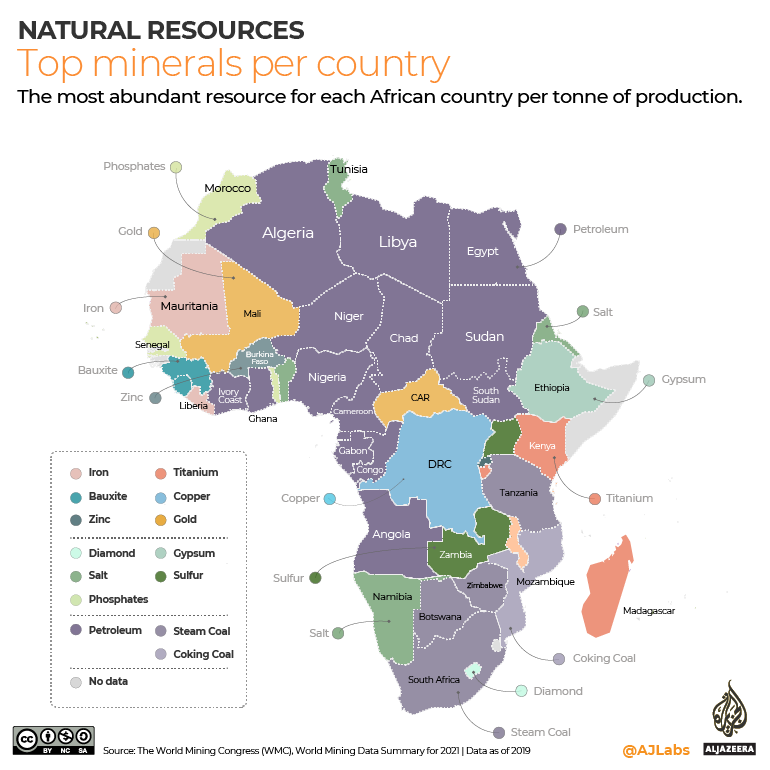
Source: Al Jazeera — Mapping Africa's natural resources | Maps News | Al Jazeera · www.aljazeera.com
Africa's Resource Curse
# Resource Curse in Africa
## Economic Issues
- Dutch Disease
- Export dependence
- Price volatility
- Limited diversification
## Political Issues
- Corruption
- Conflict over resources
- Weak institutions
- Authoritarian rule
## Social Issues
- Income inequality
- Environmental damage
- Displacement of communities
- Limited local benefitsTrap: Don't assume Nigeria leads in solid minerals - it's primarily an oil producer
Trap: Morocco is known for phosphates, not precious metals
Geography link: Many African mineral belts follow ancient geological formations like the Kaapvaal Craton