With reference to the religious history of India, consider the following statements: 1. Sthaviravadins belong to Mahayana Buddhism. 2. Lokottaravadin sect was an offshoot of Mahasanghika sect of Buddhism. 3. The deification of Buddha by Mahasanghikas fostered the Mahayana Buddhism. Which of the statements given above is/are Correct?
Contents17
- A1 and 2 only
- B2 and 3 only
- C3 only
- D1, 2 and 3
Show answer
Answer: (B) 2 and 3 only
This question is about early Buddhist sects.
Let's understand the split:
About 100 years after Buddha's death, Buddhism split into two groups:
Sthaviravadins ("Elders"): They believed Buddhas are just men — pure and simple. They focused on individual salvation (Arahantship).
Mahasanghikas ("Great Assembly"): They believed Buddhas are supernatural/divine. This group eventually evolved into Mahayana Buddhism.
Statement 1 (Sthaviravadins belong to Mahayana) — NOT CORRECT: It's the opposite! Sthaviravadins were a separate group. It was the MAHASANGHIKAS who evolved into Mahayana. The Sthaviravadins are closer to what became Theravada Buddhism.
Statement 2 (Lokottaravadin was an offshoot of Mahasanghika) — CORRECT: Over the centuries, the Mahasanghikas split into sub-sects, including the Lokottaravadins. The word "Lokottara" means "supernatural," and their philosophy was based on the concept of a Supernatural Buddha.
Statement 3 (Mahasanghikas first attributed divinity to Buddha and represented him in human form) — CORRECT: The Mahasanghikas were the first to consider Buddha as divine/transcendental and were the first to create statues of Buddha in human form (anthropomorphic representation).
Answer: B (2 and 3 only).
Key Takeaway:
Sthaviravadins = Elders = Buddha is human = led to Theravada.
Mahasanghikas = Buddha is divine = first statues of Buddha = led to Mahayana.
Lokottaravadins are a sub-sect of Mahasanghikas.
The first major Buddhist split around 100 years after Buddha's death created two opposing views: Sthaviravadins saw Buddha as human, while Mahasanghikas saw Buddha as divine.
Mahasanghikas were the first to make human statues of Buddha and consider him supernatural, which directly led to the development of Mahayana Buddhism centuries later.
The question tests whether students can distinguish between early Buddhist sects and avoid confusing Sthaviravadins with Mahayana Buddhism.
First Buddhist Schism
Ancient And Medieval History Sthaviravadins Mahasanghika
First Buddhist Schism: Sthaviravadins vs Mahasanghikas
Buddhism split into Sthaviravadins (Elders) and Mahasanghikas (Great Assembly) around 100 years after Buddha's death
Sthaviravadins believed Buddha was human; Mahasanghikas considered Buddha divine/supernatural
Mahasanghikas evolved into Mahayana Buddhism; Sthaviravadins led to Theravada Buddhism
The schism occurred during the Second Buddhist Council at Vaishali
The Great Split
Around 100 years after Buddha's death, Buddhism faced its first major doctrinal split during the Second Buddhist Council at Vaishali. This wasn't just a theological debate — it fundamentally shaped how Buddhism would develop across Asia.
Core Differences
Aspect | Sthaviravadins (Elders) | Mahasanghikas (Great Assembly) |
|---|---|---|
View of Buddha | Human teacher who achieved enlightenment | Divine/Supernatural being with transcendental powers |
Salvation Focus | Individual liberation (Arahantship) | Universal salvation for all beings |
Monastic Rules | Strict adherence to Vinaya rules | More flexible interpretation of rules |
Later Evolution | Led to Theravada Buddhism | Evolved into Mahayana Buddhism |
Geographic Spread | Sri Lanka, Southeast Asia | Central Asia, China, Tibet, Japan |
Question Connection
Statement 1 was the key trap — it reversed the relationship by claiming Sthaviravadins belonged to Mahayana. The reality is exactly opposite: Sthaviravadins were the conservative faction that believed Buddha was human, while Mahasanghikas deified Buddha and evolved into Mahayana.
Trap: Confusing Sthaviravadins with Mahayana — they're opposites! Sthaviravadins → Theravada, Mahasanghikas → Mahayana
Memory Aid: Sthavira = 'Elder' = conservative = Buddha is human. Mahasangha = 'Great Assembly' = liberal = Buddha is divine
Common Error: Thinking the 'Great Assembly' name means Sthaviravadins were the major sect — actually Mahasanghikas were called this
Mahasanghika Sub-sects
Ancient And Medieval History Lokottaravadin Mahasanghika
Mahasanghika Sub-sects: Lokottaravadins and Others
Lokottaravadins were a sub-sect of Mahasanghikas who emphasized Buddha's supernatural nature
Lokottara means 'supernatural' or 'transcendental' in Sanskrit
Mahasanghikas fragmented into multiple sub-sects over several centuries
Evolution of Sects
After the initial split, the Mahasanghika school itself fragmented into various sub-sects over the centuries. Each developed specific interpretations of Buddha's nature and Buddhist doctrine.
Mahasanghika Family Tree
# Mahasanghika School
## Lokottaravadins
- Emphasized supernatural Buddha
- Lokottara = 'transcendental'
- Influenced Mahayana thought
## Ekavyavaharikas
- Single utterance doctrine
- All Buddha's teachings simultaneous
## Gokulika
- Regional sect
- Preserved Mahasanghika traditions
## Other Sub-sects
- Bahusrutiya
- Prajñaptivada
- Caitika
Lokottaravadin Significance
The Lokottaravadins were particularly important because their doctrine of Buddha's supernatural nature (Lokottara) directly contributed to the theological foundation of Mahayana Buddhism. They bridged the gap between the early Mahasanghika ideas and full Mahayana development.
Direct UPSC Fact: Lokottaravadins = offshoot of Mahasanghikas ✓ (Statement 2 was correct)
Etymology Trap: 'Lokottara' literally means 'beyond the world' = supernatural/transcendental Buddha
Don't Confuse: Lokottaravadins with Sthaviravadins — completely different schools with opposite philosophies
Buddha Deification & Mahayana Origins
Ancient And Medieval History deification of Buddha Mahasanghikas Mahayana Buddhism
Buddha's Deification: From Human Teacher to Divine Being
Mahasanghikas first deified Buddha, treating him as supernatural rather than human
They created the first anthropomorphic (human-form) statues of Buddha
This deification directly fostered the development of Mahayana Buddhism
Earlier Buddhist art used symbols (lotus, wheel, footprints) instead of human images
Revolutionary Change
The Mahasanghikas made a revolutionary theological shift — transforming Buddha from a human teacher who achieved enlightenment into a divine, transcendental being with supernatural powers. This wasn't just doctrine; it changed how Buddhists worshipped and represented their founder.
Evolution of Buddha Representation
%%{init: {"flowchart": {"wrappingWidth": 460}}}%%
flowchart TD
  s1["`**Early Buddhism (Buddha's lifetime)**
Buddha explicitly discouraged personality worship, focused on **Dhamma** (teaching)`"]
  s2["`**Post-Buddha Period (1st-2nd century BCE)**
Buddhist art used **symbols**: wheel (**dharmachakra**), lotus, footprints, empty throne`"]
  s3["`**Mahasanghika Innovation (1st century CE)**
First **anthropomorphic statues** — Buddha shown in human form as divine being`"]
  s4["`**Mahayana Development (2nd century CE onwards)**
Full deification: Buddha as eternal, omnipresent, with **multiple Buddhas** concept`"]
  s1 --> s2
  s2 --> s3
  s3 --> s4
Theological Impact
Transcendental Buddha: Mahasanghikas taught that Buddha's physical body was just an appearance — his true nature was divine and eternal
Multiple Buddhas: This opened the door to concepts like Amitabha Buddha and celestial Buddhas in Mahayana
Bodhisattva Ideal: Divine Buddha concept enabled the Mahayana teaching that anyone could become a Buddha through the bodhisattva path
Popular Appeal: Deified Buddha attracted more lay followers who could worship and pray to Buddha as a god
Question Connection
Statement 3 was correct — Mahasanghikas' deification of Buddha did foster Mahayana Buddhism. This wasn't just theological speculation; it was the crucial bridge between early sectarian Buddhism and the fully developed Mahayana tradition.
Key UPSC Point: Mahasanghikas deified Buddha → fostered Mahayana ✓ (Statement 3 correct)
Art History Connection: First Buddha statues (not just symbols) came from Mahasanghika influence
Don't Reverse: It was Mahasanghikas who deified Buddha, NOT Sthaviravadins (who kept Buddha human)
Theravada vs Mahayana Buddhism
Ancient And Medieval History
Major Buddhist Schools: Theravada vs Mahayana
Theravada ('Way of Elders') evolved from Sthaviravadins — conservative, individual salvation focus
Mahayana ('Great Vehicle') evolved from Mahasanghikas — liberal, universal salvation focus
Theravada dominates Southeast Asia; Mahayana dominates East Asia
Two Paths Diverged
The ancient schism between Sthaviravadins and Mahasanghikas eventually crystallized into two major Buddhist traditions that spread across different regions of Asia, each developing distinct practices and interpretations.
Comprehensive Comparison
Aspect | Theravada Buddhism | Mahayana Buddhism |
|---|---|---|
Ancient Root | Sthaviravadins (Elders) | Mahasanghikas (Great Assembly) |
Buddha's Nature | Human teacher, fully enlightened | Divine/Cosmic being with supernatural powers |
Salvation Goal | Arhat (individual liberation) | Bodhisattva (universal liberation) |
Sacred Texts | Pali Canon (Tripitaka) | Sanskrit texts + additional Mahayana sutras |
Key Concept | Four Noble Truths, Eightfold Path | Emptiness (Sunyata), Compassion (Karuna) |
Geographic Spread | Sri Lanka, Myanmar, Thailand, Laos, Cambodia | China, Tibet, Mongolia, Korea, Japan, Vietnam |
Monastic Focus | Strict adherence to Vinaya rules | More flexible, includes lay practitioners |
Buddha Representation | Historical Shakyamuni Buddha only | Multiple Buddhas (Amitabha, Medicine Buddha, etc.) |
Geographic Distribution
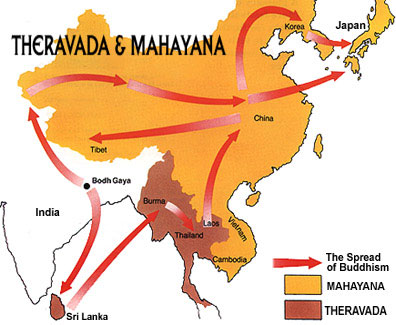
Source: BuddhaNet — The Buddhist Studies: Theravada and Mahayana - buddhanet.net · www.buddhanet.net
Memory Aid: Thera = Elder = Conservative = Individual salvation. Maha = Great = Liberal = Universal salvation
Geographic Trap: Don't confuse regional spread — Theravada = Southeast, Mahayana = East Asia
Text Confusion: Theravada uses Pali canon; Mahayana uses Sanskrit texts plus additional sutras