With reference to the guilds (Shreni) of ancient India that played a very important role in the country's economy, which of the following statements is/are correct? 1. Every guild was registered with the central authority of the State and the king was the chief administrative authority on them 2. The wages, rules of work, standards and prices were fixed by the guild 3. The guild had judicial powers over its own members Select the correct answer using the codes given below:
Contents14
- A1 and 2 only
- B3 only
- C2 and 3 only
- D1, 2 and 3
Show answer
Answer: (C) 2 and 3 only
Ancient Indian guilds (Shreni) were powerful autonomous bodies:
Statement 2 correct — guilds set their own rules for wages, working conditions, quality standards, and prices.
The guild council regulated all aspects of the trade.
Statement 3 correct — guilds had judicial authority over their members.
Any member violating guild rules was tried by the guild court.
Statement 1 is WRONG — guilds were NOT registered with a central state authority, and the king was NOT their chief administrative authority.
Guilds were corporate bodies that enjoyed considerable autonomy from royal control.
The king sometimes consulted influential guild leaders, but did not control them.
Source: Economic History of India by N. Jayapalan.
Answer: 2 and 3 only.
Ancient Indian guilds (Shreni) were autonomous corporate bodies that controlled wages, work standards, prices, and had their own courts for members.
The key trap is assuming the king controlled guilds - in reality, guilds operated independently and were not registered with or administered by the central state authority.
Ancient Indian Guilds (Shreni)
Ancient And Medieval History guilds Shreni
Ancient Indian Guilds (Shreni): Organization, Powers & UPSC Traps
Guilds (Shreni) were autonomous corporate bodies of merchants and artisans
Guilds had judicial powers over their own members
Guilds fixed wages, prices, and quality standards independently
Guilds were NOT controlled by the king or central authority
What Were Guilds?
Shreni were powerful trade and craft associations that dominated ancient India's economy. These were corporate bodies of merchants, artisans, and skilled workers who organized themselves by profession — goldsmith guilds, weaver guilds, merchant guilds, etc.
Guild Powers & Functions
Function | Details | Example |
|---|---|---|
Economic Control | Fixed wages, prices, quality standards | Potter guild set clay pot prices across the city |
Judicial Authority | Tried members for violations, imposed penalties | Guild court punished member for selling substandard goods |
Internal Governance | Elected guild leaders, made rules | Shreshthi (guild president) led the association |
Banking Functions | Provided loans, collected deposits | Merchant guilds acted like modern banks |
Guild Autonomy
Guilds enjoyed considerable independence from royal control — they were not state departments
The king sometimes consulted influential guild leaders on economic matters but did not administratively control them
Guild laws were recognized by the state as valid — Dharmashastra texts mention guild regulations
Guilds could migrate collectively to other kingdoms if treated unfairly by the ruler
Question Connection
This PYQ tests the common misconception that ancient Indian guilds were state-controlled bodies. Statement 1 is the trap — students often assume centralized control existed. The correct understanding is that guilds were autonomous corporate entities with self-governance.
Trap: Assuming guilds were registered with central authority — they were autonomous bodies
Confusion: King as chief administrative authority over guilds — king only consulted them, did not control
Modern parallel trap: Don't equate ancient guilds with modern trade unions under government regulation
Gupta Period Economy
Ancient And Medieval History
Gupta Period Economy: Trade, Agriculture & Urban Centers
Gupta period (320-550 CE) marked the peak of ancient Indian economic prosperity
Guild system reached its zenith during this period
Extensive internal and external trade with Roman Empire, Southeast Asia
Agriculture remained the primary occupation with improved techniques
Economic Golden Age
The Gupta period is called the Golden Age not just for arts and culture, but also for economic prosperity. Trade flourished, cities expanded, and the guild system provided stable economic organization.
Gupta Economic Features
Sector | Key Features | Evidence |
|---|---|---|
Agriculture | Iron ploughshares, better irrigation | Allahabad Pillar mentions agricultural prosperity |
Trade | Gold coins, silk route, sea trade | Roman gold coins found in South India |
Crafts | Textiles, metalwork, ivory | Ajanta cave paintings show craft techniques |
Urban Centers | Pataliputra, Ujjain, Mathura | Archaeological evidence of planned cities |
Guild System Peak
Guilds became most powerful during Gupta rule — they had political influence beyond economic control
Guild inscriptions from this period show complex organizational structures
Kamasutra by Vatsyayana mentions various guild activities in urban life
Guilds acted as financial institutions — lending money and collecting deposits
Gupta Trade Network
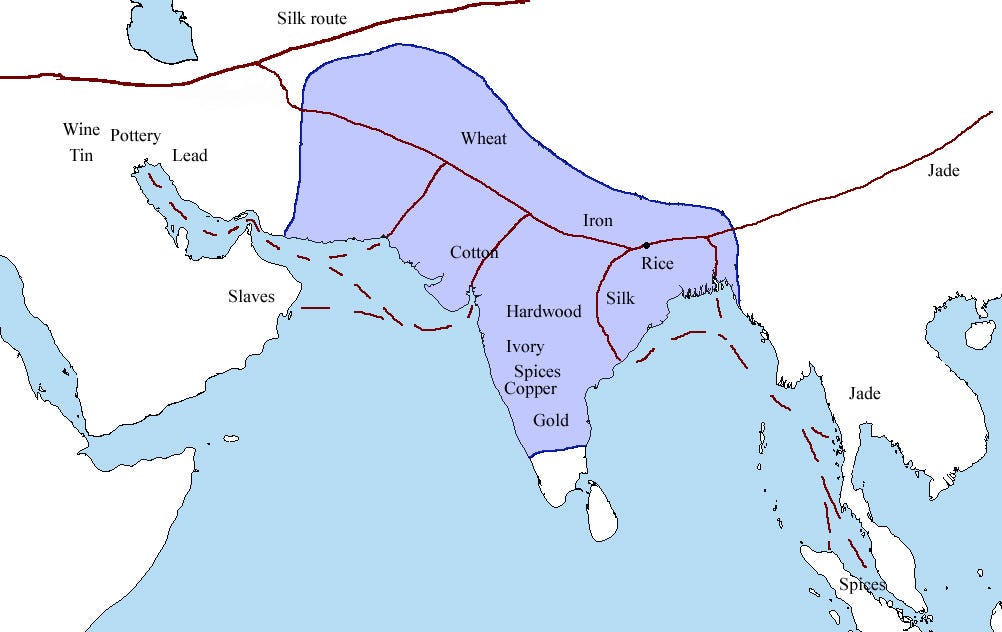
Source: Medium — 5 Ancient Empires that Grew Rich through Global Trade | by Ashish ... · medium.com
Ancient Indian Judicial System
Ancient And Medieval History judicial powers
Ancient Indian Judicial System: Courts, Laws & Guild Justice
Multiple court system — royal courts, guild courts, village panchayats
Dharmashastra texts provided legal framework alongside customary laws
Guild courts had jurisdiction over trade disputes and member violations
King's court was the highest appellate authority
Decentralized Justice
Ancient India had a multi-tier judicial system where different courts handled different types of cases. This decentralization allowed specialized bodies like guilds to manage their internal affairs efficiently.
Types of Courts
Court Type | Jurisdiction | Cases Handled | Legal Basis |
|---|---|---|---|
Royal Court | Entire kingdom | Major crimes, appeals | Rajadharma (royal law) |
Guild Court | Guild members | Trade disputes, quality violations | Guild regulations |
Village Panchayat | Local community | Minor disputes, family matters | Local customs |
Caste Panchayat | Caste community | Social violations, marriages | Dharmashastra |
Guild Judicial Powers
Guild courts could impose fines, expel members, and ban from trade
Manu Smriti recognizes guild laws as valid alongside royal and customary laws
Guild decisions were binding — members who violated rules faced economic boycott
Appeal system existed — serious guild decisions could be appealed to royal court
Don't assume centralized system — ancient India had multiple parallel court systems
Guild courts were legitimate — not informal dispute resolution but recognized legal institutions
King was not supreme in all matters — guilds had autonomous judicial authority in their domain