India maintained its early cultural contacts and trade links with Southeast Asia across the Bay of Bengal. For this pre-eminence of early maritime history of Bay of Bengal, which of the following could be the most convincing explanation /explanations?
Contents19
- AAs compared to other countries, India had a better ship-building technology in ancient and medieval times
- BThe rulers of southern India always patronized traders, Brahmin priests and Buddhist monks in this context
- CMonsoon winds across the Bay of Bengal facilitated sea voyages
- DBoth (a) and (b) are convincing explanations in this context
Show answer
Answer: (C) Monsoon winds across the Bay of Bengal facilitated sea voyages
The most convincing explanation for India's early maritime trade with Southeast Asia is the MONSOON WIND SYSTEM.
The monsoon winds blow in predictable, reversing patterns — southwest in summer (June-September) and northeast in winter (October-February).
Ancient sailors used this to their advantage: they sailed TO Southeast Asia with one monsoon and RETURNED with the other.
This made regular, round-trip voyages practical and reliable without any advanced navigation technology.
Option (a) — better shipbuilding — is debatable and not the PRIMARY reason; many civilizations had ships.
Option (b) — royal patronage — helped but doesn't explain why the Bay of Bengal specifically became important.
Option (d) — combining (a) and (b) — still misses the main point.
The monsoon winds are the most convincing explanation because they explain the geographical pattern: why trade was specifically across the Bay of Bengal and not elsewhere.
The monsoon winds across the Bay of Bengal blow in predictable, reversing patterns - southwest in summer and northeast in winter - allowing ancient sailors to make reliable round-trip voyages to Southeast Asia.
UPSC is testing whether students understand that geography and natural phenomena, not just human factors like technology or patronage, drive historical trade patterns.
Monsoon Wind System & Maritime Trade
Ancient And Medieval History Monsoon winds Bay of Bengal sea voyages
Monsoon Winds: The Engine of Ancient Maritime Trade
Southwest monsoon (June-September) and Northeast monsoon (October-February) created predictable sailing seasons
Ancient sailors sailed TO Southeast Asia with one monsoon, RETURNED with the opposite monsoon
Made round-trip voyages across Bay of Bengal reliable without advanced navigation technology
Explains why Bay of Bengal became the primary trade corridor, not Arabian Sea or other routes
Why Monsoons Matter
The monsoon wind system made the Bay of Bengal a natural highway for ancient trade. Unlike other seas where winds are unpredictable, monsoons blow in reversing seasonal patterns — creating a reliable transport system that ancient sailors could plan around.
Ancient Sailing Cycle
%%{init: {"flowchart": {"wrappingWidth": 460}}}%%
flowchart TD
  s1["`**Southwest Monsoon (June-Sept)**
Indian traders sail TO Southeast Asia with favorable winds`"]
  s2["`**Trading Season**
Conduct business in Southeast Asian ports during monsoon`"]
  s3["`**Northeast Monsoon (Oct-Feb)**
Return to India with opposite winds`"]
  s4["`**Home Season**
Process goods, prepare for next voyage cycle`"]
  s1 --> s2
  s2 --> s3
  s3 --> s4
Maritime Advantages
Predictable timing: Sailors knew exactly when to depart and return
No advanced navigation needed: Wind patterns provided natural guidance
Regular trade cycles: Annual rhythm supported sustained commercial relationships
Reduced risk: Consistent winds meant safer, more reliable voyages
Monsoon Trade Routes
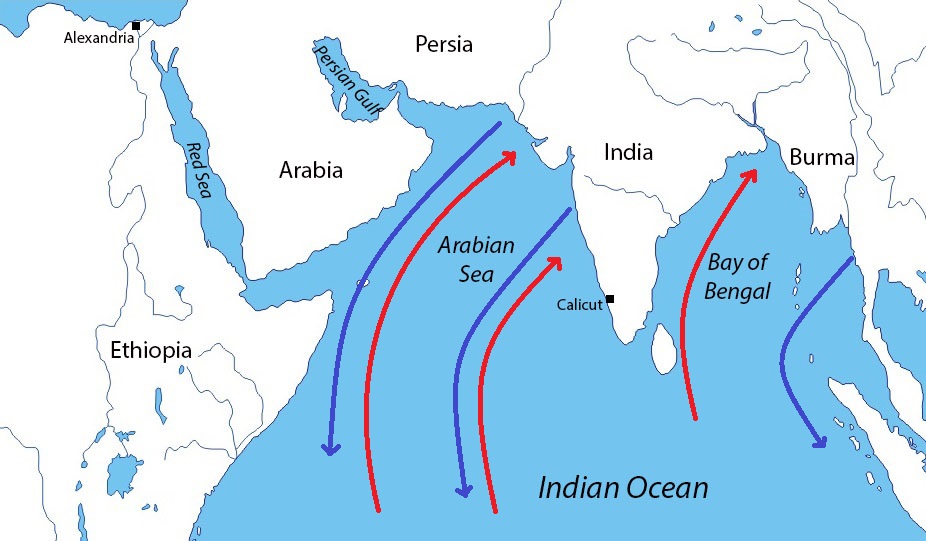
Source: Byzantine Emporia — The Monsoon Trade System: An Indian Ocean Network - Byzantine Emporia · byzantinemporia.com
Trap: Don't assume shipbuilding technology was the main factor — many civilizations had ships
Trap: Royal patronage helped trade but doesn't explain the geographical pattern of Bay of Bengal dominance
Key insight: The question asks for the most convincing explanation — monsoons explain WHY this specific sea route
India's Ancient Maritime Trade Networks
Ancient And Medieval History cultural contacts trade links Southeast Asia
Ancient Indian Maritime Trade: Beyond the Monsoons
India traded across Bay of Bengal from Sangam period (3rd century BCE - 3rd century CE)
Spices, textiles, precious stones exported; gold, silver, exotic goods imported
Cultural export: Hindu-Buddhist traditions, architecture, scripts spread to Southeast Asia
Major ports: Puhar, Mamallapuram, Arikamedu on east coast
Historical Context
India's maritime trade with Southeast Asia began during the Sangam period and peaked under the Cholas. This wasn't just commerce — it was cultural transmission that shaped entire civilizations from Cambodia to Indonesia.
Trade Exchange Pattern
Direction | Main Exports | Key Imports | Cultural Impact |
|---|---|---|---|
India → Southeast Asia | Spices, cotton textiles, precious stones | Local crafts, forest products | Hindu-Buddhist culture, Sanskrit, architecture |
Southeast Asia → India | Gold, silver, tin | Exotic woods, spices | Artistic techniques, new crops |
Supporting Factors
Royal patronage: Southern rulers like Cholas actively promoted overseas trade
Merchant guilds: Organized trading communities with established networks
Religious missions: Buddhist and Hindu monks facilitated cultural exchange
Port infrastructure: Well-developed coastal cities with harbors and warehouses
Question Connection
While royal patronage and shipbuilding contributed to India's maritime success, the monsoon wind system was the fundamental geographical advantage that made regular Bay of Bengal trade possible in the first place.
Don't confuse: Supporting factors (patronage, ships) vs primary geographical reason (monsoons)
Remember: The question asks about Bay of Bengal specifically — monsoons explain this regional focus
Ancient Indian Shipbuilding
Ancient And Medieval History ship-building technology
Ancient Indian Shipbuilding: Technology & Limitations
India had skilled shipbuilding but not necessarily superior to all other civilizations
Large ships mentioned in texts like Yuktikalpataru but technology was comparable, not superior
Shipbuilding supported trade but didn't drive the Bay of Bengal focus
Sewn-plank technique: Boats sewn with coconut fiber, no iron nails initially
Technical Capabilities
Ancient Indian texts describe ships capable of carrying hundreds of passengers and cargo across oceans. The sewn-plank technique using coconut fiber was well-developed, and coastal communities had sophisticated boat-building knowledge.
Indian Innovations
Sewn boats: Planks stitched with coir rope, flexible in rough seas
Multi-masted vessels: Large ships with multiple sails for ocean voyages
Compartmentalized hulls: Watertight sections to prevent sinking
Skilled navigators: Knowledge of stars, currents, and seasonal patterns
Why This Isn't the Answer
While India had good shipbuilding, many civilizations developed ocean-going vessels — Arabs, Chinese, Romans all had maritime technology. The question asks for the most convincing explanation for Bay of Bengal dominance, and superior ships alone don't explain the geographical pattern.
Trap: Don't assume Indian shipbuilding was universally superior — it was good but not unique
Key distinction: Technology enabled trade but monsoons drove the specific Bay of Bengal focus
Royal Patronage of Maritime Trade
Ancient And Medieval History rulers of southern India patronized traders Brahmin priests Buddhist monks
Royal Support for Ancient Maritime Commerce
Chola rulers especially promoted overseas trade and naval expeditions
Patronage facilitated trade but doesn't explain Bay of Bengal geographic focus
Kings provided tax incentives, port facilities, protection for merchant guilds
Religious missions got royal support to spread culture alongside commerce
State Support System
Southern Indian rulers, particularly the Cholas, actively promoted maritime trade through institutional support. They provided protection, infrastructure, and incentives that made long-distance commerce profitable and sustainable.
Forms of Royal Patronage
Support Type | Examples | Beneficiaries | Impact |
|---|---|---|---|
Infrastructure | Port facilities, lighthouses, warehouses | All merchants | Reduced costs, safer operations |
Financial | Tax exemptions, loans, insurance | Merchant guilds | Higher profits, expansion capital |
Military | Naval protection, convoy escorts | Trading fleets | Reduced piracy, secure routes |
Cultural | Funding temples, monasteries abroad | Priests, monks | Cultural influence, trade networks |
Chola Maritime Policy
Naval expeditions: Military campaigns to Southeast Asia opened trade routes
Merchant guilds: Royal charters gave trading communities legal status and privileges
Cultural diplomacy: Funded Hindu temples and Buddhist monasteries in foreign lands
Port development: Invested in harbor infrastructure and coastal defenses
Why This Supports But Doesn't Explain
Royal patronage was crucial for sustaining and expanding trade, but it doesn't answer why the Bay of Bengal specifically became the primary route. Rulers could have promoted trade in any direction — the monsoon advantage determined the geographic focus.
Trap: Royal support was important but not the primary geographical reason
Remember: Patronage explains how trade flourished, monsoons explain where it focused