Consider the following events in the history of India: 1. Rise of Pratiharas under King Bhoja 2. Establishment of Pallava power under Mahendravarman-I 3. Establishment of Chola power by Purantaka 4. Pala dynasty founded by Gopala What is the correct chronological order of the above events, starting from the earliest time?
Contents21
- A2-1-4-3
- B3-1-4-2
- C2-4-1-3
- D3-4-1-2
Show answer
Answer: (C) 2-4-1-3
This is a chronological ordering question.
Let's establish when each event happened:
- Rise of Pratiharas under King Bhoja — Mihir Bhoja ruled from 836-885 CE.
- Establishment of Pallava power under Mahendravarman-I — He reigned c. 600-630 CE.
- Establishment of Chola power by Parantaka — He became ruler in 907 CE.
- Pala dynasty establishment — Gopala was elected emperor of Gauda in 750 CE.
Now arranging chronologically (earliest first):
- Mahendravarman-I (Pallavas) — c. 600 CE → Event 2
- Gopala (Palas) — 750 CE → Event 4
- Mihir Bhoja (Pratiharas) — 836 CE → Event 1
- Parantaka (Cholas) — 907 CE → Event 3
Correct order: 2 → 4 → 1 → 3
Answer: C (2-4-1-3).
Key Takeaway: Remember the sequence: Pallavas (600s) → Palas (750) → Pratiharas (836) → Cholas (907). A memory trick: "P-P-P-C" — Pallava, Pala, Pratihara, Chola, in increasing order of time.
This tests knowledge of the tripartite struggle period when Palas, Pratiharas, and Rashtrakutas competed for control of northern India from 8th-10th centuries CE.
UPSC uses chronology questions to check if students can distinguish between different phases of medieval Indian political development rather than just memorizing dynasty names.
The key insight is recognizing that Pallavas were much earlier (7th century) while the other three dynasties emerged during the post-Harsha power vacuum period.
Pallava Dynasty Under Mahendravarman-I
Ancient And Medieval History Pallava Mahendravarman-I
Pallava Dynasty: Mahendravarman-I & Peak Period (600-630 CE)
Mahendravarman-I (600-630 CE) established Pallava dominance in South India
Capital at Kanchi (modern Kanchipuram), controlled Tamil Nadu and parts of Andhra Pradesh
Pioneer of rock-cut architecture at Mamallapuram
Dynasty Overview
The Pallavas were the earliest major power in this chronological sequence, establishing their dominance around 600 CE. Mahendravarman-I transformed them from regional rulers into a major South Indian empire.
Key Pallava Rulers
Ruler | Period | Major Achievement | Architectural Legacy |
|---|---|---|---|
Mahendravarman-I | 600-630 CE | Established empire, converted from Jainism to Shaivism | Initiated rock-cut temples |
Narasimhavarman-I | 630-668 CE | Defeated Chalukyas, captured Vatapi | Completed Mamallapuram monuments |
Rajasimha | 700-728 CE | Peak of Pallava power | Kailasanatha Temple at Kanchi |
Mahendravarman-I's Significance
Religious transformation: Converted from Jainism to Shaivism, promoted Hindu revival
Military expansion: Extended Pallava territory from Kaveri to Krishna river
Cultural patronage: Sanskrit scholar, wrote play Mattavilasa Prahasana
Administrative reforms: Strengthened central authority from Kanchi
Pallava Territory

Source: BYJU'S — Pallava Dynasty · byjus.com
Chronology trap: Pallavas came first (600 CE), not Cholas - students often confuse later Chola dominance
Name confusion: Mahendravarman-I vs Mahendravarman-II - the question refers to the 7th century founder
Dynasty overlap: All four dynasties (Pallava, Pala, Pratihara, Chola) existed simultaneously but established power at different times
Pala Dynasty Foundation by Gopala
Ancient And Medieval History Pala dynasty Gopala
Pala Dynasty: Gopala's Democratic Election & Bengal Rule (750 CE)
Gopala elected emperor of Gauda (Bengal) in 750 CE through democratic process
Founded Pala dynasty that ruled Bengal and Bihar for 400+ years
Ended Matsyanyaya (anarchy) in Bengal through stable governance
Foundation Context
The Pala dynasty emerged in 750 CE when Bengal faced Matsyanyaya (law of fish - anarchy where stronger devoured weaker). Gopala's democratic election by regional chieftains ended this chaos and established 400+ years of Pala rule.
Pala Dynasty Timeline
%%{init: {"flowchart": {"wrappingWidth": 460}}}%%
flowchart TD
  s1["`**750 CE - Gopala**
Democratic election, ended Matsyanyaya, established dynasty`"]
  s2["`**775-810 CE - Dharmapala**
Peak expansion, controlled Kannauj briefly, built Vikramashila`"]
  s3["`**810-850 CE - Devapala**
Greatest Pala ruler, empire from Assam to Vindhyas`"]
  s4["`**988-1038 CE - Mahipala-I**
Pala revival, reclaimed Bengal from Cholas`"]
  s1 --> s2
  s2 --> s3
  s3 --> s4
Gopala's Achievements
Unique succession: Only medieval Indian dynasty founded through democratic election by chieftains
Territory: Controlled Gauda (North Bengal), Vanga (East Bengal), and parts of Bihar
Religious policy: Buddhist patron but tolerant of Hinduism
Administrative system: Established feudal structure that lasted centuries
Pala vs Contemporary Dynasties
Dynasty | Region | Religion | Peak Period | Capital |
|---|---|---|---|---|
Palas | Bengal-Bihar | Buddhism | 8th-9th century | Pataliputra/Monghyr |
Pratiharas | North India | Hinduism | 9th century | Kannauj |
Rashtrakutas | Deccan | Hinduism | 8th-10th century | Manyakheta |
Date precision: Gopala's election was 750 CE, not his death date - students mix founding vs ending dates
Region confusion: Palas ruled Bengal-Bihar, not South India like Pallavas
Tripartite struggle: Palas participated later under Dharmapala, not immediately under Gopala
Pratihara Rise Under Mihir Bhoja
Ancient And Medieval History Pratiharas King Bhoja
Gurjara-Pratiharas: Mihir Bhoja's Golden Age (836-885 CE)
Mihir Bhoja (836-885 CE) brought Pratiharas to peak power in North India
Controlled Kannauj and dominated the Tripartite Struggle
Successfully resisted Arab invasions from the west
Dynasty Context
The Gurjara-Pratiharas had existed since 7th century but reached their zenith under Mihir Bhoja (836-885 CE). His reign marked the peak of Pratihara power during the famous Tripartite Struggle for Kannauj.
Tripartite Struggle Participants
Dynasty | Key Ruler | Peak Period | Region Controlled | Objective |
|---|---|---|---|---|
Pratiharas | Mihir Bhoja | 836-885 CE | North India, Gujarat | Control Kannauj |
Palas | Dharmapala | 775-810 CE | Bengal, Bihar | Northern expansion |
Rashtrakutas | Govinda III | 793-814 CE | Deccan, Maharashtra | Northern territories |
Mihir Bhoja's Achievements
Territorial peak: Extended empire from Gujarat to Bundelkhand, Rajasthan to Kannauj
Military success: Defeated both Palas and Rashtrakutas in multiple battles
Administrative efficiency: Strong feudal system with loyal Rajput vassals
Cultural patronage: Promoted Sanskrit learning and Hindu temple construction
Pratihara Empire Structure
# Mihir Bhoja's Empire
## Core Territory
- Kannauj (capital)
- Rajasthan
- Gujarat
- Western UP
## Military Strength
- Rajput cavalry
- Feudal allies
- Fortified cities
- Standing army
## External Challenges
- Pala expansion
- Rashtrakuta raids
- Arab invasions
- Local rebellionsBhoja confusion: The question refers to Mihir Bhoja (Pratihara, 836 CE), not Raja Bhoja (Paramara, 11th century)
Rise vs peak: 836 CE marks Mihir Bhoja's accession, when Pratiharas reached peak power - not dynasty founding
Geography: Pratiharas controlled North India, not Bengal (Palas) or South India (Pallavas/Cholas)
Chola Revival Under Parantaka-I
Ancient And Medieval History Chola power Purantaka
Medieval Chola Revival: Parantaka-I's Empire Building (907-955 CE)
Parantaka-I (907-955 CE) revived Chola power after centuries of Pallava dominance
Established Thanjavur as capital and conquered Pandya kingdom
Founded the Medieval Chola dynasty that later dominated South India and Southeast Asia
Dynasty Revival
The Cholas had been overshadowed by Pallavas for centuries. Parantaka-I (907-955 CE) revived Chola power by conquering the Pandyas and establishing Thanjavur as capital, laying the foundation for later imperial expansion under Rajaraja and Rajendra.
Chola Revival Process
%%{init: {"flowchart": {"wrappingWidth": 460}}}%%
flowchart TD
  s1["`**907 CE - Parantaka's Accession**
Became Chola king, started aggressive expansion policy`"]
  s2["`**910 CE - Pandya Conquest**
Defeated Pandyas at Battle of Vellore, annexed Madurai`"]
  s3["`**920s CE - Ceylon Campaign**
Invaded Sri Lanka, captured northern regions temporarily`"]
  s4["`**949 CE - Rashtrakuta Defeat**
Lost to Krishna III at Takkolam, temporary setback`"]
  s1 --> s2
  s2 --> s3
  s3 --> s4
Chronological Sequence - All Four Dynasties
Event | Ruler | Year | Significance | Position in Sequence |
|---|---|---|---|---|
Pallava establishment | Mahendravarman-I | 600 CE | First major power | Event 2 - Earliest |
Pala foundation | Gopala | 750 CE | Bengal dominance | Event 4 - Second |
Pratihara peak | Mihir Bhoja | 836 CE | North Indian control | Event 1 - Third |
Chola revival | Parantaka-I | 907 CE | South Indian resurgence | Event 3 - Latest |
Parantaka-I's Achievements
Military expansion: Conquered Pandya kingdom, invaded Ceylon (Sri Lanka)
Administrative capital: Shifted from Uraiyur to Thanjavur, which remained Chola capital for centuries
Temple construction: Built numerous temples including renovations at Chidambaram
Economic policy: Promoted trade and agriculture, strengthened royal treasury
Medieval South India
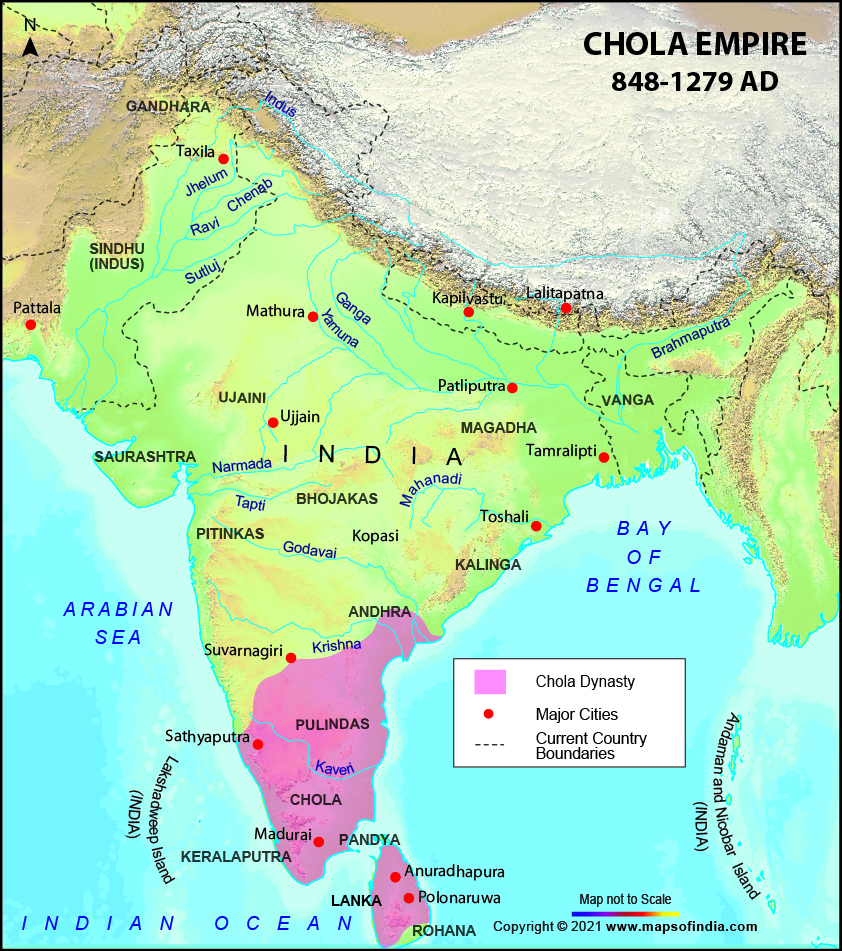
Source: India Map — Chola Dynasty, Map of Chola Dynasty · www.mapsofindia.com
Name spelling: Question uses 'Purantaka' but standard spelling is 'Parantaka' - both refer to same ruler
Chola confusion: This refers to Medieval Chola revival (907 CE), not ancient Sangam Cholas
Latest chronologically: Parantaka came last (907 CE) among all four events - students often assume Cholas were earlier