Due to improper/indiscriminate disposal of hold and used computers or their parts, which of the following are released into the environment as e-waste? 1. Beryllium 2. Cadmium 3. Chromium 4. Heptachlor 5. Mercury 6. Lead 7. Plutonium Select the correct answer using the codes given below:
Contents13
- A1, 3, 4, 6 and 7 only
- B1, 2, 3, 5 and 6 only
- C2, 4, 5 and 7 only
- D1, 2, 3, 4, 5, 6 and 7
Show answer
Answer: (B) 1, 2, 3, 5 and 6 only
Computers and electronic devices contain several toxic heavy metals and substances.
Let's check each:
Beryllium (1) — YES. Used in circuit boards, hard disk drives, motherboards, wiring boards, and connectors.
Cadmium (2) — YES. Found in rechargeable NiCd batteries, semiconductor chips, and some older CRT monitors.
Chromium (3) — YES. Used as a corrosion-resistant coating on metal parts and in data tapes.
Mercury (5) — YES. A key component of LCD screens, laptop displays, batteries, and some switches in computers.
Lead (6) — YES. Found in CRT monitors, soldering on circuit boards, and batteries.
Heptachlor (4) — NO. Heptachlor is an organochlorine compound used as a PESTICIDE/insecticide. It has nothing to do with computer manufacturing or e-waste.
Plutonium (7) — NO. Plutonium is a radioactive element used in nuclear weapons and reactors. It is NOT found in regular computer parts.
Elimination shortcut: if you're sure Heptachlor (pesticide) is not e-waste, you can eliminate options A, C, and D — leaving only B.
E-waste contains toxic heavy metals like beryllium, cadmium, chromium, mercury, and lead that leach into soil and water when improperly disposed.
The trap here is mixing actual computer components (heavy metals) with completely unrelated substances like heptachlor (pesticide) and plutonium (nuclear material).
E-waste Toxic Components
Environment Beryllium Cadmium Chromium Mercury Lead e-waste
E-waste Toxic Components: Heavy Metals in Electronics
Five toxic heavy metals are released from computer e-waste: Beryllium, Cadmium, Chromium, Mercury, and Lead
Heptachlor is a pesticide, Plutonium is for nuclear reactors — neither found in computers
Circuit boards and batteries are major sources of toxic metals in e-waste
Computers contain multiple heavy metals that become toxic e-waste when improperly disposed. These metals are essential for electronic functions but pose serious environmental and health risks when released.
Toxic Metals in Computer Components
Metal | Found In | Primary Use | Health Risk |
|---|---|---|---|
Beryllium | Circuit boards, hard drives, connectors | Electrical conductivity | Lung disease, cancer |
Cadmium | NiCd batteries, semiconductor chips, CRT monitors | Battery electrodes, coatings | Kidney damage, bone disease |
Chromium | Metal parts, data tapes | Corrosion-resistant coating | Respiratory problems, cancer |
Mercury | LCD screens, laptop displays, switches | Electrical switches, backlighting | Nervous system damage |
Lead | CRT monitors, circuit board soldering | Radiation shielding, soldering | Brain damage, developmental issues |
Question Analysis
This 2013 question tested knowledge of which substances are actually found in computers versus unrelated toxic compounds
Elimination strategy: Heptachlor (pesticide) and Plutonium (nuclear material) have no connection to electronics manufacturing
Trap: Heptachlor sounds chemical and toxic, but it's a pesticide — not found in computers
Trap: Plutonium is highly toxic but used in nuclear weapons/reactors — not consumer electronics
Trap: All five heavy metals (Beryllium, Cadmium, Chromium, Mercury, Lead) ARE present in computers
E-waste Management in India
Environment e-waste
E-waste Management Rules & Challenges in India
India generates over 3 million tonnes of e-waste annually — 3rd largest globally
E-waste Rules 2016 (amended 2018) mandate Extended Producer Responsibility (EPR)
Only 30-40% of India's e-waste is formally recycled
India faces a massive e-waste crisis due to rapid digitization, short device lifespans, and inadequate recycling infrastructure. Most e-waste ends up in informal recycling, releasing toxic metals into soil and water.
India's E-waste Regulatory Framework
Rule/Policy | Year | Key Provision | Impact |
|---|---|---|---|
E-waste Rules | 2016 | Extended Producer Responsibility (EPR) | Manufacturers responsible for collection |
Amendment | 2018 | Includes CFLs, mercury lamps | Expanded scope of e-waste |
Plastic Waste Rules | 2016 | Covers plastic components in electronics | Complementary regulation |
Right to Repair | 2023 draft | Standardized spare parts, repair manuals | Reduce e-waste generation |
Major E-waste Sources in India
IT equipment (computers, laptops) — 70% of total e-waste
Consumer electronics (TVs, refrigerators) — 12% of e-waste
Telecom equipment (mobile phones) — 8% with fastest growth rate
E-waste Generation Hotspots
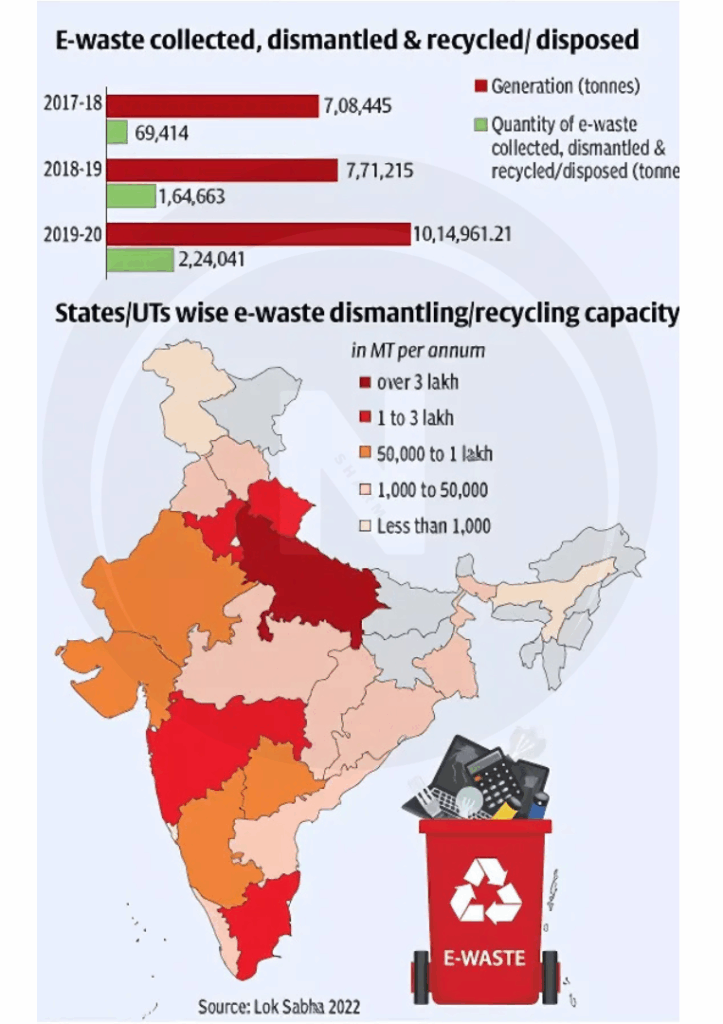
Source: House of UPSC — India's rising e-waste, the need to recast its management - House ... · houseofupsc.com
Trap: E-waste Rules are from 2016, not 2011 or 2019 — but amended in 2018
Trap: EPR (Extended Producer Responsibility) applies to manufacturers, not just consumers
Trap: India is 3rd largest e-waste generator globally, not 2nd or 5th
Heptachlor Pesticide
Environment Heptachlor
Heptachlor: Banned Organochlorine Pesticide
Heptachlor is an organochlorine pesticide banned under Stockholm Convention
Used for termite control and soil treatment — not found in electronics
Persistent Organic Pollutant (POP) that bioaccumulates in food chains
Heptachlor is a banned insecticide from the organochlorine family — the same group as DDT. It was used primarily for termite control but has no connection to computer manufacturing or e-waste.
Organochlorine Pesticides Comparison
Pesticide | Primary Use | Ban Status | Key Problem |
|---|---|---|---|
Heptachlor | Termite control, soil treatment | Banned globally | Bioaccumulation, cancer risk |
DDT | Malaria vector control | Restricted use only | Eggshell thinning in birds |
Chlordane | Termite control | Banned in most countries | Liver damage, nervous system |
Endrin | Crop protection | Banned globally | Highly toxic to wildlife |
Why Heptachlor is NOT E-waste
Chemical nature: Organochlorine compound designed for killing insects, not conducting electricity
Manufacturing use: Applied as external pesticide treatment, never integrated into electronic components
Source confusion: UPSC tests whether students know the difference between industrial chemicals and agricultural pesticides
Trap: Heptachlor sounds technical and is definitely toxic — but it's agricultural, not electronic
Trap: Don't confuse organochlorine pesticides with heavy metals — completely different pollution sources
Major trap: All organochlorine pesticides (DDT, Heptachlor, Chlordane) are banned/restricted — none are in computers
Plutonium Nuclear Element
Science And Technology Plutonium
Plutonium: Nuclear Fuel & Weapons Material
Plutonium is a radioactive element used in nuclear weapons and reactors
Not found in computers — too dangerous and expensive for consumer electronics
Pu-239 is fissile material produced in nuclear reactors from Uranium-238
Plutonium is a highly radioactive, man-made element created in nuclear reactors. It's used exclusively for nuclear weapons and reactor fuel — never in consumer electronics due to its extreme toxicity and radioactivity.
Radioactive Elements: Uses & Sources
Element | Primary Use | Where Found | Consumer Electronics? |
|---|---|---|---|
Plutonium | Nuclear weapons, reactor fuel | Nuclear facilities only | Never |
Uranium | Nuclear fuel, depleted uranium | Nuclear plants, military | Never |
Cesium | Medical sources, research | Specialized applications | Never |
Americium | Smoke detectors | Household smoke alarms | Very limited use |
Tritium | Watch dials, exit signs | Some consumer products | Rare, regulated use |
Nuclear Fuel Cycle & Plutonium Production
%%{init: {"flowchart": {"wrappingWidth": 460}}}%%
flowchart TD
  s1["`**Uranium Mining**
**U-238** extracted from ore, enriched to **U-235** for reactor fuel`"]
  s2["`**Nuclear Reactor**
U-238 absorbs neutrons and transforms into **Pu-239** (weapons-grade plutonium)`"]
  s3["`**Reprocessing**
Spent fuel processed to separate plutonium from other radioactive waste`"]
  s4["`**End Use**
Pu-239 used for nuclear weapons or mixed-oxide (MOX) reactor fuel`"]
  s1 --> s2
  s2 --> s3
s3 --> s4Trap: Plutonium is extremely toxic but has zero connection to computers or e-waste
Trap: Don't confuse nuclear materials with heavy metals — different categories of toxic substances
Trap: Americium (smoke detectors) is the only common radioactive element in household items