If National Water Mission is properly and completely implement, how will it impact the country? 1. Part of the water needs of urban areas will be met through recycling of waste-water 2. The water requirements of coastal cities with inadequate alternative sources of water will be met by adopting appropriate technologies that allow for the use of ocean water 3. All the rivers of Himalayan origin will be linked to the rivers of peninsular India 4. The expenses incurred by farmers for digging bore-wells and for installing motors and pump-sets to draw ground-water will be completely reimbursed by the Government Select the correct answer using the codes given below:
Contents16
- A1 only
- B1 and 2 only
- C3 and 4 only
- D1, 2, 3 and 4
Show answer
Answer: (B) 1 and 2 only
The National Water Mission aims to:
(a) recycle wastewater to meet urban water needs (statement 1 correct),
and
(b) use desalination and other technologies for coastal cities with inadequate freshwater sources (statement 2 correct).
Statement 3 is wrong because linking ALL Himalayan rivers to peninsular rivers is not a goal of the National Water Mission — river interlinking is a separate project.
Statement 4 is wrong because the Mission does not promise full reimbursement of bore-well and pump-set costs to farmers.
Answer: 1 and 2 only.
National Water Mission is one of eight missions under India's National Action Plan on Climate Change, focusing on water security through conservation and efficiency.
The mission specifically targets urban water recycling and desalination for coastal cities, but does not include the massive river interlinking project or direct farmer subsidies for groundwater equipment.
UPSC is testing whether students can distinguish between different water-related government initiatives and avoid mixing up the specific objectives of each program.
National Water Mission
Environment National Water Mission
National Water Mission: Objectives & UPSC Traps
One of 8 missions under National Action Plan on Climate Change (NAPCC)
Focuses on water conservation and 20% increase in water use efficiency
Promotes wastewater recycling for urban areas and desalination for coastal cities
Does NOT include river interlinking or farmer bore-well reimbursement
What It Is
The National Water Mission is one of eight missions under India's National Action Plan on Climate Change (NAPCC) launched in 2008. It addresses water scarcity through conservation and efficiency improvements — not through massive infrastructure projects or financial subsidies.
Key Objectives
Objective | Target/Approach | UPSC Relevance |
|---|---|---|
Water Use Efficiency | 20% increase by 2020 | Specific numerical target often tested |
Urban Water Supply | Wastewater recycling and reuse | Statement 1 in this question |
Coastal Water Supply | Desalination and ocean water technologies | Statement 2 in this question |
Groundwater Management | Recharge and conservation | Not bore-well reimbursement |
Basin-level Management | Integrated water resource planning | Not river interlinking |
Question Analysis
This 2012 question tests whether students confuse the National Water Mission with other water projects. Statement 1 (wastewater recycling) and Statement 2 (desalination for coastal cities) are correct mission objectives. Statements 3 and 4 are traps.
Trap: Confusing National Water Mission with river interlinking project — they are separate initiatives
Trap: Assuming the mission provides financial subsidies to farmers — it focuses on conservation, not reimbursement
Trap: Mixing up water missions with other NAPCC missions like National Solar Mission
Statement 3: River interlinking is a separate project under Ministry of Water Resources, not NWM
Statement 4: NWM promotes groundwater recharge, not bore-well cost reimbursement
National Action Plan Climate Change
Environment National Action Plan on Climate Change
NAPCC: Eight National Missions Overview
Launched in 2008 to address climate change through 8 national missions
Covers mitigation and adaptation strategies across key sectors
National Water Mission is one of the eight under NAPCC
Context
India's National Action Plan on Climate Change (NAPCC) was launched in 2008 as a comprehensive strategy to address climate change challenges. It operates through eight sector-specific missions targeting both mitigation and adaptation.
The Eight Missions
Mission | Primary Focus | Key Target/Feature |
|---|---|---|
National Solar Mission | Solar energy expansion | 100 GW solar capacity by 2022 |
National Mission for Enhanced Energy Efficiency | Energy conservation | Perform, Achieve & Trade (PAT) scheme |
National Mission on Sustainable Habitat | Sustainable urban planning | Energy efficient buildings |
National Water Mission | Water conservation | 20% increase in water use efficiency |
National Mission for Sustaining Himalayan Ecosystem | Himalayan conservation | Biodiversity and glacial protection |
National Mission for Green India | Forest cover increase | 6 million hectares afforestation |
National Mission for Sustainable Agriculture | Climate resilient farming | Drought-proofing and soil health |
National Mission on Strategic Knowledge | Climate research | Knowledge platform creation |
Number confusion: Remember 8 missions, not 7 or 9
Mission mixing: Don't attribute river interlinking to National Water Mission
Target confusion: 100 GW solar belongs to Solar Mission, 20% water efficiency to Water Mission
Launch year: NAPCC launched in 2008, not 2009 or 2010
Urban Water Technologies
Environment recycling of waste-water ocean water coastal cities
Wastewater Recycling & Desalination in India
Wastewater recycling can meet 10-30% of urban water demand
Desalination is key solution for water-scarce coastal cities
Both technologies are promoted under National Water Mission
Why These Technologies
Urban India faces severe water stress with demand exceeding supply. Wastewater recycling and desalination offer sustainable alternatives to groundwater depletion and long-distance water transfer projects.
Key Urban Water Technologies
Technology | Application | Indian Examples | Advantages | Challenges |
|---|---|---|---|---|
Wastewater Recycling | Treat sewage for reuse | Bengaluru, Chennai STPs | Reduces freshwater demand | High treatment costs |
Desalination | Convert seawater to freshwater | Chennai, Nemmeli plant | Unlimited ocean source | High energy consumption |
Rainwater Harvesting | Collect and store rainwater | Mandatory in Chennai | Low cost, groundwater recharge | Seasonal dependency |
Dual Piping | Separate drinking/non-drinking supply | Gurgaon townships | Efficient water use | Infrastructure investment |
India's Water Challenges
Per capita water availability dropped from 5,177 cubic meters (1951) to 1,544 cubic meters (2011)
21 cities including Delhi, Chennai, Hyderabad face groundwater depletion by 2020
Coastal cities like Chennai, Mumbai face saltwater intrusion in groundwater
Wastewater treatment capacity covers only 37% of sewage generated in urban areas
Desalination in India
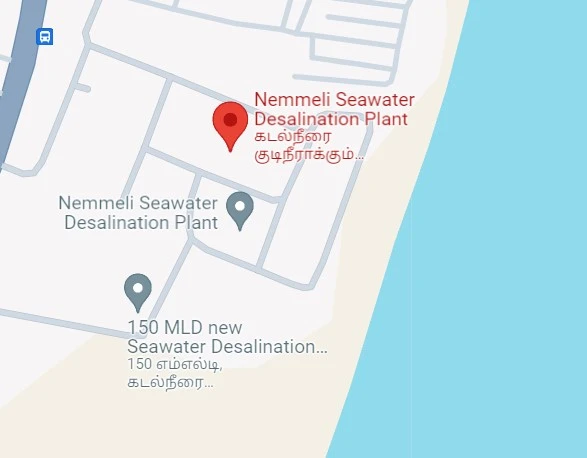
Source: Blackridge Research & Consulting — Nemmeli Seawater Desalination Plant: The Largest ... · www.blackridgeresearch.com
River Interlinking Project
Geography rivers of Himalayan origin rivers of peninsular India linked
National River Linking Project: Separate from Water Mission
Separate project from National Water Mission — not part of NAPCC
Proposes 30 links connecting Himalayan and Peninsular rivers
Ken-Betwa is the first link under implementation
Aims to transfer surplus water from water-rich to water-scarce basins
What It Is
The National River Linking Project (NRLP) is a separate large-scale infrastructure project — not part of the National Water Mission. It proposes to link rivers through canals and reservoirs to transfer water between basins.
River Linking Components
Component | Number of Links | Key Rivers | Purpose |
|---|---|---|---|
Himalayan Component | 14 links | Ganga, Brahmaputra | Connect Himalayan rivers |
Peninsular Component | 16 links | Godavari, Krishna, Cauvery | Connect peninsular rivers |
Total Project | 30 links | All major river systems | Inter-basin water transfer |
Current Status
Ken-Betwa link is the first project under implementation with ₹44,605 crore cost
Environmental clearances remain a major challenge for most links
Inter-state disputes over water sharing delay many proposed links
Supreme Court constituted a special committee to monitor the project
Major trap: River interlinking is NOT part of National Water Mission or NAPCC
Separate ministry: River linking handled by Ministry of Jal Shakti, Water Mission under Environment Ministry
Different approach: Water Mission focuses on conservation, river linking on transfer
Timeline confusion: River linking concept predates NAPCC (2008) by several years