Consider the following statements: Statement-I: India's public sector health care system largely focuses on curative care with limited preventive, promotive and rehabilitative care. Statement-II: Under India's decentralized approach to health care delivery, the States are primarily responsible for organizing health services. Which one of the following is correct in respect of the above statements?
Contents13
- ABoth Statement-I and Statement-II are correct and Statement-II is the correct explanation for Statement-I
- BBoth Statement-I and Statement-II are correct and Statement-II is not the correct explanation for Statement-I
- CStatement-I is correct but Statement-II is incorrect
- DStatement-I is incorrect but Statement-II is correct
Show answer
Answer: (B) Both Statement-I and Statement-II are correct and Statement-II is not the correct explanation for Statement-I
Both statements are correct, but Statement-II does NOT explain Statement-I.
Statement-I:
India's public health system spends most on curative care (inpatient + outpatient care = about 53% of health expenditure) vs only about 10% on preventive care.
Statement-II:
Under the 7th Schedule, public health is a State subject, so states are primarily responsible for health services.
While both are true, the fact that health is a state subject doesn't explain why the focus is on curative rather than preventive care.
Answer is (b).
India spends about 53% of health expenditure on curative care but only 10% on preventive care, showing a major imbalance in the public health system.
The National Health Policy 2017 and COVID-19 experience brought renewed focus on this curative vs preventive care debate in Indian healthcare.
UPSC is testing whether students can distinguish between correlation and causation - both statements can be true without one explaining the other.
Healthcare Expenditure: Curative vs Preventive Care
Indian Economy curative care preventive promotive rehabilitative care
India's Healthcare Expenditure Pattern: Curative vs Preventive Focus
India spends ~53% of health expenditure on curative care vs only ~10% on preventive care
Curative care treats diseases after they occur; preventive care stops diseases before they happen
This imbalance leads to higher long-term healthcare costs and poor population health outcomes
The Problem
India's public healthcare system is heavily skewed toward curative care — treating patients after they fall sick. This creates a cycle where more resources go to expensive hospital treatments rather than cost-effective prevention programs.
Types of Healthcare
Type | What It Does | Examples | India's Focus |
|---|---|---|---|
Curative Care | Treats existing diseases | Hospital treatment, surgeries, medicines | High (~53%) |
Preventive Care | Prevents diseases before they occur | Vaccinations, health screenings, sanitation | Low (~10%) |
Promotive Care | Promotes good health habits | Health education, nutrition programs | Low |
Rehabilitative Care | Helps recovery after treatment | Physiotherapy, counseling, disability support | Low |
Why This Matters
Economic burden: Curative care costs 10x more than preventive care for the same health outcome
Population health: Focus on treatment means diseases spread before being controlled
UPSC relevance: Questions often test understanding of healthcare delivery models and their effectiveness
Don't assume decentralized healthcare explains the curative focus — these are separate issues
Statement-II doesn't explain Statement-I even when both are factually correct
Preventive care includes promotive and rehabilitative — don't treat them as separate from prevention
Decentralized Healthcare Delivery in India
Indian Polity decentralized approach States organizing health services
Decentralized Healthcare: State Responsibility Under Indian Federalism
Public Health is in the State List of 7th Schedule — states have primary responsibility
Centre handles national programs and inter-state health issues under Concurrent List
This creates variation in healthcare quality across different states
Constitutional Basis
Under India's federal structure, public health is primarily a State subject. This means state governments are responsible for organizing, funding, and delivering healthcare services to their populations.
Healthcare Responsibilities
Level | 7th Schedule List | Key Responsibilities | Examples |
|---|---|---|---|
State | State List | Primary healthcare delivery, hospitals, medical education | PHCs, district hospitals, MBBS colleges |
Centre | Union List | National health policies, medical research, drug regulation | AIIMS, drug approval, national guidelines |
Both | Concurrent List | Population control, prevention of disease spread | Family planning, epidemic control, NRHM |
Decentralization Effects
State variations: Kerala has better health indicators than Bihar due to state-level policy differences
Resource gaps: Poorer states struggle to provide adequate healthcare compared to richer states
Central schemes: NRHM, Ayushman Bharat try to bridge these gaps through federal funding
Healthcare Delivery Structure
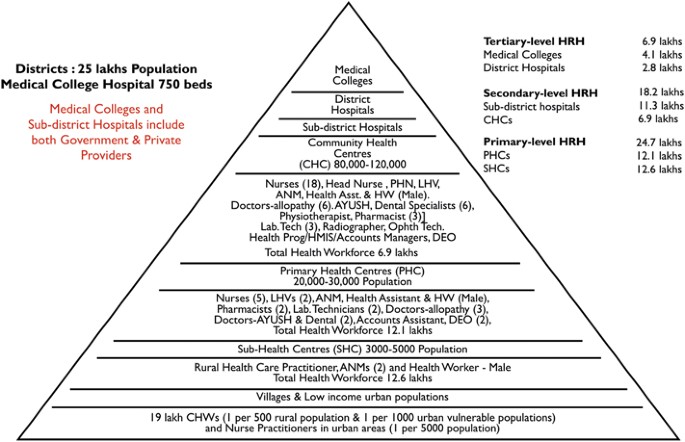
Source: Nature — Health systems in India | Journal of Perinatology · www.nature.com
Decentralization doesn't explain curative focus — both rich and poor states can choose prevention strategies
Don't confuse healthcare delivery (state subject) with health policy (concurrent subject)
Primary responsibility lies with states, but Centre plays important coordinating role
Statement-Explanation Questions in UPSC
Indian Polity
Mastering Statement-Explanation Questions: Logic Over Facts
Both statements can be true but Statement-II may not explain Statement-I
Look for cause-and-effect relationship, not just factual correctness
Option B is common: both correct but no logical connection
The Logic Test
In Statement-Explanation questions, UPSC tests logical reasoning, not just factual knowledge. Even if both statements are individually correct, Statement-II must causally explain why Statement-I is true.
How to Solve
%%{init: {"flowchart": {"wrappingWidth": 460}}}%%
flowchart TD
  s1["`**Check Statement-I**
Is this factually correct?`"]
  s2["`**Check Statement-II**
Is this factually correct?`"]
  s3["`**Test the Connection**
Does Statement-II explain WHY Statement-I happens?`"]
  s4["`**Choose Option**
A = both correct + explains; B = both correct + doesn't explain`"]
  s1 --> s2
  s2 --> s3
  s3 --> s4
Common Patterns
Option A trap: Both statements true but examiner provides unrelated explanation
Option B success: Most complex questions where facts are correct but logic fails
Correlation vs Causation: Just because two things happen together doesn't mean one causes the other
Don't pick Option A just because both statements sound related to the same topic
Ask: 'Does federalism cause curative focus?' — if answer is unclear, choose Option B
Independent truths don't automatically create cause-and-effect relationships