With reference to ‘Bitcoins’, sometimes seen in the news, which of the following statements is/are correct? 1. Bitcoins are tracked by the Central Banks of the countries. 2. Anyone with a Bitcoin address can send and receive Bitcoins from anyone else with a Bitcoin address. 3. Online payments can be sent without either side knowing the identity of the other. Select the correct answer using the code given below.
Contents18
- A1 and 2 only
- B2 and 3 only
- C3 only
- D1, 2 and 3
Show answer
Answer: (B) 2 and 3 only
Answer: (b) 2 and 3 only
Let's evaluate each statement about Bitcoins:
Statement 1 is INCORRECT:
Bitcoins are NOT tracked by Central Banks.
Bitcoin is a DECENTRALIZED digital currency — its core feature is that no central authority (no government, no central bank) controls or tracks it.
Transactions are recorded on a distributed public ledger called the 'blockchain', which is maintained by a network of computers worldwide.
Statement 2 is CORRECT:
Anyone with a Bitcoin address CAN send and receive Bitcoins from anyone else with a Bitcoin address.
Bitcoin addresses are like account numbers — they are strings of alphanumeric characters.
You don't need a bank or intermediary to transact.
Statement 3 is CORRECT:
Online payments CAN be sent without either side knowing the identity of the other.
Bitcoin transactions are pseudonymous — the blockchain records the transaction between two Bitcoin addresses, but the real-world identity behind those addresses is not necessarily known.
This anonymity feature has made Bitcoin popular but also controversial.
How Bitcoin mining works:
'Miners' use powerful computers to solve complex mathematical puzzles.
When they solve a puzzle, they verify a block of transactions and add it to the blockchain, receiving new Bitcoins as a reward.
Since statements 2 and 3 are correct but 1 is wrong, the answer is (b) "2 and 3 only".
Bitcoin is a decentralized digital currency that operates without any central bank or government control, using blockchain technology maintained by a global network of computers.
In 2015-16, Bitcoin gained significant media attention as its price volatility and regulatory concerns increased globally, making it a relevant current affairs topic for UPSC.
The question tests understanding of cryptocurrency fundamentals - decentralization, peer-to-peer transactions, and pseudonymous nature - which distinguishes it from traditional banking systems.
Bitcoin Fundamentals
Indian Economy Bitcoins Bitcoin address
Bitcoin: Decentralized Digital Currency & Key Features
Bitcoin is a decentralized digital currency — no central bank or government controls it
Transactions happen directly between Bitcoin addresses without intermediaries
Payments are pseudonymous — real identities can remain unknown
All transactions are recorded on a public ledger called blockchain
What is Bitcoin
Bitcoin is the world's first cryptocurrency — a digital currency that exists only in electronic form. Unlike traditional money, it operates without banks, governments, or central authorities controlling it.
Bitcoin vs Traditional Money
Feature | Bitcoin | Traditional Money |
|---|---|---|
Control | Decentralized — no single authority | Centralized — controlled by central banks |
Transaction Method | Direct peer-to-peer transfer | Through banks/intermediaries |
Identity | Pseudonymous addresses | KYC required — full identity known |
Tracking | Public blockchain but anonymous | Central bank monitoring with full details |
Physical Form | Digital only | Physical cash + digital |
How Bitcoin Works
Bitcoin addresses are alphanumeric strings that work like account numbers — anyone can send/receive Bitcoins using these
Blockchain is a distributed public ledger where all transactions are permanently recorded across thousands of computers
Mining involves solving complex mathematical puzzles to verify transactions and earn new Bitcoins as rewards
Wallets store private keys that prove ownership of Bitcoins — lose the key, lose the Bitcoins forever
Why This Was Asked
This 2016 question tested whether students understood Bitcoin's decentralized nature — the key trap was Statement 1 claiming central banks track Bitcoin, which contradicts its fundamental design.
Trap: Statement 1 — Bitcoin is NOT tracked by central banks. This is its defining feature as a decentralized currency
Common confusion: Students think 'digital currency' means 'government-controlled' — Bitcoin is digital but independent of governments
Address vs Identity: Bitcoin addresses enable transactions, but they don't reveal real-world identities (pseudonymous, not anonymous)
Blockchain Technology
Science And Technology
Blockchain: Distributed Ledger Technology Behind Bitcoin
Blockchain is a distributed public ledger that records all Bitcoin transactions
Maintained by a network of computers worldwide — no single point of control
Each transaction block is cryptographically linked to the previous one
Immutable — once recorded, transactions cannot be altered or deleted
Core Concept
Blockchain is the technology that makes Bitcoin possible. Think of it as a digital ledger book that's copied across thousands of computers worldwide — every transaction gets recorded in all copies simultaneously.
How Blockchain Works
%%{init: {"flowchart": {"wrappingWidth": 460}}}%%
flowchart TD
  s1["`**Transaction Initiated**
User A wants to send Bitcoin to User B`"]
  s2["`**Network Verification**
Miners verify the transaction using complex calculations`"]
  s3["`**Block Creation**
Verified transaction is bundled with others into a 'block'`"]
  s4["`**Chain Addition**
New block is cryptographically linked to previous blocks`"]
  s5["`**Network Update**
Updated blockchain is distributed to all computers in the network`"]
  s1 --> s2
  s2 --> s3
  s3 --> s4
  s4 --> s5
Key Advantages
Transparency — all transactions are publicly visible on the blockchain (though identities are pseudonymous)
Security — cryptographic hashing makes it nearly impossible to alter past transactions
Decentralization — no single point of failure since the ledger exists on thousands of computers
Global Access — works 24/7 across borders without needing traditional banking infrastructure
Blockchain Structure
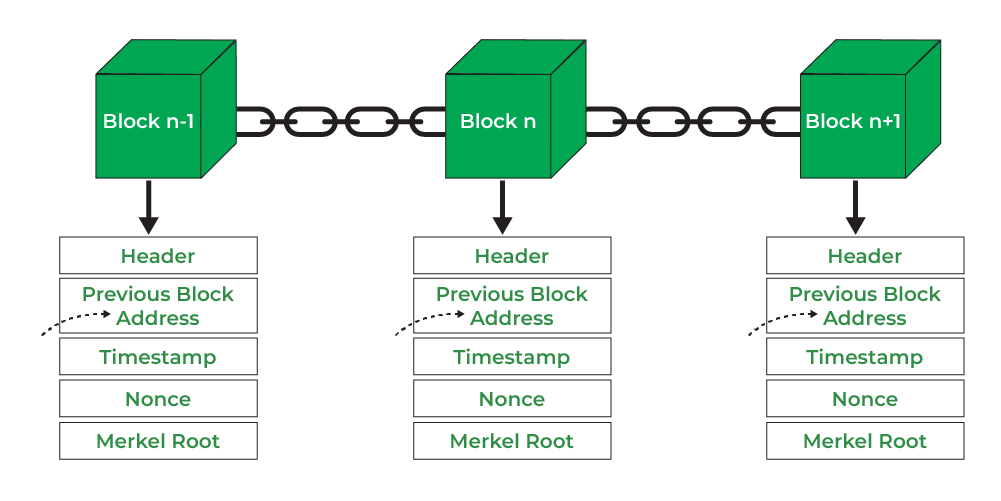
Source: GeeksforGeeks — Blockchain Structure - GeeksforGeeks · www.geeksforgeeks.org
Cryptocurrency Regulation in India
Indian Economy
India's Approach to Cryptocurrency Regulation & Policy
RBI has issued multiple warnings against cryptocurrency risks since 2013
India introduced 30% tax on crypto gains in 2022-23 budget
No outright ban but regulatory framework is still evolving
RBI is developing Central Bank Digital Currency (CBDC) — the digital rupee
Current Status
India has taken a cautious approach to cryptocurrencies — not banning them outright but imposing high taxes and regulatory scrutiny while developing its own digital currency alternative.
Evolution of India's Crypto Policy
Year | Key Development | Impact |
|---|---|---|
2018 | RBI banned banks from crypto services | Crypto trading severely restricted |
2020 | Supreme Court overturned RBI ban | Trading resumed legally |
2022 | 30% tax on crypto gains introduced | High tax burden on crypto profits |
2022-23 | Digital Rupee (CBDC) pilot launched | Government alternative to private crypto |
Key Regulatory Concerns
Money laundering risks — cryptocurrencies can be used to hide illegal transactions
Tax evasion potential — difficult to track crypto holdings and gains
Financial stability — volatile crypto markets could impact banking system
Consumer protection — high volatility and technical complexity pose risks to ordinary investors
Current status: Crypto is legal but heavily taxed in India — not banned outright
RBI vs Government: RBI issues warnings, Government sets tax policy — different roles
CBDC vs Bitcoin: Digital Rupee is centralized government currency, Bitcoin is decentralized private currency
Types of Digital Currencies
Indian Economy
Digital Currencies: Classification & Key Differences for UPSC
Cryptocurrencies like Bitcoin are decentralized and privately issued
CBDCs are digital versions of national currencies issued by central banks
Virtual currencies in games/platforms have limited real-world use
Stablecoins are cryptocurrencies pegged to stable assets like USD
Digital Currency Landscape
Digital currencies encompass various electronic forms of money — from decentralized cryptocurrencies to government-issued digital versions of national currencies.
Types of Digital Currencies
Type | Issuer | Control | Examples | Key Feature |
|---|---|---|---|---|
Cryptocurrency | Private entities/algorithms | Decentralized | Bitcoin, Ethereum | No central authority |
CBDC | Central Banks | Centralized | Digital Rupee, Digital Yuan | Government-backed legal tender |
Stablecoin | Private companies | Semi-centralized | USDT, USDC | Pegged to stable assets |
Virtual Currency | Gaming/platform companies | Platform-controlled | V-Bucks, Robux | Limited to specific ecosystems |
Digital Currency Ecosystem
# Digital Currencies
## Decentralized (Crypto)
- Bitcoin (BTC)
- Ethereum (ETH)
- Peer-to-peer
- Blockchain-based
## Centralized (CBDC)
- Digital Rupee
- Digital Yuan
- Central bank issued
- Legal tender status
## Hybrid (Stablecoins)
- USD-pegged
- Algorithmically stable
- Private but regulatedCBDC vs Crypto: CBDCs are government-controlled, cryptocurrencies are decentralized — opposite philosophies
Digital vs Virtual: Digital currencies have real-world value, virtual currencies are often limited to games/platforms
Legal tender: Only CBDCs have legal tender status — Bitcoin is not legal tender in most countries including India