With reference to 'Urban Cooperative banks' in India consider the following statements: 1. They are supervised and regulated by local boards set up by the State Governments. 2. They can issue equity shares and preference shares. 3. They were brought under the purview of the Banking Regulation Act, 1949 through an Amendment in 1966. Which of the statements given above is/are correct?
Contents18
- A1 only
- B2 and 3 only
- C1 and 3 only
- D1, 2 and 3
Show answer
Answer: (B) 2 and 3 only
Statement 1 is wrong:
Urban Cooperative Banks (UCBs) are not regulated only by State Government boards.
Since 1966, large UCBs came under the Banking Regulation Act, 1949 and RBI supervision.
There was a system of 'dual control' — RBI handled banking functions (licensing, interest rates) while State Governments handled registration, management, audit, etc.
The Banking Regulation (Amendment) Act, 2020 further strengthened RBI's control over UCBs.
Statement 2 is correct:
RBI has issued guidelines allowing UCBs to raise capital by issuing equity shares (to members within their area of operation), preference shares, and debt instruments.
Statement 3 is correct:
UCBs have historically been under dual control — partly regulated by RBI (banking functions) and partly by State Cooperative Registrars (administrative functions).
Statements 2 and 3 are correct.
Answer: (b).
Urban Cooperative Banks serve over 8.6 crore customers and hold deposits worth over Rs 5 lakh crore, making their regulation crucial for financial stability.
The Banking Regulation (Amendment) Act 2020 strengthened RBI's powers over UCBs after several high-profile failures like PMC Bank, removing the dual control system that had created regulatory gaps.
UPSC is testing whether students understand the shift from dual control (RBI + State) to unified RBI control, which fundamentally changed UCB governance structure.
Urban Cooperative Banks Regulation
Indian Economy Urban Cooperative banks supervised and regulated local boards State Governments
Urban Cooperative Banks: Regulatory Framework & Dual Control
UCBs operate under dual control — RBI handles banking functions, State Governments handle registration/management
Banking Regulation Act 1949 brought UCBs under RBI supervision through 1966 Amendment
UCBs can issue equity shares and preference shares as per RBI guidelines
Banking Regulation Amendment Act 2020 strengthened RBI's control over UCBs
What are UCBs
Urban Cooperative Banks are cooperative credit institutions serving urban and semi-urban areas. Unlike commercial banks, they operate as cooperatives with member ownership and democratic management.
Dual Control System
Authority | Functions Controlled | Key Areas |
|---|---|---|
Reserve Bank of India | Banking Operations | Licensing, interest rates, prudential norms, inspection |
State Cooperative Registrars | Administrative Functions | Registration, management, audit, winding up |
Evolution of UCB Regulation
%%{init: {"flowchart": {"wrappingWidth": 460}}}%%
flowchart TD
  s1["`**Pre-1966**
UCBs regulated only by State Governments under Cooperative Societies Acts`"]
  s2["`**1966 Amendment**
**Banking Regulation Act 1949** extended to UCBs — dual control system begins`"]
  s3["`**2020 Amendment**
**Banking Regulation Amendment Act 2020** — RBI gets more powers over UCBs`"]
  s1 --> s2
  s2 --> s3
Capital Raising Powers
UCBs can issue equity shares to members within their area of operation
Preference shares can be issued as per RBI guidelines for capital augmentation
Debt instruments are also permitted for raising funds
Share issuance must comply with both RBI guidelines and State Cooperative laws
Trap: Statement 1 says UCBs are regulated only by State Government boards — wrong due to dual control since 1966
Confusion: Students mix UCBs with Primary Agricultural Credit Societies which have more State control
Date Trap: 1966 Amendment is key — brought UCBs under Banking Regulation Act, not just State laws
Recent Update: 2020 Amendment strengthened RBI control — know this for current affairs questions
Banking Regulation Act 1949 Amendments
Indian Economy Banking Regulation Act, 1949 Amendment in 1966
Banking Regulation Act 1949: Key Amendments & UCB Integration
Banking Regulation Act 1949 is the primary legislation governing banking in India
1966 Amendment brought cooperative banks under RBI's regulatory purview
2020 Amendment specifically strengthened RBI's control over UCBs and PMC Banks
Legislative Framework
The Banking Regulation Act 1949 initially covered only commercial banks. The regulatory framework expanded through strategic amendments to include cooperative institutions under RBI supervision.
Major Amendments
Year | Amendment Focus | Impact on UCBs | Key Provisions |
|---|---|---|---|
1949 | Original Act | Not covered | Regulated only commercial banks |
1966 | Cooperative Banks | Brought under Act | Dual control system established |
2020 | Strengthened Control | Enhanced RBI powers | Supersession, reconstruction, amalgamation powers to RBI |
2020 Amendment Key Changes
RBI can supersede UCB boards without State Government approval
Reconstruction and amalgamation powers given to RBI for stressed UCBs
Deposit insurance made compulsory for all UCBs
Enhanced governance standards and fit & proper criteria for UCB directors
Date Precision: 1966 Amendment specifically — not 1965 or 1967
Scope Confusion: Act initially covered only commercial banks, not all banking institutions
Recent vs Historical: Don't confuse 2020 Amendment (UCB focus) with 1966 Amendment (initial inclusion)
Cooperative Banking Structure in India
Indian Economy
Cooperative Banking Structure: Three-Tier System & Urban vs Rural
India has three-tier cooperative structure — Primary, District, State levels
NABARD supervises rural cooperative banks, RBI supervises urban cooperative banks
Short-term and Long-term cooperative credit structures operate separately
Cooperative Banking Overview
India's cooperative banking system serves both rural and urban populations through distinct structures. Rural cooperatives follow a three-tier federal structure, while urban cooperatives operate independently in cities.
Cooperative Banking Classification
# Cooperative Banks in India
## Rural Cooperatives
- Primary Agricultural Credit Societies (PACS)
- District Central Cooperative Banks
- State Cooperative Banks
## Urban Cooperatives
- Primary Urban Cooperative Banks
- Multi-State UCBs
- Salary Earner Societies
Rural vs Urban Cooperatives
Aspect | Rural Cooperatives | Urban Cooperatives |
|---|---|---|
Primary Regulator | NABARD | RBI |
Structure | Three-tier federal | Independent units |
Area of Operation | Rural & semi-urban | Urban & semi-urban |
Main Purpose | Agricultural credit | Urban credit & banking services |
Membership | Farmers, rural population | Urban residents, professionals |
Cooperative Structure Diagram
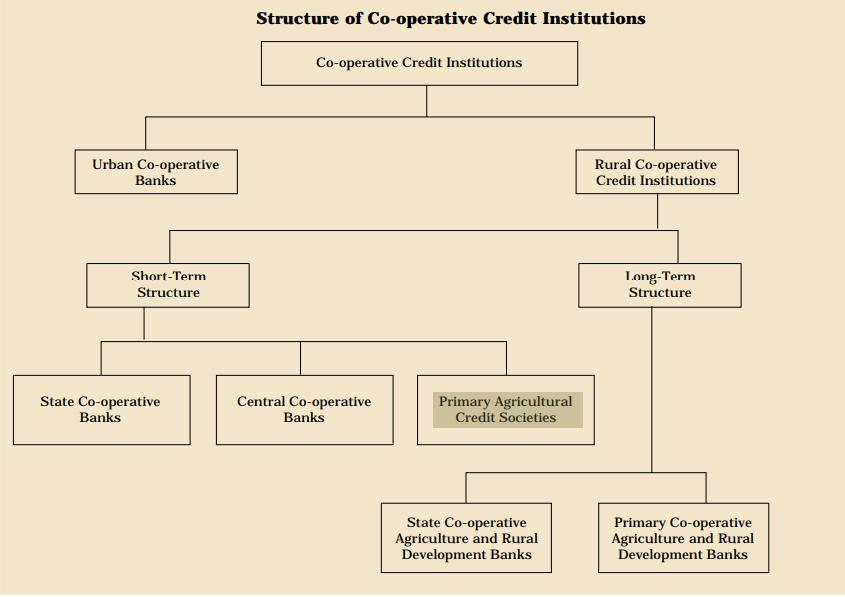
Source: Drishti IAS — Primary Agricultural Credit Societies · www.drishtiias.com
Don't Confuse: UCBs with rural PACS — different regulatory authorities and structures
Supervision Mix-up: NABARD supervises rural cooperatives, RBI supervises UCBs
Structure Error: Rural cooperatives are three-tier, UCBs are not part of this hierarchy
RBI Supervision of Banking Sector
Indian Economy
RBI's Supervisory Role: Commercial Banks to Cooperative Banks
RBI is the central bank and primary banking regulator in India
Supervises commercial banks, UCBs, NBFCs, and payment systems
NABARD handles rural cooperatives, RBI handles urban cooperatives
RBI's Regulatory Mandate
The Reserve Bank of India acts as the central bank and banking regulator. Its supervisory role expanded from commercial banks to include cooperative banks, NBFCs, and fintech companies.
RBI Supervisory Scope
Institution Type | RBI's Role | Key Regulatory Tools |
|---|---|---|
Commercial Banks | Complete supervision | Licensing, CRR/SLR, interest rates, inspections |
Urban Cooperative Banks | Banking functions only | Prudential norms, licensing, interest rates |
NBFCs | Registration & regulation | Capital adequacy, asset classification |
Payment Systems | Authorization & oversight | Payment system licenses, security standards |
RBI Powers Over UCBs
Licensing new UCBs and branch expansion approvals
Prudential regulations — capital adequacy, asset quality, governance
Interest rate policies and credit policies for UCBs
Inspection and supervision of UCB banking operations
Enforcement actions — penalties, restrictions, supersession (post-2020)
Not Complete Control: RBI doesn't control UCB registration, management, audit — State Governments do
NABARD Confusion: Don't confuse RBI (UCBs) with NABARD (rural cooperatives)
Limited Historical Powers: Pre-2020, RBI had limited powers over UCB management — now enhanced