With reference to Indian economy, consider the following: 1. Bank rate 2. Open market operations 3. Public debt 4. Public revenue Which of the above is/are component/components of Monetary Policy?
Contents14
- A1 only
- B2, 3 and 4
- C1 and 2
- D1, 3 and 4
Show answer
Answer: (C) 1 and 2
To answer this, you need to clearly distinguish between MONETARY POLICY (managed by RBI) and FISCAL POLICY (managed by the Government through the budget).
Bank rate (Statement 1) — YES, this is a monetary policy tool.
The bank rate is the interest rate at which RBI lends long-term funds to commercial banks.
When RBI raises the bank rate, borrowing becomes costlier for banks, which tightens money supply.
When it lowers the bank rate, borrowing becomes cheaper, increasing money supply.
Open market operations (Statement 2) — YES, this is a monetary policy tool.
OMOs involve the RBI buying or selling government securities in the open market.
When RBI BUYS securities, it injects money into the banking system (increasing liquidity).
When RBI SELLS securities, it absorbs money from the system (reducing liquidity).
Over the last two decades, OMOs have become a key tool for RBI to manage short-term interest rates and liquidity.
Public debt (Statement 3) — NO, this is a FISCAL POLICY component.
Public debt refers to the total borrowings of the government (through bonds, treasury bills, etc.).
It is managed by the government through its budget, not by RBI as part of monetary policy.
Public Revenue (Statement 4) — NO, this is a FISCAL POLICY component.
Public revenue includes all income of the government (taxes, fees, fines, etc.).
Tax rates and revenue collection are fiscal decisions made by the government in the Union Budget.
Answer: 1 and 2 only.
Simple rule:
Monetary policy = RBI's tools to control money supply (bank rate, repo rate, CRR, SLR, OMOs).
Fiscal policy = Government's tools (taxation, spending, borrowing).
Bank rate and open market operations are RBI's direct tools to control money supply in the economy, while public debt and revenue are government budget decisions.
The core distinction tested here is monetary policy (RBI controls money supply) versus fiscal policy (government controls taxation and spending).
Monetary Policy Tools
Indian Economy Bank rate Open market operations
Monetary Policy Tools: RBI's Arsenal for Money Supply Control
Bank Rate: Interest rate at which RBI lends long-term to commercial banks
Open Market Operations: RBI buys/sells government securities to control liquidity
Repo Rate: Most frequently used tool for short-term lending (1-14 days)
CRR & SLR: Reserve requirements that directly control bank lending capacity
RBI's Control Mechanism
Monetary policy is RBI's toolkit to manage money supply and interest rates in the economy. When RBI wants to tighten money supply (combat inflation), it raises rates and sells securities. When it wants to ease money supply (boost growth), it cuts rates and buys securities.
Key Monetary Policy Instruments
Tool | Mechanism | Impact on Money Supply | Frequency of Use |
|---|---|---|---|
Bank Rate | RBI's long-term lending rate to banks | Higher rate = Less money | Rarely changed |
Repo Rate | RBI's overnight lending rate (1-14 days) | Higher rate = Less money | Most frequently used |
Open Market Operations | RBI buys/sells govt securities | Buying = More money | Daily operations |
Cash Reserve Ratio | % of deposits banks must keep with RBI | Higher CRR = Less money | Occasionally changed |
Statutory Liquidity Ratio | % of deposits in govt securities | Higher SLR = Less money | Rarely changed |
Bank Rate vs Repo Rate
Bank Rate: Long-term lending (>14 days), acts as ceiling for other rates
Repo Rate: Short-term lending (1-14 days), most active policy tool since 2000s
Reverse Repo: Rate at which RBI borrows from banks (opposite of repo)
Marginal Standing Facility: Emergency borrowing rate, typically 0.25% above repo
Question Context
This PYQ tests whether you can distinguish RBI's monetary tools (bank rate, OMOs) from government's fiscal tools (public debt, public revenue). The trap is mixing up central bank functions with government budget functions.
Never confuse: Bank Rate (monetary) vs Budget deficit (fiscal)
OMOs involve govt securities but are RBI operations, not government borrowing
Public debt = fiscal policy even though RBI may technically issue the securities
Quantitative tools (CRR, SLR, Bank Rate) vs Qualitative tools (moral suasion, credit guidelines)
Fiscal Policy Components
Indian Economy Public debt Public revenue
Fiscal Policy: Government's Budget Tools for Economic Management
Public Revenue: All government income including taxes, fees, dividends
Public Debt: Total government borrowings through bonds, T-bills, external loans
Fiscal Policy: Government uses taxation & spending to influence economy
Union Budget: Annual statement of government's fiscal policy measures
Government's Economic Role
Fiscal policy is the government's use of taxation and public expenditure to influence economic activity. Unlike monetary policy (RBI's domain), fiscal policy is announced through the Union Budget and implemented by government ministries.
Components of Fiscal Policy
Component | What It Includes | Policy Lever | UPSC Example |
|---|---|---|---|
Public Revenue | Tax (direct/indirect) + Non-tax (fees, fines) | Raise/cut tax rates | GST rate changes |
Public Expenditure | Revenue (salaries, subsidies) + Capital (infrastructure) | Increase/cut spending | MGNREGA allocation |
Public Debt | Internal (bonds, T-bills) + External (World Bank loans) | Borrowing levels | Market borrowing limits |
Deficit Management | Revenue, Fiscal, Primary deficits | Deficit targets | 3% fiscal deficit target |
Public Revenue Sources
# Public Revenue
## Tax Revenue
- **Direct Taxes** (Income, Corporate)
- **Indirect Taxes** (GST, Customs)
- **State Taxes** (Stamp duty, Land revenue)
## Non-Tax Revenue
- **Fees & Fines**
- **Dividends** from PSUs
- **Interest receipts**
- **Spectrum auctions**
Government Borrowing Process
%%{init: {"flowchart": {"wrappingWidth": 460}}}%%
flowchart TD
  s1["`**Budget Deficit**
**Expenditure > Revenue** creates funding gap`"]
  s2["`**Borrowing Decision**
Government decides **internal vs external** borrowing`"]
  s3["`**Debt Instruments**
Issues **bonds, T-bills** or takes **multilateral loans**`"]
  s4["`**Market Impact**
High borrowing can **crowd out** private investment`"]
  s5["`**Debt Servicing**
**Interest payments** become future budget burden`"]
  s1 --> s2
  s2 --> s3
  s3 --> s4
s4 --> s5Public debt ≠ monetary policy even though RBI may issue government securities
Tax revenue = fiscal but tax collection efficiency can affect money supply indirectly
Government borrowing from RBI increases money supply but it's still fiscal policy
Deficit financing has monetary implications but remains a fiscal decision
Monetary vs Fiscal Policy
Indian Economy
Monetary vs Fiscal Policy: UPSC's Favorite Distinction Trap
Monetary Policy: RBI's domain - controls money supply through interest rates
Fiscal Policy: Government's domain - uses taxation and spending for economic goals
Key test: Ask 'Who controls it?' - RBI or Government?
Core Differences
Aspect | Monetary Policy | Fiscal Policy |
|---|---|---|
Authority | Reserve Bank of India (RBI) | Central Government |
Primary Tool | Interest rates & money supply | Taxation & government spending |
Decision Body | Monetary Policy Committee (MPC) | Parliament (via Union Budget) |
Frequency | Bi-monthly MPC meetings | Annual budget + interim changes |
Target | Price stability (4% inflation target) | Growth, employment, equity |
Transmission | Through banking system | Through government expenditure |
Memory Tricks
'M' for Money: Monetary = Money supply = MPC = Market operations
'F' for Finance: Fiscal = Finance Ministry = Funding through taxes
RBI acronym: Repo, Bank rate, Injection (OMOs) = all monetary
Government's 3 Ts: Taxation, Treasury spending, Total debt = all fiscal
Policy Coordination Framework
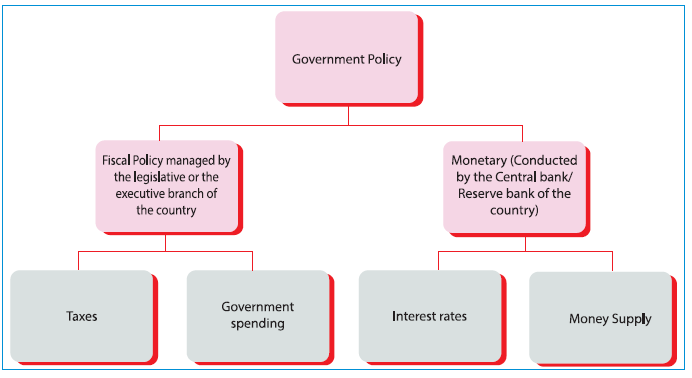
Source: NEXT IAS — Monetary Policy in India: Meaning, Types & Tools · www.nextias.com
Trap: Government securities appear in both - RBI buys/sells them (monetary) vs Government issues them (fiscal)
Trap: Interest rates affect government borrowing costs but rate-setting is purely monetary
Trap: Public debt management involves RBI technically but policy decisions are fiscal
Classic confusion: Deficit financing through RBI = fiscal decision with monetary effects