Consider the following statements: 1. The Self-Help Group (SHG) programme was originally initiated by the State Bank of India by providing microcredit to the financially deprived. 2. In an SHG, all members of a group take responsibility for a loan that an individual member takes. 3. The Regional Rural Banks and Scheduled Commercial banks support SHGs. How many of the above statements are correct?
Contents16
- AOnly one
- BOnly two
- CAll three
- DNone
Show answer
Answer: (B) Only two
Statement 1 is wrong:
SHGs were NOT started by SBI.
The concept originated from Bangladesh's Grameen Bank (Muhammad Yunus).
In India, NABARD initiated the SHG movement in 1986-87.
Statement 2 is correct:
SHGs can form smaller Joint Liability Groups (JLGs) for members who need larger loans.
Statement 3 is correct:
Regional Rural Banks (RRBs) play a key role in financing SHGs and SHG-Bank linkage programs.
Only two are correct.
Answer is (b).
SHGs are the backbone of India's financial inclusion strategy, with over 13 crore women organized into nearly 1.4 crore groups receiving institutional credit.
The SHG-Bank Linkage Programme launched by NABARD in 1992 became the world's largest microfinance model, making it a favorite UPSC topic.
UPSC tests whether students can distinguish between the Grameen Bank origin story versus India's institutional adaptation through NABARD and banking networks.
Self-Help Groups (SHGs)
Indian Economy Self-Help Group SHG
Self-Help Groups (SHGs): Structure, History & UPSC Facts
NABARD initiated SHG movement in India in 1986-87, not SBI
SHGs use Joint Liability Groups (JLGs) for individual member loans
RRBs and SCBs both support SHG financing programs
Concept originated from Bangladesh's Grameen Bank (Muhammad Yunus)
SHGs are small groups of 10-20 members who pool savings and provide microcredit to each other. The concept revolutionized financial inclusion by reaching the unbanked rural population through community-based lending.
SHG vs Traditional Banking
Aspect | SHGs | Traditional Banks |
|---|---|---|
Collateral | No collateral required | Collateral/guarantees needed |
Group Structure | 10-20 members, mutual guarantee | Individual borrowers |
Interest Rates | Lower rates due to group security | Higher commercial rates |
Target Audience | Rural poor, women | Urban, salaried class |
Loan Processing | Community-based decision | Bank branch approval |
Key Features
Joint Liability Model: All members guarantee each other's loans, reducing default risk
Women-centric: Majority of SHG members are women, promoting gender financial inclusion
Savings First: Groups must demonstrate regular savings before accessing credit
Capacity Building: Members receive training in financial literacy and business skills
Democratic Structure: Groups elect leaders and make collective decisions
SHG Ecosystem
# SHG Network
## Promoting Institutions
- NABARD
- NGOs
- Government Agencies
- Banks
## Financial Partners
- Regional Rural Banks
- Scheduled Commercial Banks
- Cooperative Banks
## Support Systems
- Training Programs
- Capacity Building
- Monitoring
- Credit RatingTrap: Statement 1 says SBI initiated SHGs - wrong, it was NABARD in 1986-87
Confusion: SHGs vs Grameen Bank model - Grameen was the original inspiration from Bangladesh
Joint Liability: Don't confuse with individual liability - all members are responsible for each loan
RRBs role: Regional Rural Banks are major supporters of SHGs, not just SCBs
NABARD & Financial Inclusion
Indian Economy NABARD
NABARD: Role in SHGs & Financial Inclusion Programs
NABARD = National Bank for Agriculture and Rural Development, established 1982
Initiated SHG-Bank Linkage Program in 1986-87, world's largest microfinance program
Apex development bank for agriculture and rural development in India
NABARD serves as the apex institution for rural and agricultural credit in India. It pioneered the SHG movement by creating the SHG-Bank Linkage Program, which became the world's largest microfinance initiative.
NABARD's Key Functions
Function | Description | Impact on SHGs |
|---|---|---|
Policy Formulation | Designs rural credit policies | Created SHG guidelines and norms |
Refinancing | Provides funds to banks for rural lending | Ensures liquidity for SHG loans |
Development | Promotes rural financial institutions | Supports SHG capacity building |
Supervision | Monitors rural banking performance | Evaluates SHG program effectiveness |
SHG-Bank Linkage Model
%%{init: {"flowchart": {"wrappingWidth": 460}}}%%
flowchart TD
  s1["`****NABARD** provides policy framework**
Sets guidelines for SHG formation and bank linkages`"]
  s2["`****Banks** (RRBs/SCBs) identify potential areas**
Target rural areas with poor banking penetration`"]
  s3["`****NGOs/Facilitators** form SHGs**
Create groups of 10-20 members, usually women`"]
  s4["`****SHGs** demonstrate savings discipline**
6-12 months of regular savings and internal lending`"]
  s5["`****Banks** provide credit linkage**
Loans to SHGs based on savings performance`"]
  s6["`****NABARD** refinances banks**
Provides low-cost funds to banks for SHG lending`"]
  s1 --> s2
  s2 --> s3
  s3 --> s4
  s4 --> s5
  s5 --> s6
NABARD's Other Programs
Joint Liability Groups (JLGs): For individual farmers needing larger loans than SHGs provide
Farmer Producer Organizations (FPOs): Collective farming and marketing institutions
Rural Infrastructure Development Fund (RIDF): Infrastructure financing for states
Watershed Development: Sustainable agriculture and water conservation programs
Regional Rural Banks (RRBs)
Indian Economy Regional Rural Banks RRBs
Regional Rural Banks: Structure & Role in SHG Financing
RRBs established in 1975 under RRB Act to serve rural areas
Ownership: 50% Central Govt + 35% Sponsor Bank + 15% State Govt
Major role in SHG-Bank Linkage Program financing
43 RRBs currently operating across India (post-consolidation)
RRBs were created to combine the local reach of cooperative banks with the business culture of commercial banks. They became crucial partners in NABARD's SHG program by providing last-mile credit delivery.
RRBs vs Other Rural Banks
Bank Type | Ownership | Area of Operation | SHG Role |
|---|---|---|---|
Regional Rural Banks | Govt + Sponsor Bank + State | District/Regional | Primary SHG lenders |
Scheduled Commercial Banks | Private/Public ownership | Pan-India | SHG support in urban/semi-urban |
Cooperative Banks | Member-owned cooperatives | Local/District | Limited SHG participation |
NABARD | 100% Government owned | National | Policy maker, not direct lender |
RRB Structure
# Regional Rural Banks
## Ownership Pattern
- 50% Central Govt
- 35% Sponsor Bank
- 15% State Govt
## Key Functions
- Rural Credit
- SHG Financing
- Priority Sector Lending
- Financial Inclusion
## Sponsor Banks
- SBI and Associates
- Nationalized Banks
- Private Banks
RRB Performance in SHGs
Largest share in SHG-Bank Linkage Program by number of SHGs financed
Better recovery rates than urban commercial banks due to community pressure
Local knowledge helps in identifying genuine SHGs and assessing creditworthiness
Lower operational costs compared to extending commercial bank branches to remote areas
Don't confuse: RRBs are different from cooperative banks - RRBs have government ownership
Ownership trap: Remember 50-35-15 formula for RRB ownership structure
Role clarity: RRBs are implementers of SHG program, NABARD is the policy maker
Coverage: Both RRBs AND SCBs support SHGs - not just one type of bank
Grameen Bank Model
Indian Economy
Grameen Bank: Original Microfinance Model & Global Impact
Muhammad Yunus founded Grameen Bank in Bangladesh in 1983
Nobel Peace Prize 2006 for pioneering microcredit movement
Inspiration for India's SHG model developed by NABARD
99% loan recovery rate through group guarantee system
The Grameen Bank proved that the poor are creditworthy when given access to financial services without traditional collateral. This revolutionary concept inspired microfinance programs worldwide, including India's SHG movement.
Grameen Model vs Indian SHG Model
Aspect | Grameen Bank (Bangladesh) | Indian SHG Model |
|---|---|---|
Initiator | Muhammad Yunus (1983) | NABARD (1986-87) |
Group Size | 5 members | 10-20 members |
Savings Requirement | Minimal initial savings | 6-12 months savings first |
Bank Structure | Dedicated microfinance bank | Linkage with existing banks |
Geographic Focus | Rural Bangladesh | Rural India (all states) |
Core Principles
No Collateral: Credit based on group guarantee and peer pressure
Women Focus: 97% of borrowers are women, recognizing their reliability
Small Loans: Start with tiny amounts, increase based on repayment history
Regular Repayment: Weekly installments create discipline and cash flow
Social Development: Loans often lead to education, healthcare, and empowerment
Global Spread
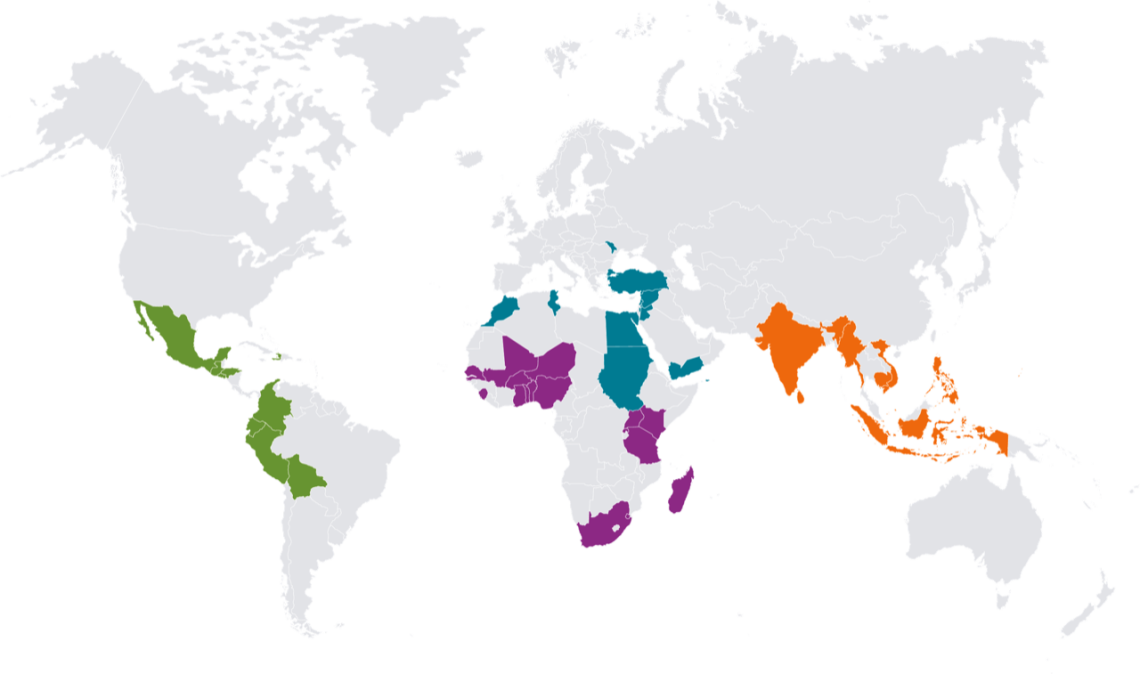
Source: Grameen Foundation — Where We Work • Grameen Foundation · grameenfoundation.org
Common mistake: Thinking SBI started SHGs - it was inspired by Grameen Bank and implemented by NABARD
Geography trap: Grameen Bank is from Bangladesh, not India
Timeline confusion: Grameen Bank (1983) came before Indian SHGs (1986-87)
Nobel Prize: Muhammad Yunus won Peace Prize (2006), not Economics Prize