Invasive Species Specialist Group (that develops Global Invasive Species Database) belongs to which one of the following organizations?
Contents14
- AThe International Union for Conservation of Nature
- BThe United Nations Environment Programme
- CThe United Nations World Commission for Environment and Development.
- DThe World Wide Fund for Nature
Show answer
Answer: (A) The International Union for Conservation of Nature
The Invasive Species Specialist Group (ISSG), which manages the Global Invasive Species Database, works under the Species Survival Commission (SSC) of IUCN.
Answer is (a) IUCN.
IUCN's Species Survival Commission manages multiple specialist groups that create global databases on conservation threats, including the Invasive Species Specialist Group that maintains the Global Invasive Species Database.
UPSC is testing whether students can distinguish between IUCN's technical specialist groups versus UNEP's broader policy coordination role in environmental governance.
IUCN Structure & Specialist Groups
Environment International Union for Conservation of Nature Invasive Species Specialist Group
IUCN Structure & Specialist Groups: SSC Network
IUCN (International Union for Conservation of Nature) houses the Species Survival Commission (SSC)
Invasive Species Specialist Group (ISSG) operates under SSC and manages the Global Invasive Species Database
SSC has 130+ specialist groups covering different species and conservation themes
IUCN's Role
IUCN is the world's oldest global environmental organization, founded in 1948. It operates through six commissions, with the Species Survival Commission (SSC) being the largest volunteer network focused on species conservation.
Key IUCN Commissions
Commission | Focus Area | Key Output |
|---|---|---|
Species Survival Commission (SSC) | Species conservation | Red List, specialist groups |
World Commission on Protected Areas | Protected areas | Protected area guidelines |
Commission on Environmental Law | Environmental law | Legal frameworks |
Commission on Education | Environmental education | Education strategies |
SSC Specialist Groups Structure
# Species Survival Commission
## Taxonomic Groups
- Primate Specialist Group
- Bear Specialist Group
- Cat Specialist Group
## Thematic Groups
- **Invasive Species Specialist Group**
- Reintroduction Specialist Group
- Conservation Breeding Group
## Regional Groups
- Asian Elephant Specialist Group
- African Elephant Specialist Group
Question Connection
The Global Invasive Species Database is maintained by ISSG under IUCN's SSC
This question tests knowledge of IUCN's internal structure, not just its existence
UNEP seems plausible as it handles global environmental issues, but ISSG specifically belongs to IUCN
WWF is a major conservation organization but does not house the ISSG
The Brundtland Commission (option C) was a one-time commission, not an ongoing organization
Global Invasive Species Database
Environment Global Invasive Species Database invasive species
Global Invasive Species Database: IUCN's Information Tool
GISD provides information on alien and invasive species that threaten biodiversity
Maintained by IUCN's Invasive Species Specialist Group (ISSG)
Contains profiles of world's 100 worst invasive alien species
Database Purpose
The Global Invasive Species Database (GISD) serves as a comprehensive information resource on invasive alien species that pose threats to native biodiversity and ecosystems worldwide.
Key Features of GISD
Feature | Description | Use |
|---|---|---|
Species Profiles | Detailed information on invasive species | Identification and management |
100 Worst List | World's most problematic invasive species | Priority setting |
Distribution Maps | Geographic spread of invasive species | Risk assessment |
Management Info | Control and prevention methods | Conservation planning |
Invasive Species Impact
Second leading cause of biodiversity loss globally (after habitat destruction)
Economic costs run into billions of dollars annually worldwide
Island ecosystems are particularly vulnerable to biological invasions
Database Interface
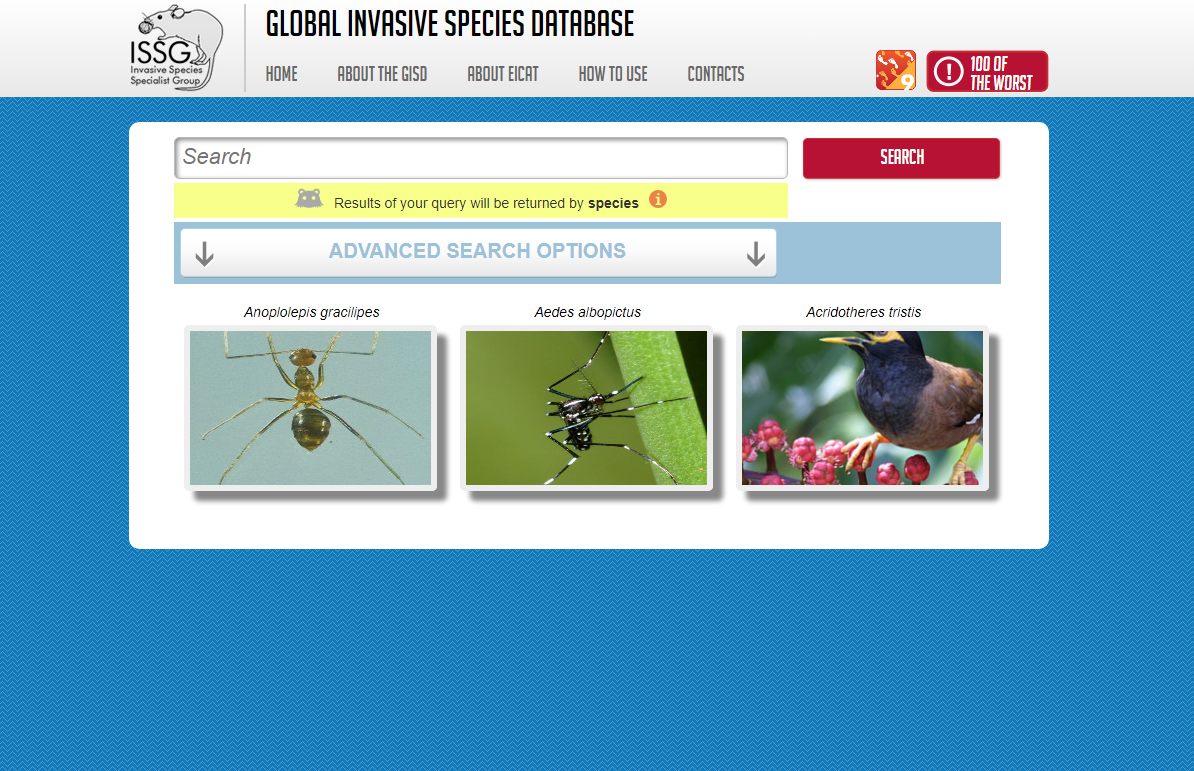
Source: Caribbean Protected Areas Gateway — Global Invasive Species Database (GISD) | CPAG RIH · caribbeanprotectedareasgateway.org
Major Conservation Organizations
Environment United Nations Environment Programme World Wide Fund for Nature
Major Conservation Organizations: IUCN, UNEP, WWF Comparison
IUCN focuses on species conservation and protected areas through scientific expertise
UNEP coordinates UN environmental activities and provides policy guidance
WWF emphasizes conservation action and fundraising for specific projects
Key Conservation Organizations
Organization | Founded | Main Role | Key Activities |
|---|---|---|---|
IUCN | 1948 | Scientific conservation union | Red List, protected areas, specialist groups |
UNEP | 1972 | UN environmental coordination | Policy frameworks, assessments |
WWF | 1961 | Conservation fundraising & action | Field projects, advocacy campaigns |
CITES | 1975 | Trade regulation | Endangered species trade control |
Organizational Distinctions
IUCN operates as a membership union of governments and NGOs with scientific focus
UNEP functions as UN's environmental conscience, coordinating global environmental action
WWF works as an independent NGO focusing on conservation fundraising and field implementation
India Connections
India is a State member of IUCN since 1969. UNEP has established partnerships with India on climate change and biodiversity. WWF-India operates as an independent organization focusing on tigers, elephants, and marine conservation.
Don't confuse UNEP (ongoing UN body) with the Brundtland Commission (one-time commission from 1980s)
WWF and IUCN both focus on conservation but have different approaches - WWF is action-oriented, IUCN is science-oriented
CITES regulates trade, IUCN provides scientific assessment - different but complementary roles