Which one of the following makes a tool with a stick to scrap insects from a hole in a tree or a log of wood?
Contents14
- AFishing cat
- BOrangutan
- COtter
- DSloth bear
Show answer
Answer: (B) Orangutan
Chimpanzees are known for making and using tools — including using sticks to scrap insects from holes in trees or logs.
They are among the most well-documented tool-users in the animal kingdom.
Answer is (b) Chimpanzee.
Tool use by primates is a key indicator of intelligence and cognitive evolution, with orangutans being among the few species that modify sticks to extract insects from tree holes.
UPSC tests animal behavior knowledge to assess understanding of evolutionary biology and species adaptation mechanisms.
Tool Use in Primates
Environment tool stick insects
Tool Use in Primates: Intelligence & Behavioral Adaptations
Orangutans use sticks to extract insects from tree holes and honey from beehives
Chimpanzees are the most documented tool users, using sticks for termite fishing
Tool use indicates advanced cognitive abilities and problem-solving skills
Found primarily in great apes - orangutans, chimpanzees, bonobos, gorillas
Why This Matters
Tool use represents one of the highest forms of animal intelligence, distinguishing great apes from most other species. Orangutans and chimpanzees both demonstrate this behavior, but orangutans are particularly noted for using sticks to scrape insects from tree holes.
Tool Use Comparison
Species | Primary Tools | Target Food | Habitat | Conservation Status |
|---|---|---|---|---|
Orangutan | Sticks, leaves | Insects, honey, seeds | Rainforest canopy | Critically Endangered |
Chimpanzee | Sticks, stones | Termites, ants, nuts | Forest & savanna | Endangered |
Bonobo | Sticks, leaves | Termites, fruit | Dense forests | Endangered |
Gorilla | Sticks (rare) | Vegetation mainly | Mountain & lowland forests | Critically Endangered |
Orangutan Tool Behavior
Use modified sticks to extract insects, honey, and seeds from crevices
Shape tools by removing leaves and adjusting length for specific tasks
Pass tool-use techniques to offspring through social learning
Show regional variations in tool types across different populations
Demonstrate forward planning by carrying tools to feeding sites
Question Context
This question tests knowledge of primate intelligence and species-specific behaviors. The answer is Orangutan because they are well-documented for using sticks to scrape insects from tree holes, particularly in their natural habitat of Southeast Asian rainforests.
Chimpanzees also use tools but are more famous for termite fishing, not insect scraping from holes
Fishing cats hunt fish but don't use tools - they wade and dive
Otters use stones to crack shells but don't make stick tools
Sloth bears use claws to dig insect nests but don't fashion tools
Orangutan Ecology & Conservation
Environment Orangutan
Orangutans: Habitat, Threats & Conservation Status
Only Asian great ape, found in Borneo and Sumatra
Critically Endangered due to palm oil plantations and deforestation
Arboreal lifestyle - spend 90% of time in trees
Solitary nature unlike other great apes
Ecological Significance
Orangutans are keystone species in Southeast Asian rainforests, serving as crucial seed dispersers for over 500 plant species. Their arboreal lifestyle and large home ranges make them particularly vulnerable to habitat fragmentation.
Orangutan Species
Species | Location | Population | Key Threats | Conservation Status |
|---|---|---|---|---|
Bornean Orangutan | Borneo (Malaysia, Indonesia, Brunei) | ~104,000 | Palm oil, logging | Critically Endangered |
Sumatran Orangutan | Northern Sumatra | ~14,000 | Agriculture expansion | Critically Endangered |
Tapanuli Orangutan | South Tapanuli, Sumatra | ~800 | Infrastructure projects | Critically Endangered |
Conservation Challenges
# Orangutan Threats
## Habitat Loss
- Palm oil plantations
- Logging
- Agriculture expansion
- Infrastructure development
## Human Activities
- Illegal pet trade
- Hunting
- Human-wildlife conflict
## Climate Factors
- Forest fires
- Climate change
- El Niño effects
Habitat Distribution
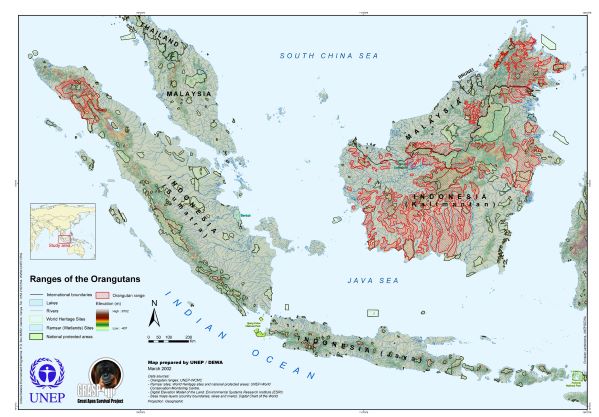
Source: Orang Utan Republik Foundation — Species Information - Orang Utan Republik Foundation · www.orangutanrepublik.org
Orangutans are found only in Asia (Borneo & Sumatra), not Africa like other great apes
They are solitary, unlike social chimpanzees and bonobos
Three species exist - Bornean, Sumatran, and newly discovered Tapanuli
Main threat is palm oil industry, not just general deforestation
Fishing Cat, Otter & Sloth Bear
Environment Fishing cat Otter Sloth bear
Comparative Behaviors: Fishing Cat, Otter & Sloth Bear
Fishing cats are semi-aquatic wildcats that hunt fish without tools
Otters use stones to crack shells but don't make stick tools
Sloth bears use powerful claws to dig termite mounds, not tools
Species Comparison
Species | Primary Food | Hunting Method | Tool Use | Habitat | Conservation Status |
|---|---|---|---|---|---|
Fishing Cat | Fish, crabs, frogs | Wade & dive | No tools | Wetlands, mangroves | Vulnerable |
Otter | Fish, crustaceans | Swimming & diving | Stones for cracking | Rivers, coasts | Varies by species |
Sloth Bear | Termites, ants, honey | Claws for digging | No tools | Forests, grasslands | Vulnerable |
Distinctive Behaviors
Fishing cats have webbed paws and can swim underwater to catch fish
Sea otters use stones as anvils to crack open shellfish while floating
Sloth bears create suction with their lips to extract insects from mounds
River otters are highly social and hunt cooperatively in family groups
India Connection
All three species are found in India. Fishing cats inhabit the Sundarbans and Eastern wetlands, sloth bears are widespread across Indian forests, and smooth-coated otters populate major river systems like the Ganges and Brahmaputra.
Fishing cats don't fish with tools - they use webbed paws and sharp claws
Otters use existing stones, they don't make or modify tools like primates
Sloth bears have the longest claws among bears but don't fashion stick tools